
Key Points
- Practical, supervised teaching practice is essential for developing confidence and competence in TEFL. Employers highly value real classroom experience over theory-only certificates, making structured practicum components crucial for employability. To maximize your training, focus on active teaching, honest feedback, and thorough reflection throughout your practical coursework.
Many aspiring English teachers sign up for a TEFL course expecting to feel classroom-ready by the end, only to find themselves clutching a certificate but uncertain how to actually manage a group of learners. Theory-heavy courses teach you what communicative language teaching is, but they rarely put you in front of real students with a lesson plan and a trainer watching from the back row. That gap between knowing the methodology and executing it confidently is exactly what structured, supervised practical training closes. This guide walks you through every stage of hands-on TEFL training, from choosing the right programme to verifying real learner progress, so you can launch your teaching career with genuine confidence.
Table of Contents
- Why practical training is essential for TEFL success
- Choosing a TEFL course with real teaching practice: What to look for
- Preparing for your TEFL practicum: Essential skills and materials
- What to expect: Step-by-step through your TEFL practicum
- Verifying results and common pitfalls in TEFL practical training
- Why real classroom practice outweighs theory – and how to maximise it
- Step up your TEFL journey: Next steps for hands-on certification
- Frequently asked questions
Key Takeaways
| Point | Details |
|---|---|
| Practical training is key | Hands-on, observed teaching practice is valued by employers and proves classroom readiness. |
| Course quality varies widely | Check for structured practicum and accreditations to ensure your training meets global standards. |
| Prepare with strong lesson planning | Use established lesson frameworks and focus on clear, measurable aims for real student impact. |
| Feedback accelerates growth | Actively seek and apply trainer and peer feedback to continuously improve your TEFL skills. |
Why practical training is essential for TEFL success
Now that we’ve set the scene, let’s understand what makes practical training indispensable for TEFL candidates.
Employers worldwide are increasingly clear about what they want: teachers who have been observed, assessed, and found competent in a real classroom. A certificate that lists only theory modules rarely satisfies hiring managers in Spain, France, Italy, or further afield. The reason is straightforward. Teaching is a performance skill, and like any performance skill, it requires repeated, guided practice under expert supervision.
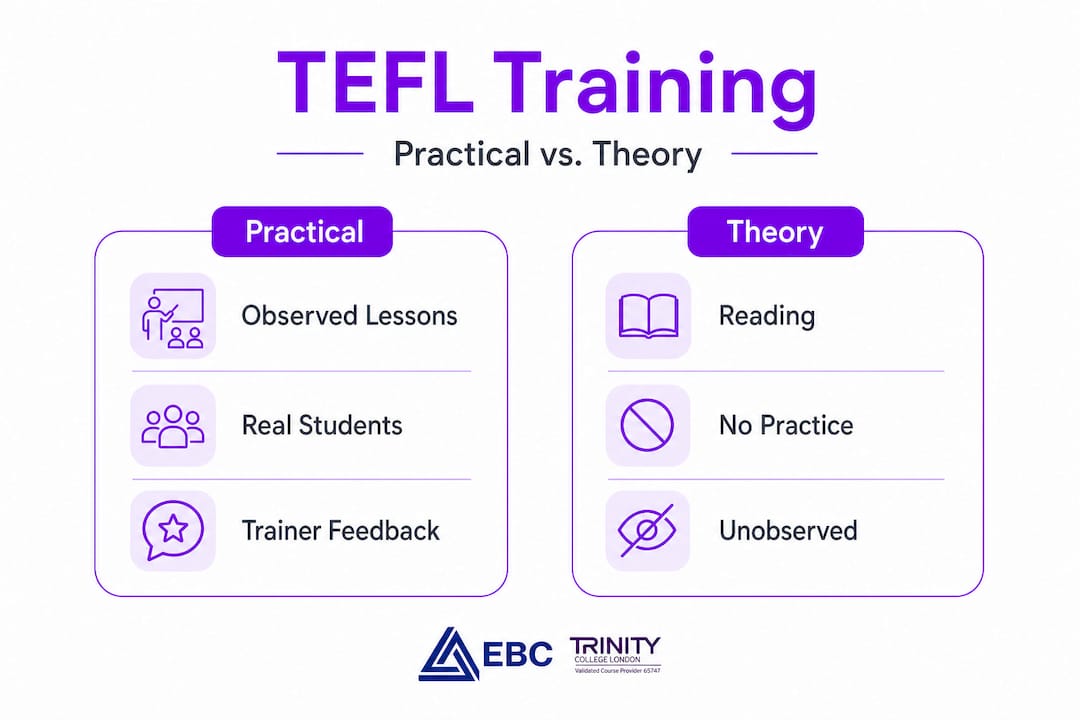
The most widely respected training models reflect this reality. The Cambridge CELTA course is structured around four interlocking elements: input sessions that introduce methodology, supervised teaching practice with real learners, classroom observation, and written assignments supported by tutorials. Trinity CertTESOL follows a similarly rigorous model. Both frameworks exist because the research and practitioner experience behind them show that trainees who teach, receive feedback, and teach again develop far faster than those who only read about pedagogy.
The TEFL teaching practicum benefits extend well beyond your training period. Trainees who complete supervised teaching hours report significantly higher confidence when entering their first paid role. They also demonstrate stronger classroom management instincts, better lesson pacing, and more effective communication with learners at different proficiency levels.
Here is what a strong practical training model typically includes:
- Supervised teaching practice with genuine language learners, not fellow trainees role-playing
- Structured observer feedback delivered by a qualified, experienced trainer
- Lesson planning support before each teaching slot
- Peer observation so you learn from watching others and being watched in turn
- Written reflection to consolidate what you have experienced
- Tutorial sessions linking your practical performance to theoretical frameworks
The value of lesson observation in TEFL is particularly underestimated. Being observed is uncomfortable for most new teachers, but it is that structured scrutiny that accelerates growth. Without it, bad habits embed themselves silently.
“Practical training that includes supervised teaching practice, observation, and regular feedback is the single most reliable predictor of a teacher’s classroom readiness.”
| Training element | Theory-only course | Accredited practicum course |
|---|---|---|
| Supervised teaching | Rarely included | Always included |
| Observer feedback | Not provided | Structured and documented |
| Real learner contact | Simulated at best | Guaranteed contact hours |
| Employer recognition | Variable | High, especially globally |
| Confidence on graduation | Often low | Consistently higher |
Choosing a TEFL course with real teaching practice: What to look for
Armed with an understanding of what matters, the next step is identifying a programme that offers authentic, quality-controlled hands-on experience.
Not every TEFL certificate is created equal. The market contains hundreds of online-only courses, some of which are little more than video modules and a multiple-choice assessment. These may be useful for background knowledge, but they will not satisfy most reputable employers, particularly in competitive markets like Spain, France, and Italy. When evaluating any programme, apply these criteria in order:
- Confirmed observed teaching practice. Ask specifically how many hours of supervised teaching are included, and verify that observers are qualified trainers, not just fellow participants.
- Structured, written feedback. Feedback should be documented and tied to clear assessment criteria, not just verbal comments after class.
- Lesson planning support. Quality programmes assign a tutor to review plans before each teaching session so you enter the room prepared.
- Recognised accreditation. Look for Trinity College London or Cambridge accreditation. These bodies set and audit standards. Other providers may use language like “internationally recognised” without independent verification.
- Relevance to your target country. If you plan to work in Spain, France, or Italy, check whether the course provider has established relationships with schools and placement networks in those countries.
When comparing CELTA and CertTESOL, both represent gold-standard options. The key difference lies in assessment weighting and portfolio requirements, but both guarantee the supervised practical teaching hours that employers expect.
As the Cambridge CELTA course documentation makes clear, if your course is a general TEFL qualification rather than CELTA or an equivalent accredited award, you should verify that the practicum includes observed feedback and structured assessment elements, specifically input sessions, observation, teaching practice, and written assignments. Without those components, your practical preparation may be incomplete regardless of what the certificate says.
Pro Tip: Before enrolling, request the course timetable and ask your provider to show you a sample observer feedback form. A programme that cannot produce one is unlikely to have a robust assessment process.
Use the guide to teaching practice to cross-reference what any provider promises against what a rigorous practicum actually looks like. It is a straightforward and effective way to separate quality programmes from lower-value alternatives.
| Accrediting body | Practical hours (minimum) | Observed lessons | Assessment type |
|---|---|---|---|
| Trinity CertTESOL | Six supervised lessons | Yes, by qualified trainer | Portfolio and observation reports |
| Cambridge CELTA | Six supervised lessons | Yes, by qualified trainer | Written assignments and tutorials |
| Generic TEFL | Varies, often none | Not guaranteed | Usually online quiz only |
Preparing for your TEFL practicum: Essential skills and materials
Once you’ve selected a strong TEFL programme, it’s time to get ready for the hands-on component.

Preparation is where many trainees underinvest. They assume the training itself will teach them everything. It will, but only if you arrive with certain foundational skills already in place. The practicum is not the moment to discover you cannot manage noise levels or write a coherent lesson aim.
The essential TEFL teaching skills that will serve you most in practical training are:
- Classroom management: Clear instructions, consistent routines, and confident positioning in the room all matter from your very first lesson.
- Lesson planning: Understanding how to sequence activities so they build logically towards a learning outcome is the backbone of every successful observed lesson.
- Adaptability: Real learners do not behave like the examples in methodology textbooks. Knowing how to adjust mid-lesson is a skill you build gradually but must begin developing early.
- Time management: Over-running or finishing ten minutes early are both common practicum problems. Timing each activity during planning is essential.
- Reflective practice: After every lesson, whether it went well or not, write down what happened, what you intended, and what the difference tells you.
Lesson frameworks give your planning a reliable structure. The most commonly used in initial teacher training are PPP (Presentation, Practice, Production), ESA (Engage, Study, Activate), and TBL (Task-Based Learning). Each suits different lesson types and learner levels. As effective TEFL lesson aims guidance makes clear, the framework you choose should serve an aim that can be evidenced in what learners can actually do by the end of the lesson, not simply a list of topics you plan to cover.
Pro Tip: Write your lesson aim before you plan any activities. If you cannot state clearly what learners will be able to do differently at the end, your plan lacks a foundation. Revisit the aim once you have drafted your activities to check that every task leads towards it.
Organise a TEFL lesson planning folder from day one of your training. Keep every plan, every observer feedback sheet, and every reflection note together. This is your growth record, and it becomes a powerful portfolio piece when you apply for teaching positions in Europe and beyond.
What to expect: Step-by-step through your TEFL practicum
Being prepared is only part of the equation. Knowing exactly what your practicum will involve helps banish uncertainty.
Most accredited TEFL practicums follow a broadly consistent structure, even if timing and sequencing vary between providers. Here is a realistic step-by-step picture:
- Induction. You meet your trainers, fellow trainees, and learn how assessment works. Expectations are set clearly.
- Input sessions. Your trainers deliver methodology sessions covering areas such as skills teaching, grammar awareness, and learner-centred approaches. These feed directly into your lesson planning.
- Observation of experienced teachers. Before you teach, you watch. You observe how a skilled teacher manages pace, interaction, and unexpected moments. This is invaluable preparation.
- First teaching practice. You deliver a short, supervised lesson. Nerves are completely normal here. Your trainer observes, takes notes, and assesses against clear criteria.
- Feedback session. Structured feedback follows every observed lesson. You discuss what worked, what to develop, and how to apply the input sessions to your next lesson.
- Subsequent teaching slots. You teach again, applying feedback. Each iteration develops your skills noticeably. This is the cycle that builds real competence.
- Written assignments and tutorials. These connect your classroom experience to wider language teaching theory and contribute to your final qualification.
- Final assessment. Observed lesson performance and written work are assessed holistically. Grades typically range from pass to distinction.
As established in the Cambridge CELTA model, this structure of input, teaching practice, observation, and written assignments is precisely what produces job-ready teachers. The benefits of teaching practicum are cumulative: each lesson you teach builds on the last.
One often-overlooked element is peer teaching during practicum. Watching your fellow trainees teach and discussing their lessons builds your analytical eye for effective teaching. You start to notice patterns across different styles, and that awareness sharpens your own planning and delivery.
Statistic to note: Teachers who complete a practicum with a minimum of six observed and assessed lessons are statistically more likely to remain in EFL teaching beyond their first year, compared with those who hold theory-only certificates.
Verifying results and common pitfalls in TEFL practical training
The final step is getting the most from your hard-won experience, ensuring you’re not just qualified, but effective and employable.
Completing your practicum hours is not the same as maximising what you learn from them. Many trainees make the same avoidable mistakes, and recognising these in advance gives you a clear advantage.
Common pitfalls in TEFL practical training:
- Teaching for coverage rather than learning. Rushing through material to finish activities does not mean learners have acquired anything. Focus on what students can demonstrably do, not what you have delivered.
- Neglecting self-reflection. Trainees who skip the reflective writing component of their training typically stagnate after the first few lessons. Reflection is what converts experience into growth.
- Vague lesson aims. Writing “learners will practise vocabulary” is not a lesson aim. It is a topic description. Proper aims specify observable learner outcomes, and lesson-framework staging should always serve those outcomes clearly.
- Treating feedback defensively. Trainer feedback is data, not criticism. Trainees who ask questions during feedback sessions and actively apply suggestions in subsequent lessons develop fastest.
- Skipping peer observation. Watching a peer teach without personal pressure is one of the easiest and most productive ways to sharpen your analytical skills.
To track genuine learner progress, use the how teaching practice works framework to assess whether your learners are producing more accurate, fluent, or confident language by the end of each lesson compared with the beginning. That shift is your real evidence of impact. Document it. You will use it in job interviews.
Engaging with peer observation in TEFL as both observer and observed also sends a strong signal to employers. It demonstrates that you are a collaborative professional, not just someone who completes required hours.
Why real classroom practice outweighs theory – and how to maximise it
Here is an uncomfortable truth that experienced TEFL trainers rarely state plainly: a trainee who reads every methodology textbook available and never stands in front of a class is less prepared than a trainee who has taught six imperfect lessons and reflected honestly on each one. Theory gives you a map. The classroom is the terrain. The terrain wins every time.
We see this pattern regularly. Candidates arrive in training having studied communicative language teaching extensively, able to define affective filter and discuss Krashen’s input hypothesis with confidence. Then they stand in front of fifteen learners and forget to give clear instructions. The knowledge was real. The transfer to practice was missing.
The trainees who develop fastest are not the ones who studied hardest before training. They are the ones who teach as much as possible during training, ask for honest feedback rather than reassurance, and treat every observed lesson as a learning event rather than a performance to survive. They also make conscious use of lesson observation time, arriving with specific questions rather than watching passively.
If your programme allows you to request additional observed hours or informal peer feedback sessions, take that opportunity without hesitation. The long-term returns on classroom time are far greater than additional reading. Confidence and classroom authority are built through doing, and the reflective habits you form during your practicum will carry you through an entire teaching career. Adaptability, self-awareness, and the ability to read a room are not qualities you acquire from a textbook.
Step up your TEFL journey: Next steps for hands-on certification
Ready to put your new knowledge to work? Here’s where to find trusted, practical training that opens global doors.
Practical training transforms a certificate into a genuine teaching credential. If you are serious about working in Spain, France, Italy, or anywhere else in the world, the quality of your practicum is the single most important factor in your employability. EBC TEFL offers Trinity College London accredited programmes designed around exactly the supervised, observed, feedback-rich training model this guide describes.
Our global network supports teachers from initial international TEFL certification through to placement in schools worldwide, with free lifetime job assistance. We also offer one-year study and work abroad programmes in Spain, France, and Italy, combining accredited teacher training, language study, visa support, and part-time teaching opportunities. If you are at the beginning of this journey, our TEFL introduction is the ideal starting point. Book a free consultation today and take your first concrete step towards a rewarding international teaching career.
Frequently asked questions
What is the difference between TEFL, CELTA, and Trinity CertTESOL practical training?
CELTA and Trinity CertTESOL guarantee supervised practical teaching with observed feedback, while not all TEFL certificates include this structure, so always verify that any course you consider contains a structured practicum with input sessions, observation, teaching practice, and written assignments.
Do I need hands-on training if I want to teach English online?
Yes, practical training remains essential for online teaching because it develops the live lesson management, quick adaptation, and confident delivery under observation that all effective teaching requires, regardless of format.
What counts as ‘observed teaching practice’ in accredited courses?
It means planning and delivering lessons to real language learners while a qualified trainer observes and provides structured, documented feedback tied to specific assessment criteria.
How can I make my practical TEFL training stand out to employers in Spain, France, or Italy?
Choose a Trinity College London or Cambridge accredited course with confirmed observed teaching hours, and document your observer feedback and learner progress in a reflective portfolio that you can present at interview.
What are common mistakes to avoid during TEFL practicum?
The most damaging mistakes are writing vague lesson aims that focus on coverage rather than learner outcomes, skipping self-reflection after each lesson, and treating feedback sessions as a formality rather than a development opportunity.