
Key Points
- The TEFL practicum provides real classroom teaching experience essential for employment readiness.
- Practicum enhances skills in classroom management, lesson planning, communication, and self-reflection.
- Both in-person and online formats of practicum are valid, with online offering greater flexibility.
Passing your TEFL theory exam feels like a milestone. But ask any experienced hiring manager at a language school in Madrid, Paris, or Rome, and they will tell you something that surprises many candidates: a certificate without teaching practice is rarely enough. The TEFL practicum, which refers to the supervised, hands-on teaching component of your certification programme, is increasingly the factor that separates confident classroom-ready teachers from those who struggle in their first role. If you are serious about teaching English abroad, understanding the practicum is not optional.
Table of Contents
- What is a TEFL practicum?
- How the practicum enhances your teaching skills
- Different practicum formats: In-person versus online
- Why practicum matters for global job placement
- The uncomfortable truth about TEFL practicum: What most guides miss
- Unlock your TEFL career with practical training and global job support
- Frequently asked questions
Key Takeaways
| Point | Details |
|---|---|
| Practicum is hands-on training | A TEFL practicum gives you real classroom experience that employers look for. |
| Formats suit diverse needs | Both in-person and online practicum options are available for flexibility. |
| Boosts global employability | Completing and documenting practicum experience increases your chances of international teaching job placement. |
| Mentorship is essential | Accredited programmes provide supervision and feedback during practicum training. |
What is a TEFL practicum?
The term “practicum” comes from the Latin practicus, meaning practical. In the context of TEFL certification, a practicum is a structured period of supervised teaching practice that forms a core part of your training. It is not a simulation or a role-play exercise. You are teaching real language learners, in a real classroom or live online environment, under the guidance of a qualified trainer who observes and evaluates your performance.
“Practical teaching experience is not a supplementary add-on to TEFL certification. It is the foundation upon which genuinely effective English teachers are built.”
A well-structured practicum typically moves through three distinct phases:
- Observation: You watch experienced teachers at work, noting how they manage classroom dynamics, handle unexpected questions, and adapt their delivery in real time.
- Lesson planning and preparation: You design your own lessons, selecting appropriate materials, setting clear objectives, and anticipating learner difficulties before you step in front of the group.
- Supervised teaching delivery: You deliver lessons independently while your trainer observes, takes notes, and provides structured written and verbal feedback afterwards.
Understanding the TEFL practicum benefits early in your training helps you approach each phase with purpose rather than anxiety. The practicum is also where you begin to develop your own teaching identity: the style, tone, and strategies that will become your professional signature in the classroom.
As highlighted in live TEFL training, practical experience within Trinity College London accredited programmes is recognised as central to producing teachers who are genuinely prepared for international employment. This accreditation standard gives employers worldwide a reliable signal that you have been tested in real conditions, not just assessed on paper.
The practicum also creates a space for teaching experience abroad to begin taking shape. For many trainees, the practicum is their very first encounter with learners from diverse linguistic and cultural backgrounds, which is precisely the kind of exposure that international schools value.
How the practicum enhances your teaching skills
Knowing what a practicum is gives you a framework. But understanding how it actively builds your professional skills reveals why it is so transformative. The practicum is not simply about clocking hours in front of learners. It is a structured process of skill development that touches every dimension of effective teaching.
Here are the four core areas where practicum experience makes the most tangible difference:
- Classroom management: Theory tells you that eye contact and clear instructions matter. The practicum shows you what happens when a group of adult learners is confused by your instruction, and teaches you how to recover quickly, calmly, and effectively.
- Lesson planning: When you plan a lesson and then deliver it, you see almost immediately which elements were too ambitious, too slow, or perfectly pitched. This feedback loop, which you simply cannot replicate by reading a textbook, sharpens your planning instincts rapidly.
- Communication with diverse learners: Teaching a mixed-level group of real students forces you to adapt your language, your pacing, and your examples on the spot. You develop the flexibility and sensitivity that every international teaching role demands.
- Self-reflection and professional growth: After each practicum lesson, your trainer provides structured feedback. Over time, this cycle of teaching, receiving feedback, and adjusting builds the kind of reflective practice that distinguishes strong teachers from average ones.
According to essential TEFL skills, classroom management and lesson design are consistently ranked among the most critical competencies that employers assess during interviews and trial lessons. The practicum is where those competencies are genuinely forged.

Pro Tip: Keep a teaching journal during your practicum. After each lesson, write three things that went well, one thing you would change, and the specific adjustment you will make next time. This habit builds self-awareness faster than almost any other method.
The practicum also develops professional confidence in ways that are difficult to quantify but immediately visible to employers. When you walk into an interview having already taught twenty or more learners and received expert feedback, your composure in a trial lesson is noticeably different.
Different practicum formats: In-person versus online
Not every aspiring teacher can relocate for a residential training course. Life is varied, and TEFL certification needs to be accessible. Fortunately, practicum formats have evolved considerably, and you now have genuine choices about how you fulfil this requirement.
| Feature | In-person practicum | Online practicum |
|---|---|---|
| Learning environment | Physical classroom | Virtual classroom via video platform |
| Learner interaction | Face-to-face, immediate | On screen face-to-face, immediate |
| Flexibility | Lower: fixed schedule and location | Higher: accessible from anywhere |
| Observation quality | Direct, immersive | Direct, immersive |
| Suitability | Those in training centres | Remote learners, working adults |
| Employer recognition | Universally accepted | Universally accepted |
As shown in options for online and face-to-face certification, both formats can satisfy practicum requirements when delivered by an accredited provider.
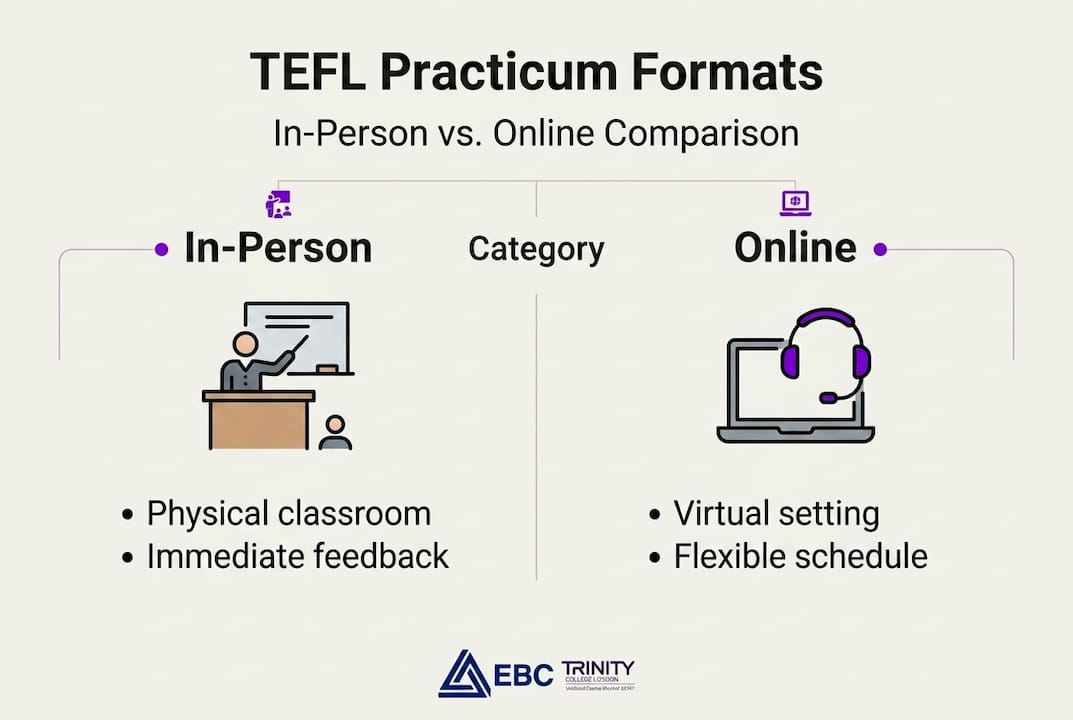
There are meaningful advantages to each approach. In-person practicums offer immediate, physical classroom dynamics. You read the room differently when you are physically present. Learner body language, energy levels, and group dynamics are far more visible. Many trainees find that the intensity of an in-person practicum accelerates their learning significantly.
Online practicums, however, open the qualification to people who cannot relocate, have family commitments, or are already working full-time. They are also excellent preparation for anyone intending to teach English online after certification. Delivering lessons through a virtual platform while being observed and assessed is direct professional experience for that career path.
Key considerations when choosing your format:
- Your current location and access to a training centre
- Whether you plan to teach in person, online, or both after certification
- Your schedule and availability for fixed training days
- The specific requirements of the certification programme you select
One practical insight worth noting: understanding what a TEFL internship involves alongside your practicum can also help you plan your professional development more strategically. Internships extend your practical exposure beyond the certification period and signal serious commitment to prospective employers.
Why practicum matters for global job placement
Let us be direct about something that many TEFL guides gloss over. Internationally, the employment market for English teachers is competitive. Schools and academies in Spain, South Korea, Japan, Italy, France, and dozens of other countries receive dozens of applications for every advertised role. What separates shortlisted candidates from those who are overlooked?
Practical teaching experience is consistently cited as one of the most decisive factors. Here is a summary of how practicum experience maps to hiring priorities:
| Employer requirement | How practicum addresses it |
|---|---|
| Classroom confidence | Demonstrated through supervised teaching hours |
| Lesson planning ability | Assessed and developed during practicum preparation |
| Learner management skills | Built through real classroom interaction |
| Adaptability | Tested when lessons do not go as planned |
| Professional certification | Validated when practicum is part of accredited programme |
The essential requirements for TEFL jobs typically include a recognised qualification with a teaching practice component. Schools are not simply ticking boxes. They need teachers who will be effective from day one. A candidate who has already taught real learners under expert supervision presents far less risk than someone whose training was purely theoretical.
The benefits of teaching English abroad extend well beyond professional development. Living and working internationally builds cultural intelligence, language awareness, and personal resilience. These are qualities that only grow stronger with genuine classroom experience behind you.
Important stat: Candidates holding Trinity College London accredited certifications with a practicum component report significantly stronger interview performance and faster job placement compared to those with theory-only qualifications. This is a consistent pattern observed across EBC’s global network of graduates in Europe, Asia, and Latin America.
Key reasons practicum drives global placement success:
- International schools specifically list “teaching practice hours” as a minimum requirement
- Trinity College London accreditation is recognised by employers across more than 100 countries
- Practicum provides evidence, not just claims, of your teaching ability
- Graduates with practicum experience tend to perform better in trial lessons during interviews
Looking at the Trinity CertTESOL advantages makes clear why accreditation with a practicum component is the gold standard for globally mobile teachers.
The uncomfortable truth about TEFL practicum: What most guides miss
Here is something most articles about TEFL certification will not tell you plainly. A significant number of people who complete theory-heavy courses arrive at their first job placement feeling underprepared. Not because they failed to study. Not because they lacked motivation. But because reading about teaching and actually doing it are genuinely different cognitive and emotional experiences.
The classroom is unpredictable in ways no coursebook can capture. A learner asks a question about grammar that falls completely outside your planned lesson. Two students in the group speak at very different levels. Your carefully timed activity finishes twelve minutes early. What do you do? These moments are not rare edge cases. They happen in almost every lesson, and the only way to develop the judgement to handle them well is to face them under guidance first.
The practicum exists precisely for this reason. It is the space where you are allowed to encounter difficulty, make mistakes, and receive expert support in processing what went wrong and what to do differently. That cycle of real experience and guided reflection is what actually builds a competent teacher. Theory gives you the map. The practicum puts you in the territory.
There is also a confidence dimension that guides rarely acknowledge. Teaching is a performance skill. Like public speaking, it requires repetition in front of a real audience to develop fluency and composure. You cannot build that through reading alone. Trainees who invest fully in their practicum, who push through the discomfort of early lessons and engage seriously with feedback, almost universally describe it as the most valuable part of their training.
We encourage every prospective teacher to see the practicum not as a hurdle to clear, but as the part of training that actually makes you ready. Teaching experience abroad deepens this readiness further once you are qualified and placed. The trajectory from practicum trainee to confident international teacher is shorter than most people expect, but only when that foundation of real practice has been properly laid.
Unlock your TEFL career with practical training and global job support
You have now seen why the practicum is so central to building a successful international teaching career. The next step is choosing a programme that takes practical training as seriously as you do.
At EBC TEFL, we offer internationally accredited certification pathways through Trinity College London, all of which include structured practicum components designed to build real classroom confidence. Our global network spans Europe, Asia, Latin America, and beyond, giving you access to genuine teaching opportunities worldwide. We also offer dedicated TEFL job placement support with free lifetime assistance, so the relationship does not end when you receive your certificate. Whether you are looking to teach in Spain, France, Italy, or further afield, we are with you every step of the way. Book your free consultation today and find out which programme suits your goals.
Frequently asked questions
How many hours of practicum are required for TEFL certification?
Most internationally accredited courses require between 6 and 20 hours of practicum, though the precise requirement varies by provider and qualification level, as outlined in the essential requirements for TEFL jobs.
Can I complete the practicum online?
Yes, many accredited TEFL providers now offer online practicum options, as detailed in guidance on online and face-to-face certification, allowing you to fulfil your teaching practice requirement remotely.
Is practicum necessary for landing an English teaching job abroad?
Practicum experience is highly valued by international employers and substantially strengthens your application, as shown in the essential requirements for TEFL jobs that schools typically publish.
What support is available during the TEFL practicum?
Accredited programmes provide direct mentorship and structured feedback throughout your practicum, a standard upheld across Trinity CertTESOL training courses offered by EBC and other approved providers.
Recommended
- International TEFL Career Steps: Your Path to Global Teaching – EBC TEFL courses
- Master the TEFL Job Placement Process for Global Teaching – EBC TEFL courses
- How to Succeed in Online TEFL and Launch a Global Teaching Career – EBC TEFL courses
- TEFL teacher salaries – How much can I earn teaching abroad?