
More than 1.5 billion people learn English worldwide, yet not all teachers hold the qualifications that students and employers trust. For british educators or those seeking work in the UK and abroad, understanding TESOL accreditation has never been more crucial. This credential signals real expertise, opens global job opportunities, and builds confidence—both for teachers and those who hire them. Discover what makes accreditation the gold standard for professional growth in English language teaching.
Table of Contents
Key Takeaways
| Point | Details |
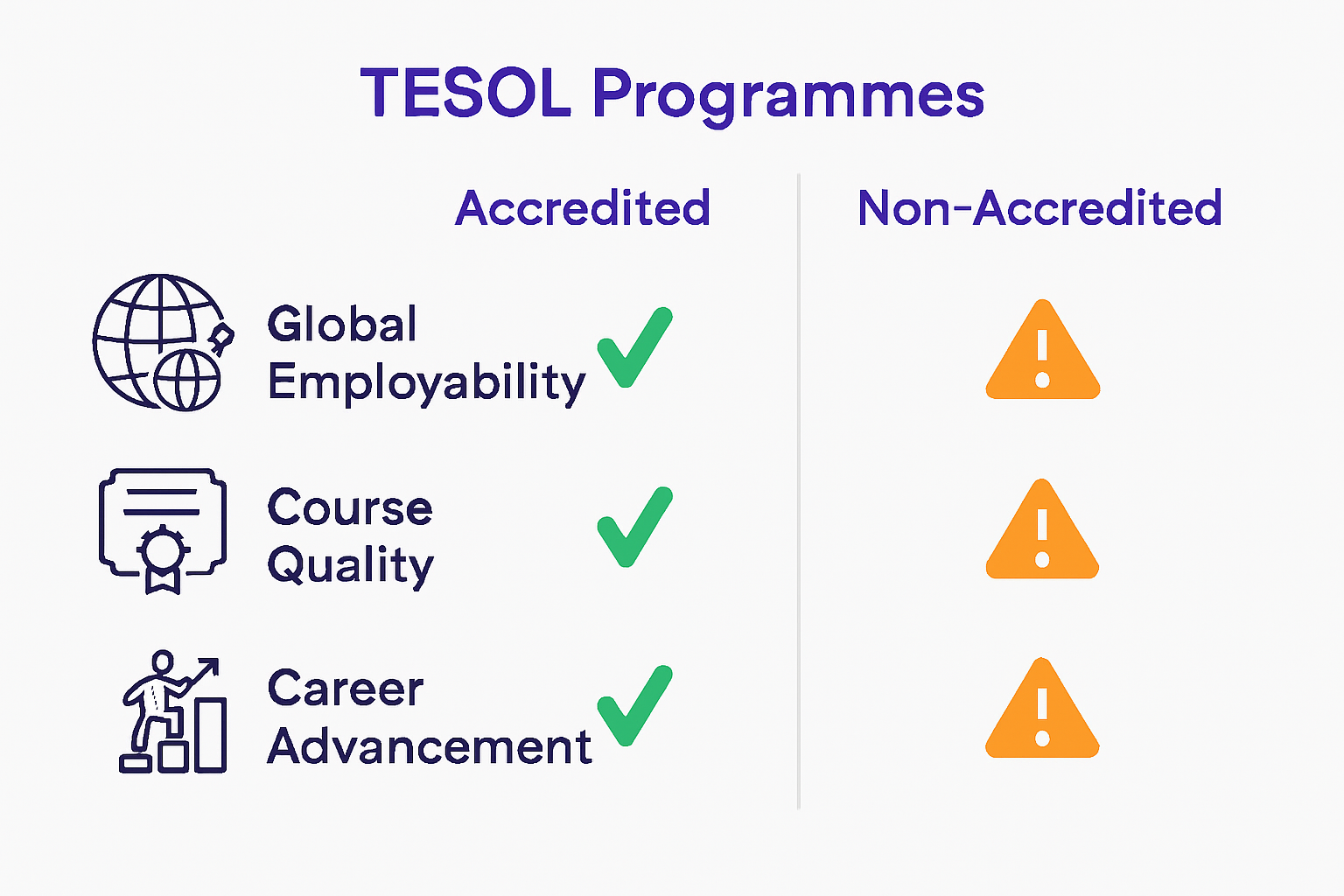
| TESOL Accreditation | Validates teaching expertise and enhances credibility, offering diverse international employment opportunities for educators. |
| Accrediting Bodies | Ensure rigorous standards and quality in language instruction by evaluating programmes and instructor qualifications. |
| Course Quality Assurance | Maintained through comprehensive accreditation processes that review curriculum, instructor skills, and teaching methodologies. |
| Global Recognition | Transforms certifications into internationally transferable qualifications, significantly improving job prospects and professional development. |
Defining TESOL Accreditation and Its Purpose
TESOL accreditation represents a professional certification that validates an individual’s expertise in teaching English to speakers of other languages. At its core, this credential demonstrates a standardised level of professional competence that enables educators to teach English effectively across diverse international contexts. Accreditation serves as a critical benchmark for quality, ensuring that language instructors possess the necessary skills, pedagogical knowledge, and practical training to support learners’ linguistic development.
The primary purpose of TESOL accreditation extends beyond simple qualification. It provides a recognised framework that establishes professional standards, validates teaching capabilities, and creates opportunities for international employment. Educators with accredited qualifications gain credibility with language schools, universities, and private institutions worldwide. These certifications signal that the holder has undergone rigorous training in language teaching methodologies, classroom management, curriculum design, and cross-cultural communication strategies.
For aspiring English language instructors, obtaining a recognised TESOL accreditation offers multiple strategic advantages. Explore our comprehensive guide on TESOL certification steps to understand the pathways available. The credential not only enhances employability but also provides structured learning that equips teachers with practical skills. Key benefits include:
International recognition across educational institutions
Standardised teaching competence verification
Enhanced career progression opportunities
Professional development and specialisation potential
Access to global teaching markets
Moreover, TESOL accreditation represents more than a mere certificate. It embodies a commitment to professional excellence, continuous learning, and effective cross-cultural communication. By establishing clear educational standards, these credentials help maintain the quality of English language instruction globally, ensuring that learners receive high-standard educational experiences regardless of geographical location.
Accrediting Bodies and Certification Standards
TESOL certification standards are established by internationally recognised accrediting bodies that ensure rigorous professional benchmarks for English language instruction. Accrediting organisations play a critical role in maintaining educational quality, developing comprehensive assessment frameworks, and setting global standards for language teaching competence. These bodies meticulously evaluate training programmes, instructor qualifications, and curriculum design to guarantee that certified educators meet professional excellence requirements.
Key international accrediting bodies include professional organisations such as Trinity College London and Cambridge Assessment English. Learn more about different TESOL certification pathways to understand how these organisations shape professional standards. These institutions develop detailed frameworks that assess critical teaching competencies, including:
Linguistic knowledge and expertise
Pedagogical teaching methodologies
Classroom management techniques
Cross-cultural communication skills
Curriculum development capabilities
Certification standards typically involve comprehensive evaluation processes that examine both theoretical understanding and practical teaching skills. Professional accrediting bodies require candidates to demonstrate proficiency through structured assessments, including written examinations, practical teaching demonstrations, lesson planning exercises, and reflective teaching portfolios. These rigorous evaluation methods ensure that certified educators possess the necessary skills to deliver high-quality English language instruction across diverse learning environments and cultural contexts.
Moreover, these accreditation standards are not static but evolve continuously to reflect changing educational landscapes, technological advancements, and emerging teaching methodologies. Reputable accrediting bodies regularly review and update their certification requirements, ensuring that TESOL professionals remain adaptable, innovative, and equipped to meet the dynamic needs of global language learners. By maintaining such comprehensive and progressive standards, these organisations contribute significantly to the professional development and global recognition of English language teaching as a sophisticated and impactful educational discipline.

How Accreditation Ensures Course Quality
Course quality in TESOL programmes is fundamentally guaranteed through comprehensive accreditation processes that scrutinise every aspect of educational delivery. These rigorous evaluation mechanisms ensure that language teaching courses meet the highest professional standards, providing learners with robust, credible, and effective educational experiences. Accreditation serves as a critical quality control mechanism, meticulously examining curriculum design, instructor qualifications, teaching methodologies, and learning outcomes.
The TESOL International Association emphasises that accreditation goes beyond simple compliance, focusing on advancing professional standards and practices. Learn more about certification pathways that meet these quality standards, understanding how comprehensive assessments protect educational integrity. According to research from the British Council, quality assurance involves several critical components:
Supervised teaching practice
Substantial professional training input
Comprehensive curriculum assessment
Regular performance monitoring
Continuous professional development requirements
Accreditation bodies implement multi-layered verification processes that examine both theoretical frameworks and practical teaching competencies. This approach ensures that certified programmes provide learners with comprehensive, contextually relevant language instruction. Instructors must demonstrate not only linguistic expertise but also advanced pedagogical skills, cultural sensitivity, and adaptive teaching strategies. The evaluation typically includes extensive documentation review, classroom observations, student feedback analysis, and stringent performance benchmarks.
Moreover, accreditation is not a one-time achievement but an ongoing commitment to educational excellence. Recognised accrediting organisations require periodic re-evaluation, ensuring that TESOL programmes continuously evolve to meet changing linguistic, technological, and educational landscapes. By maintaining such dynamic and comprehensive quality assurance mechanisms, these bodies safeguard the professional standards of English language education, ultimately benefiting learners, educators, and institutions worldwide.
Global Recognition and Employment Benefits
Global recognition represents a pivotal advantage of accredited TESOL certification, transforming professional credentials into internationally transferable qualifications that unlock employment opportunities across diverse educational landscapes. Employers worldwide increasingly prioritise candidates with standardised, recognised certifications that demonstrate comprehensive language teaching expertise. This global validation ensures that certified educators can confidently pursue teaching positions in international schools, universities, language institutes, and corporate training programmes across multiple countries and cultural contexts.
Key employment benefits include:
Enhanced international job market accessibility
Higher salary potential
Credibility with educational institutions
Streamlined visa and work permit applications
Expanded professional networking opportunities
Competitive edge in global recruitment processes
British Council research underscores that externally validated qualifications dramatically improve employment prospects by meeting rigorous national and international accreditation standards. Certified professionals gain substantial advantages in competitive job markets, with employers recognising these credentials as reliable indicators of teaching competence, pedagogical knowledge, and cross-cultural communication skills. The certification becomes more than a document – it represents a comprehensive professional endorsement of an educator’s capabilities.
Ultimately, global recognition transcends mere paperwork, embodying a professional passport that enables educators to navigate international teaching landscapes with confidence and credibility. Accredited TESOL certifications demonstrate not just linguistic proficiency, but a commitment to professional excellence, adaptive teaching methodologies, and continuous learning. By investing in a globally recognised qualification, professionals position themselves as valuable, versatile language educators capable of making meaningful impacts in diverse educational environments worldwide.
Common Pitfalls and What to Avoid
Navigating TESOL certification requires strategic awareness of potential challenges that can derail professional development and credibility. Many aspiring language educators unknowingly encounter obstacles that can compromise their career prospects, making it crucial to understand and proactively address common pitfalls in the certification process. Recognising these potential challenges early helps professionals make informed decisions and protect their long-term educational and career objectives.
Explore our comprehensive guide to certification pathways to better understand how to avoid typical certification mistakes. The most significant pitfalls in TESOL accreditation include:
Selecting non-accredited or unrecognised programmes
Overlooking programme curriculum depth and quality
Ignoring practical teaching components
Failing to verify international recognition
Neglecting continuous professional development requirements
Choosing courses without supervised teaching practice
Professionals must exercise extreme caution when selecting TESOL certification programmes. Unaccredited or substandard courses can create significant barriers to employment, potentially rendering investments of time and money ineffective. Critical red flags include programmes lacking comprehensive practical teaching components, minimal supervised instruction time, and certifications not recognised by international educational institutions. Aspiring educators should thoroughly research programme credentials, examining factors such as accreditation status, curriculum comprehensiveness, and alignment with international teaching standards.
Moreover, the most sophisticated approach involves viewing TESOL certification as an ongoing professional journey rather than a one-time achievement. Successful candidates continuously update their skills, remain adaptable to evolving educational technologies and methodologies, and maintain a proactive approach to professional development. By understanding potential pitfalls, conducting rigorous programme research, and committing to continuous learning, language educators can build robust, internationally respected professional credentials that open global teaching opportunities.
Unlock Your Global Teaching Career with Trusted TESOL Accreditation
Understanding the importance of TESOL accreditation is key to overcoming the challenges of finding recognised, quality teacher training that truly prepares you for international employment. If you are concerned about selecting accredited courses that ensure practical teaching skills, long-term professional development, and worldwide recognition, you are not alone. Many aspiring English teachers seek a clear pathway that guarantees global employability, practical learning, and continuous support.
At EBC TEFL Course, we offer expertly accredited TESOL and TEFL certification programmes that reflect the highest industry standards including Trinity College London accreditation. Our courses combine comprehensive training, supervised teaching practice, and specialisation options that align perfectly with the professional benchmarks outlined in TESOL accreditation frameworks. Seize the opportunity to elevate your teaching credentials and open doors to teaching positions in Spain, France, Italy, and various Asian countries. Learn more about your options and how you can ensure your qualifications have genuine international value by exploring TESOL certification steps and TEFL accreditation guide.
Take control of your career now by booking a free consultation to discuss your personalised training pathway. Book a Call today to start your journey towards an internationally recognised TESOL accreditation that employers trust worldwide.
Frequently Asked Questions
What is TESOL accreditation?
TESOL accreditation is a professional certification that validates an individual’s expertise in teaching English to speakers of other languages, ensuring they meet a standardised level of competence for effective instruction.
Why is TESOL accreditation important for educators?
TESOL accreditation enhances an educator’s credibility, provides access to international job markets, and confirms that they have undergone rigorous training in teaching methodologies and practices.
How do accrediting bodies ensure the quality of TESOL programmes?
Accrediting bodies maintain quality by evaluating training programmes, instructor qualifications, and curriculum design through comprehensive assessments, ensuring that certified educators possess the necessary skills and knowledge.
What are the common mistakes to avoid when obtaining TESOL certification?
Common pitfalls include selecting non-accredited programmes, overlooking the depth of the curriculum, neglecting practical teaching experience, and failing to pursue continuous professional development.
Recommended
TEFL Accreditation: Everything You Need to Know – EBC TEFL courses
7 Key Advantages of the Trinity CertTESOL for Aspiring Teachers – EBC TEFL courses
Does a TESOL Certificate Expire? The Truth About TEFL/TESOL Validity
Which TEFL Course Is Most Recognised? A Complete Guide to Choosing the Right Certification
