
Most graduates aiming to teach English abroad quickly discover that only accredited TESOL certifications unlock opportunities in Spain, France, and Italy. The right qualification makes a real difference—more than 80 percent of international schools prefer teachers with globally recognised credentials. If you want a teaching career that takes you across Europe with confidence, finding a respected TESOL programme is the first crucial move. This guide shares actionable steps to help you stand out, even with limited teaching experience.
Table of Contents
- Step 1: Research Accredited TESOL Programmes
- Step 2: Prepare Essential Application Documents
- Step 3: Submit Your TESOL Application Online
- Step 4: Attend Interview and Evaluation Sessions
- Step 5: Verify Acceptance and Secure Placement
Quick Summary
| Key Point | Explanation |
| 1. Research accredited TESOL programmes | Select programmes with global recognition and practical experience to enhance teaching career opportunities abroad. |
| 2. Organise essential application documents | Maintain meticulous organisation of all required documents to create a strong and complete application package. |
| 3. Submit the application meticulously online | Follow specific digital submission protocols and check formatting to ensure a polished, professional application. |
| 4. Prepare for interviews and evaluations | Demonstrate your teaching potential by showcasing adaptability and intercultural competence during interviews. |
| 5. Confirm acceptance and secure placement | After acceptance, review programme details thoroughly and communicate effectively for a smooth placement process. |
Step 1: Research accredited TESOL programmes
Navigating the world of TESOL certification requires strategic research to identify programmes that will genuinely advance your international teaching career. Your goal is to select an accredited programme recognised globally, ensuring your qualifications open doors to teaching opportunities worldwide.
Start by investigating programmes with recognised international accreditation, specifically those endorsed by Trinity College London. These certifications provide the most robust credentials for teaching English abroad. Focus on comprehensive programmes that offer practical teaching experience, not just theoretical knowledge. Check the curriculum details carefully to understand the depth of training provided research the programme’s graduate success rates and employment support networks.
When evaluating potential TESOL courses, consider multiple factors beyond basic certification. Look for programmes that offer specialised modules like online teaching methodologies, business English instruction, and cultural adaptation techniques. Verify the programme’s global recognition and partnerships with international schools and language institutions. Some key elements to investigate include the total course hours, practical teaching practicum requirements, and whether the certification includes job placement assistance.
Professional Recommendation: Create a detailed spreadsheet comparing different TESOL programmes, tracking key metrics like accreditation status, course duration, practical teaching components, and post-qualification support to make an informed decision.
Below is a comparative table highlighting key criteria for selecting an accredited TESOL programme:
| Criteria | Why It Matters | How to Check |
| International Accreditation | Recognised worldwide credentials | Accrediting body’s reputation |
| Practical Teaching Experience | Enhances classroom readiness | Programme curriculum details |
| Graduate Success Rate | Indicates job market relevance | Alumni placement statistics |
| Job Placement Support | Facilitates employment overseas | Dedicated support services |
Step 2: Prepare essential application documents
Preparing your TESOL application documents requires meticulous attention to detail and strategic organisation. Your goal is to create a comprehensive application package that showcases your professional potential and meets international teaching programme requirements.
Begin by gathering core documentation, including your academic transcripts, passport copies, and comprehensive TESOL application materials. Ensure all academic certificates are officially translated if they are not in English. Professional headshots and a well-crafted curriculum vitae are crucial components that demonstrate your commitment and suitability for international teaching roles. Include any relevant language certifications, teaching experience certificates, and supplementary qualifications that strengthen your application.

Carefully review each programme’s specific document requirements, as international institutions have varying expectations. Some programmes might request additional materials such as letters of recommendation, language proficiency test results, or written statements explaining your teaching motivations. Create digital and physical copies of all documents, organising them systematically to facilitate quick submission. Pay close attention to document formatting, translation requirements, and authentication procedures that might involve notarisation or apostille certification.
Professional Recommendation: Create a digital document folder with clearly labelled subfolders for original documents, translated copies, and application drafts to streamline your application process and prevent last minute document scrambling.
Here is a summary table outlining essential documents for a strong TESOL application:
| Document Type | Purpose | Special Requirements |
| Academic Transcripts | Proves educational background | Certified translation if not in English |
| Passport Copy | Establishes identity | Colour scan, clear image |
| CV and Headshot | Represents professionalism | Recent photo, concise CV |
| Language/Teaching Certificates | Strengthens qualification claim | Official copies or notarised versions |
| Reference Letter | Validates teaching abilities | Signed, from educational professional |
Step 3: Submit your TESOL application online
Submitting your TESOL application online requires precision, attention to digital submission protocols, and strategic organisation. Your objective is to present a polished professional application that demonstrates your commitment to international teaching opportunities.
Begin by carefully navigating the online application portal with methodical preparation. Create a dedicated email account for professional correspondence and ensure all digital files are correctly formatted as PDF documents. Double check that your file names are clear and professional typically including your full name and document type. When completing online application forms, allocate sufficient time to review each section thoroughly before final submission. Verify that all required fields are completed accurately and that supporting documents are uploaded correctly.
Pay close attention to programme specific submission guidelines, as international teaching institutions often have unique digital application requirements. Some programmes might request additional online questionnaires, video introductions, or supplementary digital materials. Maintain copies of all submitted documents and take screenshots of successful submission confirmations. Ensure your internet connection is stable during the application process to prevent potential technical interruptions that could compromise your submission.
Professional Recommendation: Create a dedicated digital folder to store application screenshots, submission confirmations, and copies of uploaded documents as a comprehensive backup strategy for your online application process.
Step 4: Attend interview and evaluation sessions
Interviews and evaluation sessions represent crucial moments in your TESOL application journey where you will demonstrate your potential as an international English language educator. Your objective is to present yourself professionally while showcasing your teaching passion and intercultural competence.
Prepare comprehensively for your interview by developing a strategic approach to professional presentation. Research the specific programme expectations and anticipate potential questions about your teaching philosophy, language experience, and international teaching motivations. Practice responses that highlight your adaptability, communication skills, and genuine interest in cross cultural education. During online or in person interviews, maintain professional attire, ensure a clean and quiet background, and demonstrate active listening skills. Be prepared to discuss your academic background, relevant experiences, and specific reasons for pursuing TESOL certification.
During evaluation sessions, expect potential teaching demonstrations or sample lesson presentations. Many programmes will assess your ability to explain complex language concepts clearly and engage potential students. Approach these sessions with confidence and creativity, demonstrating your understanding of interactive teaching methodologies. Show your capacity to adjust communication styles for different learner levels and cultural contexts. Remain open to feedback and view the evaluation as an opportunity to learn and showcase your potential as a global educator.
Professional Recommendation: Record a practice teaching video beforehand to review your presentation style and identify areas for improvement before your actual evaluation session.
Step 5: Verify acceptance and secure placement
Reaching the final stage of your TESOL application process requires careful attention to detail and proactive communication. Your primary objective is to confirm your acceptance and strategically secure your international teaching placement.
After receiving your acceptance notification, meticulously review all programme details and understand the comprehensive placement requirements. Carefully examine the official acceptance document, verifying all programme specifics including start dates, location assignments, and any additional documentation needed for visa processing. Promptly respond to all communication from the programme administrators and submit any outstanding paperwork. Prepare digital and physical copies of your acceptance letter, as these documents will be crucial for subsequent visa applications and travel arrangements.
Contact the programme placement team to discuss potential teaching locations and understand the specific requirements for your chosen destination. Some programmes offer multiple placement options, so be prepared to demonstrate flexibility and cultural adaptability. Confirm your preferred teaching regions while remaining open to alternative opportunities that align with your professional goals. Request detailed information about housing arrangements, local support networks, and initial orientation processes. Ensure you have a comprehensive understanding of your contractual obligations and the support services available to you during your international teaching experience.
Professional Recommendation: Create a dedicated email folder and digital document storage system specifically for your TESOL placement communications to maintain organised and easily accessible records throughout your placement process.
Take Control of Your TESOL Journey with Trinity College London Accreditation
Mastering the TESOL application process involves overcoming challenges such as identifying recognised programmes, preparing detailed documentation, and securing international teaching placements. If you are aiming for a globally respected qualification with practical, hands-on training and lifetime job placement support, choosing the right provider is essential. Our Trinity College London accredited TESOL and TEFL courses at EBC TEFL are designed to meet these exact needs, combining rigorous certification with global employment opportunities.
Experience the advantage of comprehensive 1-year study and work abroad programmes in Spain, France, and Italy. These unique programmes offer language study, visa assistance, part-time work options, and rich cultural immersion alongside your accredited teacher training. Benefit from expert guidance through every application step, from document preparation to interview readiness, making your dream of teaching English abroad a reality. Explore our detailed course descriptions and success stories to see how we support aspiring educators every step of the way.
Ready to elevate your TESOL application and secure your place on a life-changing teaching adventure?
Start your globally recognised TESOL certification journey now with EBC TEFL. Book a free consultation and get personalised support tailored to your ambitions. Take the first step towards a dynamic international teaching career today.
Frequently Asked Questions
What are the key steps in the TESOL application workflow?
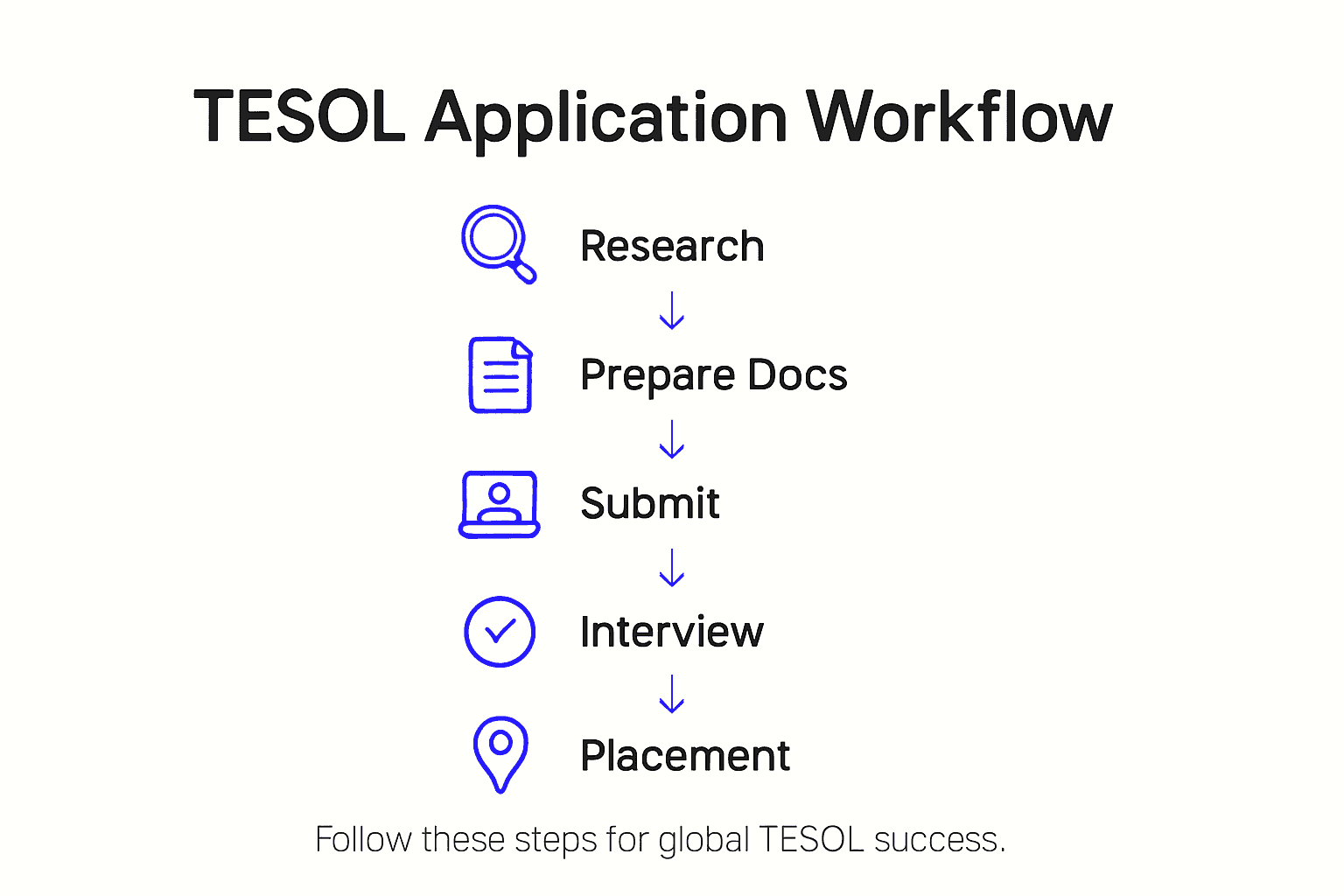
The key steps in the TESOL application workflow include researching accredited programmes, preparing essential application documents, submitting your application online, attending interviews and evaluation sessions, and verifying acceptance and securing placement. Follow these steps systematically to enhance your chances of securing your desired teaching position.
How do I choose the right accredited TESOL programme for my teaching career?
To choose the right accredited TESOL programme, examine factors such as international accreditation, practical teaching experience, graduate success rates, and job placement support. Create a spreadsheet to compare multiple programmes based on these criteria, ensuring you understand how each aligns with your professional goals.
What documents do I need to prepare for my TESOL application?
You will typically need your academic transcripts, a passport copy, a curriculum vitae, professional headshots, and any relevant language or teaching certifications. Organise these documents systematically, and ensure any non-English certificates are officially translated, ready for submission.
How should I prepare for the TESOL interview and evaluation?
Prepare for your TESOL interview by researching the programme’s specific expectations and practising responses to potential questions. Focus on demonstrating your teaching philosophy, language experience, and adaptability during interviews or evaluations by being well-presented and engaging.
What should I do after receiving my TESOL acceptance?
After receiving your TESOL acceptance, carefully review all programme details including start dates and location assignments. Respond promptly to communication from programme administrators, ensuring you submit any required documentation for visa processing and confirm your preferred teaching region.
How can I keep my TESOL application documents organised?
To keep your TESOL application documents organised, create a dedicated digital folder with clearly labelled subfolders for original, translated, and application materials. This will help you track your documents easily and streamline your submission process.
