
Key Points
- Human tutors are essential for delivering personalized feedback and assessment in TEFL courses.
- Accredited TEFL programs require tutor-led teaching practice, observation, and professional evaluation.
- Tutors help build practical teaching skills, confidence, and classroom management essential for global teaching success.
Many people assume that completing a TEFL certification is simply a matter of working through course content, watching videos, and passing a final test. That assumption is understandable, but it is also fundamentally wrong. The tutor standing behind your training is not a background figure. They are the reason accredited TEFL qualifications carry weight with employers across the world. Without genuine tutor involvement, you are not receiving recognised training. You are receiving self-study material dressed up as a professional course. This article cuts through the confusion, explains what TEFL course tutors actually do, and shows you why their role is the difference between a certificate that opens doors and one that does not.
Table of Contents
- What makes a TEFL course tutor essential?
- How tutors shape practical teaching expertise
- Building confidence and classroom management
- Feedback, assessment, and maintaining standards
- Why effective TEFL course tutors unlock global careers
- Find accredited courses and tutor-led training
- Frequently asked questions
Key Takeaways
| Point | Details |
|---|---|
| Tutor involvement critical | Accredited TEFL courses require dedicated tutor guidance and cannot rely solely on automated content. |
| Practical skills built | Tutors guide teaching practice and deliver targeted feedback to build real classroom confidence and competence. |
| Global opportunities unlocked | Effective tutors and practical training are essential for accessing international English teaching roles. |
| Assessment ensures standards | Continuous tutor assessment and feedback maintain course quality and meet industry accreditation requirements. |
What makes a TEFL course tutor essential?
There is a widespread misconception that modern TEFL courses can be fully automated. Online platforms have made it easier than ever to access learning content, and many providers market their courses as flexible, self-paced, and convenient. Convenience is valuable. But convenience without tutor involvement cannot produce a certified, job-ready English teacher.
Understanding the TEFL tutor meaning is the first step toward choosing a course that genuinely prepares you. According to published role descriptions in the sector, TEFL course tutors deliver training content, follow course timetables, build trainee confidence for teaching, assess teaching abilities, and provide feedback on teaching practice. Each of those responsibilities requires a human being with professional expertise. No algorithm can replicate them.
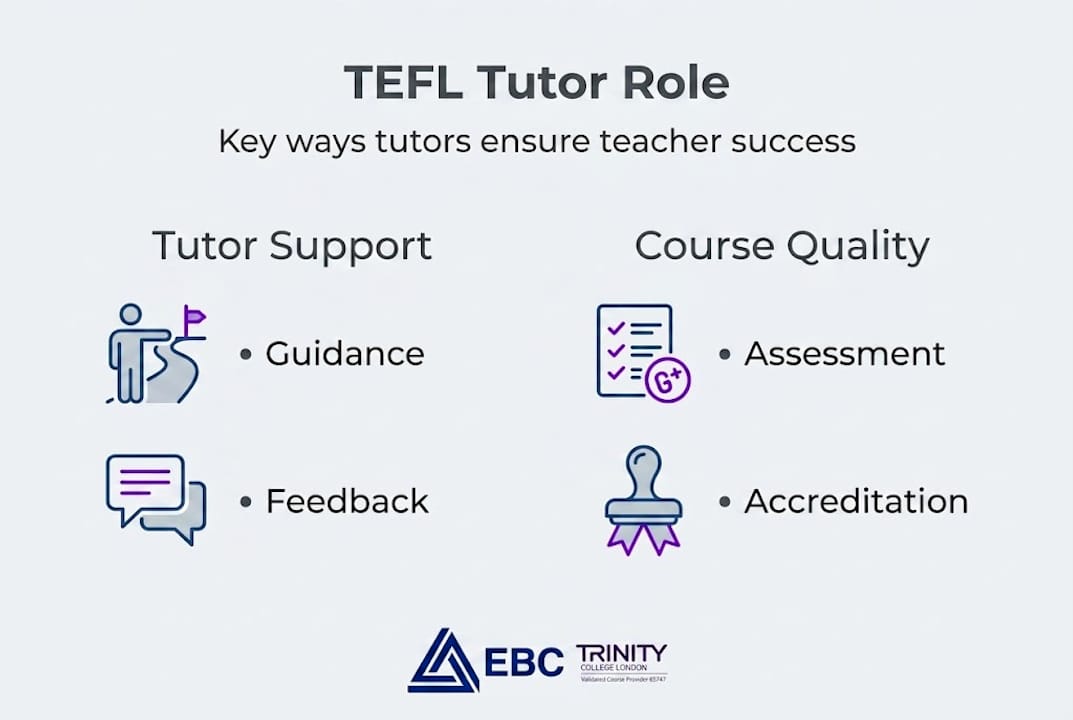
Tutors do far more than present information. They track your individual progress, identify where you are struggling, and adjust their guidance accordingly. They watch you teach, listen to how you explain grammar rules, and notice when your pacing is off or your instructions are unclear. This kind of personalised attention is what separates a qualified teacher from someone who simply read a textbook.
Accreditation standards reinforce this point firmly. Bodies such as Trinity College London require tutor involvement as a non-negotiable condition for course approval. The TEFL accreditation standards published by oversight organisations make clear that fully automated courses do not meet the criteria for recognised certification. Employers in Spain, Italy, Japan, South Korea, and dozens of other countries know this. They check. A certificate without tutor-led components will not pass scrutiny at a reputable language school.
Comparison: Tutor-led vs automated TEFL courses
| Feature | Tutor-led course | Automated course |
|---|---|---|
| Teaching practice supervision | Yes, mandatory | No |
| Personalised feedback | Yes, throughout | No |
| Accreditation eligibility | Yes | Usually no |
| Employer recognition | High | Low to none |
| Confidence building | Active and ongoing | Not possible |
| Assessment of classroom skills | Yes | No |
Pro Tip: When researching TEFL programmes, ask providers directly whether a named, qualified tutor will observe your teaching practice and provide written feedback. If they cannot answer clearly, treat that as a warning sign.
The table above tells a clear story. Tutor involvement is not a bonus feature. It is the structural foundation of a course worth completing.
How tutors shape practical teaching expertise
Knowing theory is useful. Being able to teach is essential. The gap between the two is where most new teachers struggle, and it is precisely where a skilled TEFL tutor makes their greatest contribution.
Supervised teaching practice is the centrepiece of accredited TEFL training. You plan a lesson, deliver it to real students, and receive structured feedback from your tutor afterward. This cycle repeats across the course, and each repetition builds a layer of competence that no amount of reading can replicate. The first time you stand in front of a class, even in a training context, you will feel the pressure of managing time, explaining concepts clearly, and responding to unexpected student questions. Your tutor is watching all of it.
Published standards confirm that the mechanics of accredited training include supervised teaching practice, lesson observation, individualised feedback, and assessment of lesson planning and classroom management. These are not optional enrichments. They are required components. Programmes that skip them are not recognised by serious accrediting bodies.
“The most transformative moments in teacher training happen not in the classroom alone, but in the debrief conversation afterward, when a tutor helps a trainee understand why something worked or didn’t.”
What does a tutor observe during a teaching session? The list is detailed and instructive:
- Language accuracy: Are your explanations of grammar and vocabulary correct and accessible to the learner’s level?
- Pacing and timing: Do you move through the lesson at an appropriate speed, or do you rush key points and stall on minor ones?
- Classroom presence: Do you project confidence, manage your voice effectively, and maintain student attention?
- Instructions: Are your task instructions clear enough for students to follow without confusion?
- Error correction: Do you handle student mistakes constructively, encouraging rather than discouraging?
- Lesson structure: Does the lesson follow a logical sequence with clear aims, activities, and a meaningful conclusion?
Each of these areas is something a tutor can identify, comment on, and help you improve. This is what lesson observation in TEFL truly means in practice. It is not passive watching. It is active professional assessment designed to accelerate your development.
Understanding the teaching practicum benefits goes beyond the training period itself. Teachers who receive rigorous, supervised practice during their certification are measurably more confident when they enter their first real classroom. They have already made their early mistakes in a supported environment. That experience is priceless when you are standing in front of a class in Barcelona, Rome, or Bordeaux on your first day of work.

Building confidence and classroom management
Confidence is not something you can download. It is built gradually through repeated experience, honest feedback, and deliberate practice. TEFL tutors understand this, and the best ones treat confidence-building as a core part of their job, not a side effect of the training.
New teachers commonly struggle with several specific challenges. Knowing these in advance helps you prepare for them and gives you a framework for understanding the feedback your tutor will offer.
- Fear of silence: Many trainees panic when a class goes quiet. A good tutor teaches you to use silence purposefully and to respond calmly when students need processing time.
- Over-explaining: New teachers often say too much. Tutors help you develop the discipline of giving clear, brief instructions and trusting students to attempt tasks.
- Avoiding error correction: Correcting students feels uncomfortable at first. Tutors guide you through techniques that make correction a positive, natural part of the learning process.
- Inconsistent pacing: Lessons that rush at the start and stall at the end are a common beginner pattern. Tutors help you develop a feel for timing through repeated practice and review.
- Weak lesson endings: Many trainees run out of time or energy before reaching a proper conclusion. A tutor will flag this and help you build habits that close lessons effectively.
Published role expectations for TEFL tutors confirm that their duties include delivering face-to-face training, following the module timetable, building confidence, assessing the ability to teach, and adhering to professional policy. That structured commitment to your development is what makes accredited training so different from self-study alternatives.
Tutors also support essential TEFL skills like lesson planning from the ground up. They review your plans before you deliver them, point out where your aims are unclear, and suggest activities better suited to your learner group. Over time, this iterative process of planning, teaching, and reviewing creates a professional habit that serves you throughout your career.
The concept of teacher development is central here. Training is not a one-time event. It is an ongoing process. The habits you form with your tutor during certification become the professional practices you carry into every classroom you ever teach.
Pro Tip: After each teaching practice session, ask your tutor for one specific thing to focus on in your next lesson. Targeted, incremental improvement is far more effective than trying to fix everything at once.
Feedback, assessment, and maintaining standards
Feedback is the engine of professional growth. Without it, you have no reliable way of knowing whether your teaching is actually effective or merely comfortable. TEFL tutors are trained to deliver feedback that is honest, constructive, and specific enough to be acted upon.
Throughout an accredited course, tutors assess your performance against defined criteria. These include lesson planning, classroom management, language accuracy, and the creativity and coherence of your teaching approach. Accreditation requirements specify that tutor grading and feedback on creative elements, live mock classes, and practical components are all mandatory parts of recognised programmes.
Assessment components in accredited TEFL training
| Assessment area | What tutors evaluate | Feedback format |
|---|---|---|
| Lesson planning | Clarity of aims, activity sequence, timing | Written notes and verbal debrief |
| Teaching delivery | Pacing, instructions, student engagement | Observation sheet with scores |
| Language use | Accuracy, level appropriateness, clarity | In-session notes and discussion |
| Classroom management | Student behaviour, grouping, transitions | Post-lesson written feedback |
| Creative elements | Originality of tasks, material use | Tutor grade with comments |
This structured approach to assessment serves two purposes. First, it gives you a clear picture of where you stand and what you need to work on. Second, it ensures that the qualification you earn reflects a verified standard of teaching ability. Employers around the world trust accredited certificates precisely because this process exists.
For online TEFL courses, the standards are equally firm. Tutors must be involved in grading practical work and in providing face-to-face interaction through platforms such as Zoom. A course that promises accreditation without any live tutor contact does not meet recognised industry requirements. Full stop.
Reading trainer insights from experienced TEFL professionals reveals a consistent theme: the trainees who progress most rapidly are those who engage actively with feedback rather than simply receiving it. They ask questions, try the suggestions in their next lesson, and reflect on the results. Tutors are looking for this kind of professional engagement, and it distinguishes the teachers who go on to build strong international teaching careers.
Assessment is not about finding fault. It is about building a foundation of verified, recognised competence that travels with you wherever in the world you choose to teach.
Why effective TEFL course tutors unlock global careers
Here is something most articles about TEFL training do not say clearly enough: your tutor is one of the most important professional relationships you will form at the start of your teaching career. Not the course platform. Not the reading materials. The tutor.
The conventional view is that a TEFL certificate is a ticket to teaching abroad, and the content of the course is what fills the ticket. We think that view misses the point entirely. The certificate confirms that a qualified professional has assessed your teaching ability and found it ready. Without that human verification, the certificate is just a printed document.
We have seen many teachers arrive at their global TEFL career steps with solid theoretical knowledge but limited classroom confidence. The ones who succeed quickly are almost always those whose tutors pushed them, gave them honest feedback, and required them to act on it. That process is not comfortable. It is not meant to be. Real professional development rarely is.
Teaching English abroad, whether in Madrid, Milan, or Lyon, requires more than grammar knowledge. It requires adaptability, composure, and the ability to read a classroom. These qualities are cultivated through tutor-guided practice. No automated system builds them. A skilled tutor does.
Find accredited courses and tutor-led training
If this article has clarified why tutor involvement matters so deeply, you are ready to take the next step with genuine confidence.
At EBC TEFL, we offer Trinity College London accredited courses that place tutor-led training at the centre of your learning experience. Whether you are pursuing the Trinity CertTESOL or exploring our one-year study and work programmes in Spain, France, and Italy, every pathway includes real tutor involvement, structured teaching practice, and the global job placement support you deserve. If you are new to the field and want to understand the foundation, our introduction to TEFL is the ideal starting point. Ready to talk through your options? Book a call with our team and get personalised guidance from people who understand what international teaching success actually takes.
Frequently asked questions
What does a TEFL tutor actually do?
TEFL tutors deliver course content, supervise teaching practice, assess classroom skills, provide personalised feedback throughout the programme, and actively support trainee confidence. Their role encompasses training delivery and assessment, making them central to any accredited qualification.
Do online TEFL courses require tutor involvement?
Yes, absolutely. Accredited online TEFL courses must include tutor grading and face-to-face interaction for practical components, typically delivered via video call. Fully automated courses without live tutor contact do not meet recognised accreditation standards and are not accepted by reputable employers.
How do tutors support lesson planning?
Tutors review lesson plans before delivery, identify unclear aims or poorly sequenced activities, and provide written and verbal guidance to help trainees improve. Their input, as confirmed in published tutor duties, directly builds the planning skills that effective classroom teachers rely on throughout their careers.
Is teaching practice supervised during TEFL courses?
Yes, supervision is mandatory. Tutors observe live teaching sessions, record feedback on structured observation sheets, and hold post-lesson debriefs. The requirements for accredited programmes confirm that supervised teaching practice, lesson observation, and individualised feedback are all non-negotiable components of recognised TEFL training.