
Key Points
- Trinity CertTESOL is an internationally recognized Level 5 qualification essential for competitive English teaching markets.
- The application process involves gathering documents, passing an interview, and submitting through an accredited provider.
- Successful candidates prepare early, focus on feedback, and start career planning alongside application steps.
The Trinity CertTESOL qualification can feel like a gateway to an extraordinary career, yet many aspiring teachers stall before they even begin. The application process looks straightforward on the surface, but without a clear map, small missteps can cost you weeks or even your place on a course. Whether you are a recent graduate, a career changer, or someone who has always wanted to teach abroad, knowing exactly what to expect at each stage transforms anxiety into action. This guide walks you through every step, from confirming your eligibility right through to receiving your offer, so you can move forward with confidence.
Table of Contents
- Understanding Trinity CertTESOL and eligibility criteria
- Preparing your application: Essential documents and tools
- Step-by-step application process for Trinity CertTESOL
- What happens after application: Interview, results, and next steps
- What most applicants miss about Trinity CertTESOL success
- Take your next steps with EBC Trinity CertTESOL
- Frequently asked questions
Key Takeaways
| Point | Details |
|---|---|
| Check eligibility early | Confirm you meet all Trinity CertTESOL entry requirements before applying. |
| Prepare strong documents | Gather your CV, statement, and references to stand out during application. |
| Expect an interview | Almost every applicant is interviewed, so prepare to communicate your motivation clearly. |
| Be proactive post-offer | Act quickly when accepted to secure your place and access course resources. |
| Look beyond the certificate | Plan for practical teaching and career placement, not just ticking boxes. |
Understanding Trinity CertTESOL and eligibility criteria
Before you submit a single form, it pays to understand precisely what you are working towards. The Trinity CertTESOL is an internationally recognised qualification accredited by Trinity College London, one of the world’s most respected awarding bodies for English language education. It is not a generic TEFL certificate. It is a rigorous, practical qualification that signals to employers globally that you are a trained, competent teacher.
The Trinity College London overview confirms that the CertTESOL sits at Level 5 on the Qualifications and Credit Framework, equivalent to the first two years of an undergraduate degree. Schools and language institutes across Europe, Asia, Latin America, and the Middle East actively seek candidates who hold it. If you want to teach in competitive markets such as Japan, Spain, or the UAE, this qualification opens doors that many other certificates simply cannot.
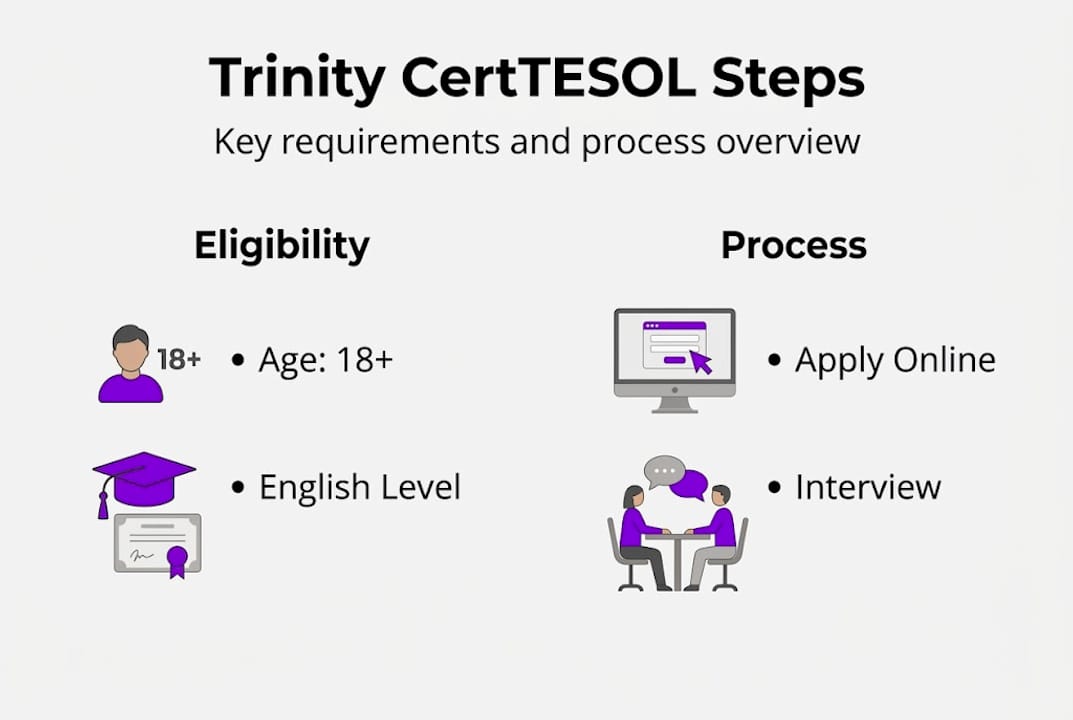
Now that you understand why the qualification is desirable, let us clarify who is eligible and what you need.
Eligibility requirements at a glance
| Requirement | Detail |
|---|---|
| Minimum age | 18 years old |
| Education level | Secondary school completion (A-levels or equivalent) |
| English proficiency | Near-native or native standard |
| Language requirement | Non-native speakers may need a language test result |
| Teaching experience | Not required |
If you are a non-native English speaker, you will need to demonstrate a high level of written and spoken English, typically at C1 or above on the Common European Framework of Reference for Languages. You can explore the full TESOL certification details to see exactly which proficiency tests are accepted.
Key documents you will need to gather:
- Valid passport or government-issued photo identification
- Proof of educational qualifications (certificates or transcripts)
- English language proficiency results (where applicable)
- An up-to-date curriculum vitae (CV)
- A personal statement explaining your motivation
- Two professional or academic references
Gathering these documents before you begin the online application saves considerable time and reduces the risk of missing deadlines.
Preparing your application: Essential documents and tools
Once you are sure you meet the entry requirements, it is time to collect and organise your application materials. A clear personal statement and CV are vital parts of your application, so give them proper attention rather than treating them as an afterthought.

Online versus offline submission: a quick comparison
| Submission method | Advantages | Potential drawbacks |
|---|---|---|
| Online portal | Faster, trackable, instant confirmation | Requires reliable internet access |
| Email submission | Flexible format | Risk of files being missed or delayed |
| In-person delivery | Direct contact with the centre | Limited to local providers only |
Most providers, including EBC, use a structured online portal that allows you to upload documents securely and track your application status in real time. This is the most efficient route for international candidates.
Step-by-step checklist for submission:
- Download the official application form from your chosen provider’s website.
- Complete all personal details accurately and legibly.
- Write your personal statement (more on this below).
- Request references from suitable contacts and allow at least two weeks for responses.
- Scan or photograph all supporting documents at high resolution.
- Upload everything to the provider’s portal or attach to a clearly labelled email.
- Save a copy of your submission confirmation for your records.
You can find further guidance in this step-by-step CertTESOL guide and additional tips on preparing for CertTESOL before you click submit.
The TEFL.org requirements page also provides useful external context for understanding what providers expect across different institutions.
Pro Tip: Your personal statement is not a biography. Use it to demonstrate why you want to teach English, where you hope to teach, and what specific qualities you bring to the classroom. Concrete examples from your life, work, or travel experiences make your statement memorable and credible.
Step-by-step application process for Trinity CertTESOL
With your paperwork in order, you are set to start the application process itself. Here is how to proceed, step by step.
- Research and select a provider. Choose an accredited centre that aligns with your schedule, location, and career goals. EBC operates globally, with programmes supporting candidates across Europe, Asia, and beyond.
- Submit your initial application. Complete the form and upload your documents. Double-check every field before you submit.
- Await acknowledgement. Reputable providers will confirm receipt within two to five working days. If you hear nothing, follow up promptly.
- Attend the pre-admission interview. Most courses include a pre-admission interview as a key selection step. This may take place via video call or in person, depending on the provider.
- Receive your admission decision. You will be notified of the outcome, along with any conditions attached to your offer.
- Complete enrolment formalities. Pay your deposit, confirm your start date, and review the course induction materials.
For a more detailed TESOL application walkthrough, including guidance on communicating with providers, visit the EBC resource pages. You can also review the step by step CertTESOL guide for additional context.
“Treat your application as your first teaching portfolio. Attention to detail, clarity, and genuine enthusiasm are exactly the qualities assessors look for.”
Before interviews, review the CertTESOL interview tips available through EBC to ensure you are well prepared.
Pro Tip: The most common mistake applicants make is submitting incomplete documents or using an outdated CV. Review your submission against the checklist at least twice before you send it. A single missing reference letter can delay your application by weeks.
What happens after application: Interview, results, and next steps
After submitting your application, the next stages determine your entry onto the course. Here is what you need to know.
The pre-admission interview assesses communication skills, motivation, and suitability for intensive teacher training. Assessors are not looking for a polished performer. They want to see genuine enthusiasm, self-awareness, and the capacity to reflect on feedback. Be honest, be specific, and show that you have thought carefully about your reasons for choosing this path.
Possible outcomes and next steps:
| Outcome | What it means | Immediate action |
|---|---|---|
| Accepted | You meet all entry criteria | Pay deposit and confirm start date |
| Conditionally accepted | Minor requirements outstanding | Complete conditions promptly |
| Waitlisted | Place available if space opens | Confirm interest and stay in contact |
| Unsuccessful | Did not meet criteria at this stage | Seek feedback and consider reapplying |
After acceptance, your next steps include:
- Paying your course deposit or arranging a payment plan.
- Completing any pre-course reading or induction tasks sent by your provider.
- Arranging travel, accommodation, and visa support if you are studying abroad.
- Joining any online communities or orientation sessions offered by your centre.
If your application is unsuccessful, do not be discouraged. You can review the official Trinity process to better understand the standards expected, and use feedback from your interview to strengthen a future application. Exploring your options for passing the CertTESOL or understanding the broader TESOL application workflow can help you approach the process with renewed focus.
Many successful graduates found that a brief period of focused preparation between applications made all the difference.
What most applicants miss about Trinity CertTESOL success
Most guides focus on the mechanics: gathering documents, acing the interview, submitting on time. These things matter. But from our experience working with candidates across dozens of countries, the applicants who truly thrive are those who treat the application process as the beginning of their career journey rather than a box-ticking exercise.
The CertTESOL course is intensive. You will receive feedback on your teaching, often for the first time in a formal setting, and adapting to that feedback quickly is a skill that distinguishes excellent teachers from average ones. Candidates who begin thinking about real preparation strategies before the course even starts consistently outperform those who wait. They observe classes, read about methodology, and start visualising themselves in the classroom.
Equally important is starting your career planning early. Do not wait until you hold your certificate to research job markets, connect with teaching communities, or consider where in the world you want to work. The teachers who land the best roles within weeks of qualifying are almost always those who began that groundwork months in advance.
Take your next steps with EBC Trinity CertTESOL
You now have a clear picture of what the Trinity CertTESOL application involves, and you are far better placed than most candidates who begin without a guide. Armed with clarity and confidence, the next practical step is connecting with a team that can support you every step of the way.
At EBC, we offer globally recognised international teaching certification alongside free lifetime job placement support for every graduate. Whether you want to explore the full range of options through TEFL and TESOL with EBC or you are ready to take the first step right now, our advisors are here to help. Book a free EBC consultation today and find out which programme is the right fit for your goals and timeline.
Frequently asked questions
How long does the Trinity CertTESOL application process usually take?
It typically takes two to four weeks from initial submission to offer. The process completion timeline can vary depending on how quickly you complete interview steps and submit all required documents.
Do I need teaching experience before applying for Trinity CertTESOL?
No prior teaching experience is required to apply. CertTESOL welcomes candidates based primarily on motivation, English proficiency, and personal suitability.
What happens if I do not pass the pre-admission interview?
You may be advised to reapply after further preparation or to consider related qualifications. Advice for unsuccessful applicants typically includes targeted feedback to help you strengthen your next attempt.
Can international candidates apply for Trinity CertTESOL online?
Yes, online CertTESOL options are available globally, making the qualification accessible to candidates regardless of their location or nationality.
Is Trinity CertTESOL accepted worldwide for teaching jobs?
Yes. CertTESOL global recognition means it is accepted by schools and employers across Europe, Asia, the Middle East, Latin America, and beyond.
Recommended
- Trinity CertTESOL Step by Step Guide for Global Educators – EBC TEFL courses
- Step-by-Step Guide to Trinity CertTESOL Certification – EBC TEFL courses
- How to Apply for TESOL: Secure Trinity CertTESOL and Work Abroad – EBC TEFL courses
- Master the TESOL Application Workflow for Global Teaching – EBC TEFL courses