
Key Points
- Recognized TEFL certificates like Trinity CertTESOL and CELTA are essential for European teaching roles and visas.
- Trinity CertTESOL emphasizes reflective practice, phonology, and practical teaching, improving career prospects.
- Online Level 5 TEFL courses are less competitive for premium positions but suitable for entry-level online work.
Not all TEFL certificates are created equal, and that distinction matters enormously when you are competing for teaching roles in Europe or beyond. Many aspiring teachers assume that holding any certificate will open the same doors, but employers, visa officials, and reputable language schools see things very differently. The certificate you choose directly affects which jobs you can apply for, whether you qualify for study and work visas in countries like Spain, France, and Italy, and how seriously you are taken in competitive hiring processes. This guide breaks down the key differences between Trinity CertTESOL, CELTA, and common online TEFL certificates so you can make an informed, confident decision.
Table of Contents
- Understanding Trinity CertTESOL and other TEFL certificates
- Key differences in course content and teaching approach
- Recognition in the global and European job market
- Comparing career outcomes: which TEFL certificate opens more doors?
- What most people miss when comparing TEFL certificates
- Take the next step: find the right accredited TEFL course
- Frequently asked questions
Key Takeaways
| Point | Details |
|---|---|
| Trinity CertTESOL credibility | Offers robust global recognition and job access, particularly in Europe. |
| Course content matters | Depth of practical teaching and reflective elements in Trinity CertTESOL gives a hiring edge. |
| Visa and work opportunities | Level 5 Trinity CertTESOL certificates unlock more legal teaching roles and study programmes abroad. |
| Career progression advantage | Highly-recognised certificates make long-term advancement and international transfers easier. |
Understanding Trinity CertTESOL and other TEFL certificates
Before comparing certificates, it helps to understand what each one actually represents. TEFL stands for Teaching English as a Foreign Language, while TESOL stands for Teaching English to Speakers of Other Languages. In practice, the two terms are used interchangeably, but the certificates behind them vary significantly in rigour, recognition, and real-world value.
The two most respected qualifications in the field are the Trinity CertTESOL and the CELTA (Certificate in English Language Teaching to Adults, awarded by Cambridge). Both are regulated at Level 5 on the Ofqual framework, which is the benchmark employers and visa authorities use to assess a certificate’s credibility. As confirmed by the CELTA vs Trinity CertTESOL guide, both are Level 5 Ofqual-regulated qualifications considered gold standards for TEFL teaching, with similar global recognition.
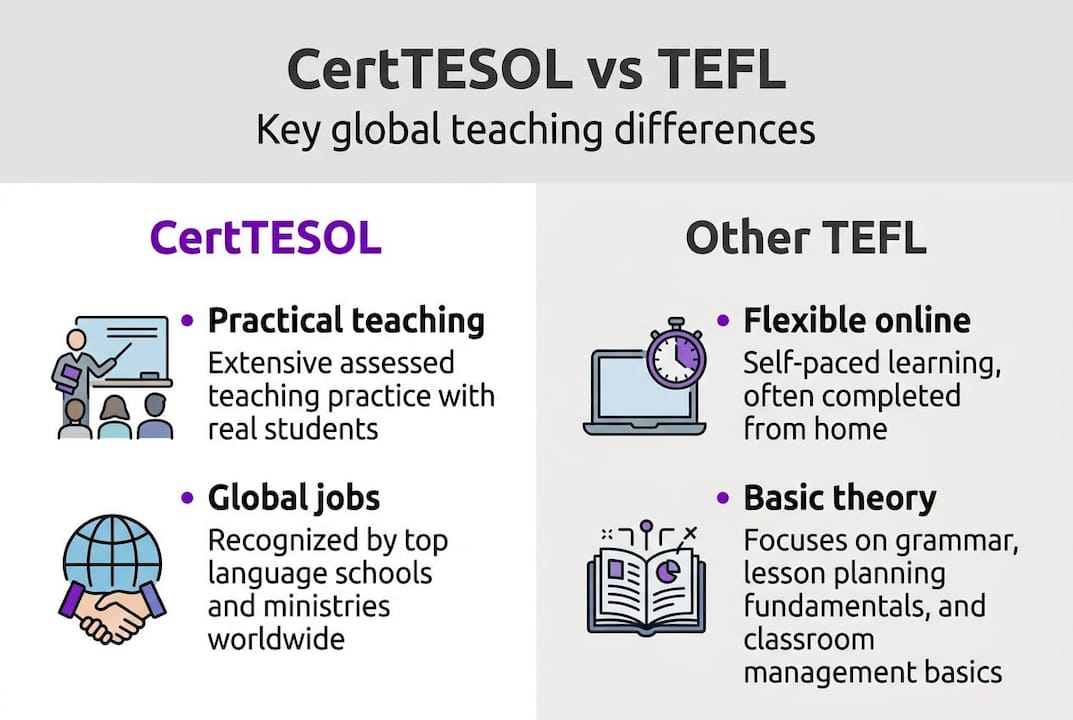
Online Level 5 TEFL certificates, such as those offered by OnTESOL or similar providers, also exist at this level but differ in delivery and practical requirements. A useful TEFL qualification comparison outlines these distinctions clearly.
| Criterion | Trinity CertTESOL | CELTA | Online Level 5 TEFL |
|---|---|---|---|
| Accreditation | Trinity College London / Ofqual Level 5 | Cambridge / Ofqual Level 5 | Varies by provider |
| Total hours | 130+ | 130+ | 100-130 |
| Observed teaching practice | 6 hours minimum | 6 hours minimum | Often 0-6 hours |
| Cost (approximate) | £1,200-£1,800 | £1,200-£2,000 | £300-£900 |
| Global employer recognition | Very high | Very high | Moderate |
A holder of an accredited Level 5 certificate is expected to demonstrate a range of competencies, including:
- Planning and delivering structured, learner-centred lessons
- Assessing and responding to learner needs in real time
- Understanding and applying phonology and grammar in context
- Reflecting critically on their own teaching practice
- Using authentic materials and adapting to mixed-ability groups
These skills are not incidental. They are what separates a confident, employable teacher from someone who simply holds a document.
Key differences in course content and teaching approach
Now that you know what the certificates are, let us dig into how the course content and methods actually differ, because this is where your day-to-day classroom experience and your interview performance are shaped.
Trinity CertTESOL is known for its emphasis on reflective practice. Rather than following a rigid lesson plan template, you are encouraged to evaluate your own teaching, identify what worked, and adapt accordingly. This produces teachers who are flexible and self-aware, which is exactly what experienced school directors look for. The advantages of Trinity CertTESOL include a deeper phonology focus and two unique written projects: the Learner Profile and the Materials Project.
CELTA, by contrast, follows a more structured and formulaic approach. Lesson plans follow a consistent format, feedback is systematic, and the emphasis is on replicating proven methods. This works well for teachers who prefer clear frameworks. The Trinity vs CELTA differences come down to philosophy as much as content.
As noted in the CertTESOL guide, Trinity emphasises reflective practice alongside personalised teaching and a deeper phonology focus, while CELTA is more structured. Neither is inferior. They simply suit different learning styles.
The stages of reflective teaching built into Trinity CertTESOL typically follow this progression:
- Teach a lesson with a clear plan and learning objectives
- Receive structured written and verbal feedback from your trainer
- Reflect independently on what succeeded and what could improve
- Revise your approach and apply changes in your next observed lesson
- Document your development in your teaching journal
Online Level 5 TEFL courses offer greater flexibility, which suits people with work or family commitments. However, the practical teaching component is often reduced or conducted via video submission rather than live observation, which limits the depth of feedback you receive.
Pro Tip: Your Materials Project from Trinity CertTESOL can be brought directly to job interviews as a portfolio piece. Schools in Spain and France are particularly impressed when candidates demonstrate they can create original, context-specific teaching materials.
Recognition in the global and European job market
Knowing the core content differences, the next step is understanding which certifications employers actually want, especially if you aim to teach in Europe.

Trinity CertTESOL and CELTA are the two certificates most consistently requested by reputable language schools, international schools, and public education programmes worldwide. For context, the English teacher requirements in Europe page outlines exactly which qualifications are needed by country and institution type.
Countries and contexts where Trinity CertTESOL or CELTA are preferred or required include:
- Spain: Academias de idiomas, British Council, state-funded auxiliares programmes
- France: Private language schools, TAPIF-adjacent roles, international institutions
- Italy: Private language centres, corporate English providers, bilingual schools
- Japan and South Korea: Major language chains such as ECC and Berlitz
- Online platforms: iTalki Pro, Preply Pro, and Cambly Plus tiers
Spain alone advertises over 25,000 English teaching roles annually, with salaries typically ranging from €800 to €1,200 per month for those on student visas. Integrated programmes that combine Trinity CertTESOL with language study and visa support allow you to work legally for 15 to 20 hours per week.
This is where the benefits for teaching abroad become tangible. In Europe specifically, Trinity CertTESOL is explicitly preferred by many employers and is recognised for study and work student visas that permit 15 to 20 hours of teaching per week. Integrated programmes combine the certificate with language study and full visa support.
| Certificate | Europe | Asia | Online | Private language schools | Public schools |
|---|---|---|---|---|---|
| Trinity CertTESOL | Highly recognised | Recognised | Accepted | Preferred | Often required |
| CELTA | Highly recognised | Recognised | Accepted | Preferred | Often required |
| Online Level 5 TEFL | Partially recognised | Accepted | Widely accepted | Accepted | Rarely sufficient |
Explore the full picture of TEFL opportunities in Europe to see which markets are growing fastest in 2026.
Comparing career outcomes: which TEFL certificate opens more doors?
Ultimately, it is about opening doors for your own career. Let us look at what paths are most accessible depending on your chosen certificate.
The gap between Trinity CertTESOL or CELTA and a basic online Level 5 TEFL becomes most visible when you apply for competitive roles in Europe, seek visa sponsorship, or pursue career progression beyond entry-level teaching. As the comparison between TEFL certifications confirms, online Level 5 certificates are sufficient for entry-level and online roles but are less competitive for premium European positions.
Here is a practical breakdown of roles typically accessible by certificate type:
Trinity CertTESOL or CELTA holders:
- Positions at reputable private language academies in Spain, France, and Italy
- Roles within British Council and similar cultural institutions
- Public school assistant and full teaching positions requiring Level 5 accreditation
- Corporate English training contracts
- Progression to Director of Studies or teacher trainer roles
Online Level 5 TEFL holders:
- Entry-level online teaching platforms
- Freelance tutoring and conversation exchange roles
- Some private academies in less competitive markets
- Supplementary or part-time teaching positions
You can explore the online TEFL vs CertTESOL comparison in detail to see how these pathways diverge over time.
Pro Tip: During competitive hiring in Spain and France, school directors often ask candidates to describe how they plan and reflect on lessons. Trinity CertTESOL graduates are trained to answer these questions fluently, giving them a measurable advantage over candidates with online-only training.
Long-term, holding a globally recognised certificate also supports location transfers. If you start teaching in Madrid and later want to move to Milan or Lyon, your Trinity CertTESOL travels with you. The path to becoming an English teacher abroad becomes significantly smoother with the right foundation.
What most people miss when comparing TEFL certificates
With all the hard facts covered, it is worth stepping back and sharing what deeper experience and industry insight reveal about the real value of premium TEFL training.
Most people comparing certificates focus on price and duration. That is understandable. But seasoned recruiters at established schools are not just checking whether you have a TEFL. They are assessing how you were trained, whether you can reflect on your practice, and whether your qualification meets the standards required for visa applications. These are things a cheaper online course simply cannot replicate.
There is also a confidence factor. Teachers who complete rigorous, observed training programmes arrive in classrooms better prepared. They handle mixed-ability groups, unexpected questions, and lesson derailments with greater ease. That readiness is visible to employers within minutes of an interview.
For anyone targeting Europe or a study and work visa, overlooking these distinctions is a costly mistake. The global teaching careers available to Trinity CertTESOL holders reflect years of institutional trust that no shortcut can replicate. Choosing Trinity CertTESOL or CELTA is an investment in long-term career flexibility, not simply a box-ticking exercise.
Take the next step: find the right accredited TEFL course
If you are ready to take a confident step towards a rewarding teaching career abroad, expert guidance and accredited courses make all the difference.
Choosing a globally recognised, accredited qualification is the single most important decision you will make as an aspiring English teacher. At EBC TEFL, we offer Trinity CertTESOL courses alongside specialist TEFL skills courses designed to strengthen your classroom practice and your CV.
We also offer one-year study and work abroad programmes in Spain, France, and Italy, combining accredited teacher training, language study, visa support, and part-time teaching opportunities. Book a free consultation today to find the programme that fits your goals and get personalised guidance from our experienced team.
Frequently asked questions
Is Trinity CertTESOL accepted for teaching jobs worldwide?
Yes, Trinity CertTESOL is globally recognised and highly valued by employers, particularly in Europe and popular Asian destinations such as Japan and South Korea.
What is the main difference between Trinity CertTESOL and online TEFL certificates?
Trinity CertTESOL includes more in-depth practical teaching, reflective projects, and higher employer recognition. Online Level 5 certificates are adequate for entry-level roles but are less competitive for premium positions in Europe.
Can I use a TEFL certificate to get a work visa in Spain, France, or Italy?
A Level 5 certificate such as Trinity CertTESOL is typically required. In Europe, integrated programmes combine the certificate with language study and visa support, allowing you to teach legally for 15 to 20 hours per week.
Which TEFL certificate is best for online teaching?
Level 5 certificates including Trinity CertTESOL are widely accepted for online teaching. However, more reputable online platforms still favour Trinity or CELTA, as online-only certificates are less competitive for higher-paying roles.
Recommended
- CELTA vs Trinity CertTESOL: choose the best certification
- What is the difference between the Trinity CertTESOL and CELTA?
- Trinity CertTESOL | Accredited TEFL Certification by EBC
- Trinity CertTESOL Certification: Boosting Global Teaching Careers
- Qué es certificar inglés: Clave para tu futuro – Academia Atenea