

If you want a Level 5 qualification that trains you to teach and not just a certificate for your CV, choose the Trinity CertTESOL. It is a Level 5 qualification on the UK’s regulated framework, it includes assessed teaching practice with real English learners, and it is moderated externally by Trinity College London. A 120-hour TEFL is a sound starting point for many people, but the CertTESOL goes further on level, practice and feedback. That is the difference employers notice when they interview you.
Even better, you don’t need to leave the USA to earn the CertTESOL. It can be completed 100% online through an approved course, such as EBC’s, with live, tutor-led virtual training.
We train teachers for classrooms across the world, so this guide sets out what separates the two routes, what each means for an American applicant, and how to decide.
Key Points
- Trinity CertTESOL is a Level 5 qualification with 200 hours of total study, at least six hours of assessed teaching practice with real learners and external moderation by Trinity.
- A 120-hour TEFL is the common entry benchmark. What it contains depends on the provider, so check the practice and assessment behind the hours.
- For Americans, the Trinity CertTESOL is recognised internationally and is the stronger choice if you plan to compete for good roles in Europe, Asia and beyond.
- The quality of training shows in your first lessons: observed practice and detailed trainer feedback build skills you can use on day one.
- EBC offers the Trinity CertTESOL at €1,450 and a 200-hour online TEFL course at €500, with trainer feedback.
- Worldwide job support is included with all EBC courses and study programmes.
Table of Contents
- TEFL, TESOL and CertTESOL: what the names mean
- Trinity CertTESOL vs 120-hour TEFL at a glance
- Recognition: what employers and schools see
- Why Americans Should Know About the British Council
- Qualification level and what it signals
- Practical teaching experience: where the two routes part ways
- Assessment and trainer feedback
- Why the quality of your training matters
- Why this qualification helps you find work and build skills
- What Americans should think about
- How to choose the right course
- Costs: what you pay and what you get
- Beyond the certificate: study and work in Europe
- Start with a Trinity CertTESOL at EBC
- FAQ
- Sources
TEFL, TESOL and CertTESOL: what the names mean
The acronyms cause most of the confusion, so start there.
TEFL means Teaching English as a Foreign Language. Trinity explains that the term is mostly used in the UK for teaching English to people for whom it is a foreign language, often for short-term study, work or leisure. TESL covers English as a second language, taught in English-speaking countries or in the learner’s home country. TESOL is now an umbrella term that incorporates both.
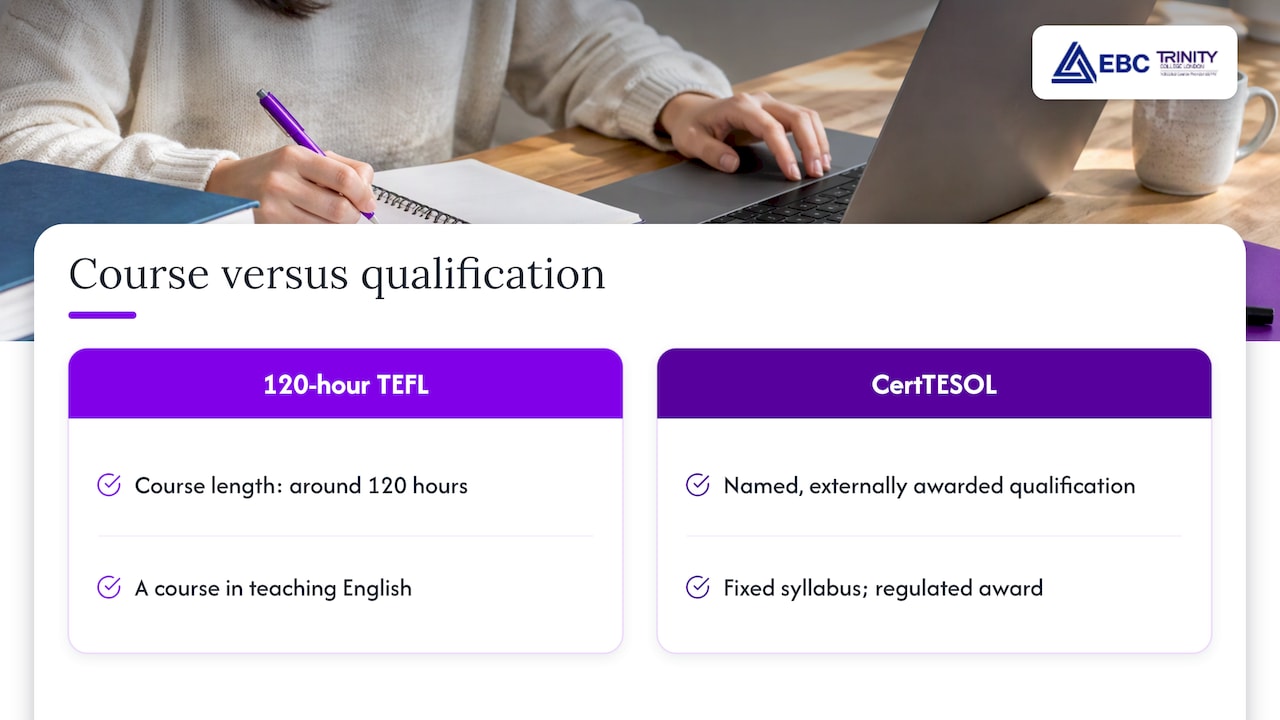
You will see “TEFL certificate” used in two ways. Sometimes it means any course in teaching English, usually around 120 hours. Sometimes it is shorthand for an internationally recognised qualification. The CertTESOL is the second kind: a named, externally awarded qualification with a fixed syllabus. A “120-hour TEFL” is a course length. A CertTESOL is a regulated award. They are not like-for-like labels.
That matters because the job market asks a practical question: what can you do in front of a class? Both routes aim to answer it. They answer it with different amounts of evidence.
Trinity CertTESOL vs 120-hour TEFL at a glance
| Feature | Trinity CertTESOL | Typical 120-hour TEFL |
|---|---|---|
| Awarding body | Trinity College London | Varies by course provider |
| Framework level | Level 5 on the Ofqual RQF | Varies; many courses have no regulated level |
| Total study time | 200 hours (130 guided learning plus 70 independent study) | Approximately 120 hours |
| Observed teaching practice | At least 6 hours with real English learners | Depends on the course and may not be included |
| Guided observation | At least 4 hours of experienced teachers’ classes | Depends on the course and may not be included |
| Assessment | Five units, all must be passed, with external moderation | Set by the provider |
| Visiting external moderation | An external moderator visits the course, interviews all students, and assesses quality | Highly unlikely so no onsite quality checks |
| Training consistency | A standardised syllabus and assessment framework across Trinity-validated centres worldwide | Non-standardised course content, teaching standards and assessment |
The figures in the CertTESOL column come from Trinity’s own pages: its qualification overview and its CertTESOL page. The practical point is that every CertTESOL carries the same minimum standards wherever you take it.
Recognition: what employers and schools see
Trinity states that the CertTESOL is recognised in the UK and internationally, that the British Council accepts it for its accredited UK teaching organisations and its overseas operations, and that it provides credits towards UK university degree programmes. Trinity also says its TESOL qualifications are accepted by most employers worldwide. The British Council also says it only accepts the Trinity CertTESOL and CELTA. Note that point 3. does not say “or equivalent”.
For an American reader, two points follow.
First, a regulated level is easy to explain to employers abroad. Level 5 on the Ofqual Regulated Qualifications Framework is, in Trinity’s words, comparable to the second year of an undergraduate degree. In a country where an employer or immigration office wants to understand what your certificate represents, a named level and awarding body are clear to read.
Second, no certificate stands alone. TESOL International Association states that no single degree, certificate or licence authorises someone to teach English in every country or field. It adds that the usual minimum for private language schools worldwide is a bachelor’s degree plus some type of TESOL certificate, and that the specific job and employer set the requirements. So the sensible plan is a degree where you can, a strong teaching qualification and a clear idea of where you want to work.
That last point is where a recognised qualification helps most. When a hiring manager sees applicants with similar degrees, the one with a regulated qualification and assessed classroom experience gives them more to go on.
Why Americans Should Know About the British Council
The British Council is the UK’s international organisation for education and cultural relations. It promotes English language learning worldwide and operates in more than 100 countries, making it a major player in the international English teaching industry and an important potential employer for teachers wanting to work abroad.
Its qualification requirements matter. According to its published teacher qualification criteria, the British Council recognises two initial teaching qualifications: Trinity CertTESOL and CELTA.
This means that if you choose a generic 120-hour TEFL certificate instead, you won’t meet this qualification requirement for British Council teaching positions. Choosing Trinity CertTESOL keeps that important international employment opportunity open.
Qualification level and what it signals
The level is a quiet but real difference. The Trinity CertTESOL is a Level 5 qualification on the UK’s Regulated Qualifications Framework (RQF), equivalent in academic level to the second year of an undergraduate university course. The Trinity CertPT is Level 6, equivalent to final-year undergraduate study, while the Trinity Diploma TESOL is Level 7, equivalent to postgraduate master’s-level study.
These levels give employers a clear indication of the depth and demands of each qualification, with standards set and regulated by an external body. Together, they provide a progression pathway from initial teacher training through professional development to advanced specialist expertise, opening up opportunities for more senior teaching, teacher training and management roles.
A course with no stated level or external awarding body may be perfectly good. But you leave it with less to show. The CertTESOL gives you something you can describe in one line: Level 5, awarded by Trinity College London, assessed through observed teaching.
Practical teaching experience: where the two routes part ways
The most important question to ask of any course is how much of your time is spent teaching real learners.
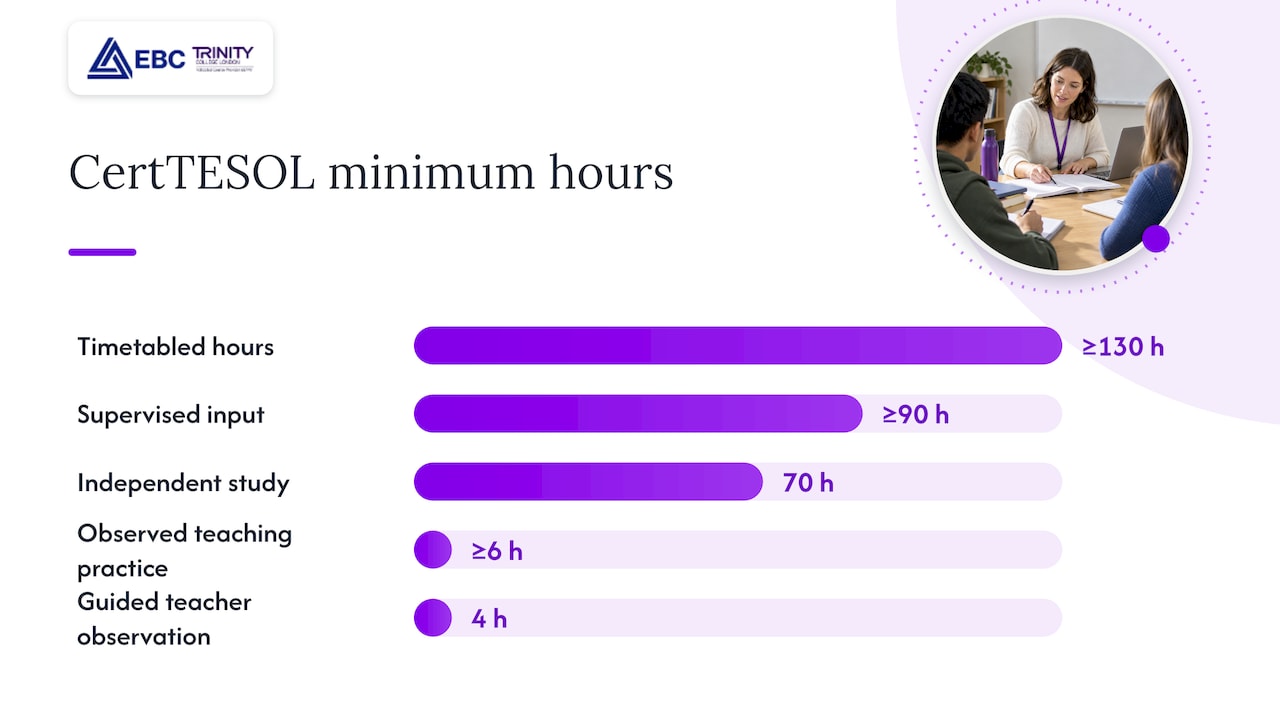
On the CertTESOL, Trinity requires at least six hours of observed and assessed teaching practice with English language learners and four hours of guided observation of experienced teachers. Trinity’s syllabus also sets a minimum of 130 timetabled hours alongside 70 hours of independent study, with at least 90 hours of supervised input. These are minimums, and they are the same for every validated centre.
Why does this matter in practice?
- You learn to plan for real people. A lesson plan that looks tidy on paper changes the moment a learner asks an unexpected question. Teaching real students shows you how to adapt.
- You get used to being watched. Observed teaching means a trainer sees what you actually do, not what you say you would do.
- You gain material for interviews. “I taught adult learners at pre-intermediate level and changed my approach after feedback” is a stronger answer than a description of a module.
Trinity also notes that the CertTESOL cannot be completed by distance learning alone, although some intensive and part-time courses include a pre-course distance component. Trinity is an independent awarding body: it validates courses run by other providers and does not run training itself. That is why the practical element is built into the qualification and cannot be skipped.
A 120-hour course can be a good grounding in lesson planning, classroom management, methods and assessment. The question to put to any course is simple: does it include teaching real learners, watched by a trainer who then gives you feedback? The CertTESOL answers yes by design.
Assessment and trainer feedback
The CertTESOL is assessed across five units, and you must pass all of them. Trinity applies external moderation, and its panel of moderators monitors validated centres so that assessment standards stay consistent across more than 100 providers worldwide.
For you as a trainee, this has three effects.
- A pass means something. Your result is checked beyond your own course, so the qualification travels with you.
- Feedback has a purpose. Each observed lesson leads to specific comments from a trainer about what to keep, change and try next. You then apply the comments in the next lesson. This cycle is how teaching skill builds.
- You become your own critic. Reflecting on your lessons is part of the work. That habit continues once you are employed and is one reason the qualification is valued as a professional one.
On a course where assessment is mainly a written quiz, you can finish with solid knowledge and still feel unsure on your first day. Regular observed lessons and trainer feedback close that gap.
Why the quality of your training matters
It is tempting to treat the certificate as a box to tick. Most people who teach English for a while find that the first term is the hardest. Native-speaker status alone does not make a teacher. Classroom management, clear instructions, error correction and lesson design are skills, and you build them through practice and feedback.
Good training pays back in several ways:
- Confidence in the first week. You walk in with routines you have already tried with real learners.
- Better interviews. You can describe what you taught, what went wrong and how you fixed it.
- More options. Adult, business and exam classes often expect more preparation than a basic course provides. Strong foundations help you move into them.
- A route to progress. A Level 5 qualification leads naturally to specialist study and, later, to Level 7.
The reasoning is plain. A job abroad can involve a visa, a move and a contract. You want to arrive able to teach, not hoping the first month goes well.
Why this qualification helps you find work and build skills
Because employers set their own requirements, think about the qualification as part of a package: degree, certificate, practice and a clear target market.
Getting hired. A named, regulated qualification with assessed practice makes your application easy to understand. It tells an employer you have already taught real classes. That is useful in competitive cities and at schools that receive many applications.
Working in different countries. Our graduates look at roles in Spain, France, Italy, Japan, South Korea, China and beyond. Entry rules differ by country and employer, and TESOL International Association suggests contacting the education department or ministry in the country where you plan to work to learn its academic requirements for teachers. A recognised qualification is the part of your application you control.
Skills you can use immediately. The CertTESOL develops lesson planning, classroom management, language analysis and reflection. These carry across age groups, subjects and settings, including online teaching.
Support after you qualify. EBC is a global company that promotes teacher training and work opportunities around the world, and our free lifetime job placement assistance is there for graduates as they look for roles. Visa requirements depend on the country and on your personal circumstances, and no outcome can be promised, so we guide you through the process and you should always check current rules with the relevant authority.
For a closer look at how the qualification compares on job prospects, see our guide to Trinity CertTESOL vs other TEFL certificates.
What Americans should think about
Americans often ask whether a UK-regulated qualification suits them. A few points help.
It is built for international use. Trinity validates centres worldwide, and the same syllabus applies wherever you study. If you plan to work outside the US, you need a qualification that is understood outside it.
Level and framework terms may be new to you. Think of Level 5 as a stated academic level, comparable to the second year of a degree. It gives you a clear way to describe your training to employers who work with UK and European frameworks.
Non-native speakers may be asked for language evidence. Some programmes or employers ask non-native English speakers for test scores. If that applies to you, check each employer’s requirements early.
Study format is flexible. Trinity says the CertTESOL is offered full-time, part-time, online or blended by validated providers. What stays constant is the observed teaching with real learners, so choose a format that fits your schedule and includes live practice.
Your degree still counts. For many roles, a bachelor’s degree is requested alongside the certificate. If you are still studying, ask us about timing before you commit.
The choice often comes down to your goal. If you want a flexible start and to test your interest in teaching, our EBC Online TEFL Certification Course is 200 hours with trainer support at €500. If you want an internationally recognised professional qualification with assessed live practice, the Trinity CertTESOL is the one we recommend.
How to choose the right course
Work through these questions before you enrol.
- Where do you want to teach? Make a shortlist of countries and look at the entry requirements there. Our guide to requirements for teaching English online is a good start if you plan to teach remotely.
- Is the qualification regulated, and who awards it? Look for a stated level and an independent awarding body.
- How many hours do you teach real learners? Ask for the number and the feedback process.
- Is the assessment moderated externally? Outside checks keep standards consistent.
- What help comes after the course? Job placement support can save you weeks of searching.
- Is the provider reputable? Language educators often discuss the role of certification in language education and how to select a trustworthy training provider, which is worth reading as you weigh your options.
If you want a step-by-step checklist, we have written one on how to choose a Trinity CertTESOL course. For a side-by-side with another well-known qualification, read our CELTA vs Trinity CertTESOL guide.
Costs: what you pay and what you get
Trinity does not run courses itself, so each provider sets its own fee. Trinity also says a moderation fee is charged to every trainee by the training organisation on top of the course fee. Because of this, compare what is included, not only the headline number.
At EBC, the Trinity CertTESOL costs €1,450 as a one-off payment. Our online TEFL course with trainer support costs €500. If you are already teaching and want to specialise, the CertPT courses in Business English, CLIL, CLT and Teaching Online are €999 each.
Think of the cost in terms of what it opens up: a qualification with a stated level, assessed practice and a graduate support service. The better your preparation, the better your chance of a strong first contract and a faster route to more advanced roles.
Beyond the certificate: study and work in Europe
If you want more than a course, we offer one-year programmes in Spain, France and Italy that combine teacher training with language or post-graduate study, plus visa support and the chance to teach or work part-time. They suit people who want a gap year in Europe with a professional outcome.
- Road2Spain Spanish + TEFL: €5,900 to €6,700
- Road2Spain Post-Graduate + TEFL: €5,400
- Road2Italy: €7,700
- Road2France: €8,500
Visa rules are set by each country’s authorities and depend on your circumstances. We support you through the process but cannot guarantee any visa outcome.
Start with a Trinity CertTESOL at EBC
We run teacher training with a global reach, so you can prepare in one place and look for work in many. The Trinity CertTESOL combines Trinity College London accreditation with practical live teaching experience, and our graduates have free lifetime worldwide job placement assistance. If you want to talk through your plans, you can book a free consultation and we will help you choose the format and timing that suit you.

If you are already teaching, our CertPT courses for practising teachers let you add a specialism in Business English, CLIL, CLT or online teaching.
FAQ
Is Trinity CertTESOL better than a 120-hour TEFL?
For professional credibility, yes: it is a Level 5 qualification with at least six hours of assessed teaching with real learners and external moderation. A 120-hour course is a useful entry benchmark, but the content varies by provider. If you want the strongest preparation and the clearest signal to employers, choose the Trinity CertTESOL.
Is a Trinity CertTESOL accepted in the United States and abroad?
Trinity says the CertTESOL is recognised in the UK and internationally and that most employers worldwide accept its TESOL qualifications. Requirements still differ by country and employer, so check the specific job. We can help you match the qualification to your target market.
What is the difference between TEFL and TESOL?
TEFL is mostly used in the UK for teaching English to people who are learning it as a foreign language. TESOL is an umbrella term covering both foreign-language and second-language settings. In the job market the two are often used interchangeably, so look at the course content and awarding body.
Can I take the CertTESOL fully online?
Yes. Trinity CertTESOL courses can now be delivered 100% online, provided the required trainer-led sessions take place in a live, real-time virtual classroom, such as Zoom. This means you can complete the qualification without attending a physical training centre, while still receiving live tutor input, feedback and observed teaching practice.
Online delivery does not mean studying entirely at your own pace: the course retains its structured training, assessment and supervised teaching practice requirements.
Do I need a degree to teach English abroad?
Many employers and some visa systems ask for a bachelor’s degree, and TESOL International Association gives a degree plus a TESOL certificate as the usual minimum for private language schools. Requirements are set by each employer and country. Check them early so your plan fits.
Sources
- Trinity College London: CertTESOL qualification page
- Trinity College London: terminology and recognition (CertTESOL)
- Trinity College London: CertTESOL qualification overview and requirements
- Trinity College London: TESOL qualifications and validated courses
- TESOL International Association: FAQ about starting a career in TESOL
Recommended
- What is the difference between the Trinity CertTESOL and CELTA?
- CELTA vs Trinity CertTESOL: choose the best certification
- How to Choose a Trinity CertTESOL Course: A Checklist – EBC TEFL courses
- Trinity CertTESOL vs other TEFL certificates: which opens more doors? – EBC TEFL courses
This page provides commentary based on information, facts, and experiences available at the time of publication. It does not constitute legal advice, and EBC accepts no liability for decisions made based on the information provided. If you require legal advice, please consult a qualified lawyer.