
Six categories decide how you plan a lesson and how hireable you are: proficiency level, age group, motivation or needs, L1 and background, attendance pattern, and special educational needs. Spotting these early lets you set realistic aims instead of guessing, and it gives you concrete, evidence-based skills to describe to employers. Trinity College London accreditation and structured training routes exist precisely because this kind of practical judgement takes training to build.
TL;DR:
- Differentiating lessons based on proficiency, age, motivation, background, attendance, and needs enhances teaching effectiveness and employability prospects.
- Conducting quick needs analyses and formative checks helps identify learner types and better tailor instruction to their specific linguistic and psychological profiles.
- Using varied teaching strategies—content, process, product, environment—accommodates diverse readiness levels and learning styles within a single classroom.
- Recognizing personality traits and cognitive styles allows for practical adjustments that boost confidence and reduce language anxiety.
- Accreditation and practical experience, especially with diverse and low-literacy groups, significantly improve chances of international employment and successful teaching abroad.
Table of Contents
- What are the main types of language learners in a TEFL classroom?
- How to identify learner types: quick needs analysis and formative checks
- Adapting your teaching: differentiated instruction in practice
- Classroom-ready micro-plans mapped to learner types
- Why recognising learner types helps you get hired abroad
- Cognitive styles: visual, auditory, and kinesthetic learners in the room
- How personality shapes progress: introverts, extroverts, and risk-takers
- Analytic vs global learners, and field-dependent vs independent styles
- Anxiety, motivation, and the emotional side of learning a language
- Build these skills through EBC TEFL’s accredited training
- Sources
What are the main types of language learners in a TEFL classroom?
Every class you walk into is really six overlapping classifications wearing one set of faces. Knowing which category a learner sits in changes what you teach, how fast you move, and what “success” looks like for them.
Proficiency bands run from absolute beginner (no English, sometimes no Latin alphabet) through elementary, intermediate, and advanced. Absolute beginners need explicit sound and letter instruction before anything else; advanced learners need precision, nuance, and exposure to register rather than basic grammar drills, as supported by practitioner guidance, a distinction covered well in guidance on understanding learners and their differing classroom needs.
Age groups split into young learners, teenagers, adults, and seniors, each with different attention spans, motivations, and tolerance for correction. A guide to teaching children versus adults sets out how game-based pacing suits under-elevens while adults respond better to explicit rules and real-world application.
Motivation and needs to determine your material choices: academic learners need exam skills and formal register, business learners need functional workplace language, survival learners need transactional phrases fast, and exam candidates need timed practice against a specific test format.
Other practical factors to weigh into every plan:
- L1 and background: shared first languages let you predict typical errors; mixed-L1 classes need English as the sole shared code, with translanguaging used as a resource rather than banned outright.
- Attendance pattern: full-time intensive learners can handle heavier weekly content; part-time or holiday learners need more recycling and slower cumulative pace.
- Special needs or low literacy: learners with a different home script or interrupted schooling need phonics-first input, multimodal support, and patient repetition before written accuracy is realistic.
How to identify learner types: quick needs analysis and formative checks
You cannot plan honestly for a class you have not profiled. A five-minute needs analysis on day one, repeated briefly in week two, saves weeks of misjudged lessons.
- Ask basic biography questions: age, first language, years of prior English study, and whether that study was formal or informal.
- State the learner’s goal in their own words: “pass an exam”, “get a job”, “talk to my grandchildren” changes everything about your syllabus.
- Check availability: full-time, evenings only, or irregular holiday attendance dictates pacing and how much you can assume they will remember week to week.
- Run one short formative task: a picture description, a short read-aloud, or a simple written prompt reveals proficiency and literacy far faster than a written test.
- Observe confidence, not just accuracy: a learner who speaks fluently with errors needs different handling from one who is accurate but silent.
- Log the results: a simple two-column note of learner profile against weekly target gives you a working record you can review and adjust.
Interpreting the results is straightforward once you have them. A learner who reads fluently but writes slowly probably has good literacy transfer from their L1; one who speaks confidently but cannot read at all needs phonics before comprehension work. Group learners loosely by these findings rather than by age or nationality alone, since two adults from the same country can sit at completely different proficiency points.
Pro Tip: Keep the fortnightly log even when your course feels too short for it to matter. A dated record of a learner’s progress from week one to week six is the single most convincing piece of evidence you can show a placement officer during a job interview.
Adapting your teaching: differentiated instruction in practice
Differentiated instruction breaks into four adjustable pillars: content, process, product, and environment. Adjusting these four is described in ELT research as a practical route to managing diverse readiness levels in one class, and it is widely regarded as the standard approach for linguistically diverse classrooms.
- Content: give the same topic at different complexity. A lesson on “daily routines” might ask a beginner to sequence pictures, an intermediate learner to narrate the routine, and an advanced learner to compare routines across cultures.
- Process: vary how learners get there. Pair a stronger reader with a weaker one for guided reading; let a confident speaker work solo while a nervous one rehearses in a small group first.
- Product: let outcomes differ. One learner writes three sentences, another writes a paragraph, a third records a short spoken summary. All demonstrate the same underlying skill at different depth.
- Environment: rearrange seating, lighting, or noise level. Some learners concentrate better near the front; some multilingual groups work best with translation pairs seated together.
A single objective, three complexity levels: this is the fastest template to build. Take one grammar point, one function, or one topic, then write a low, mid, and high version of the same task before the lesson starts, rather than during it.
Multilingual classrooms benefit from specific, low-effort strategies: bilingual glossaries on the wall, peer translation for instructions, and simplified teacher input delivered slowly with gesture. A ten-principle framework for multilingual pedagogy recommends exactly this kind of flexible, child-centred approach rather than rigid English-only rules.
For low-literacy or other-alphabet learners, prioritise phonics and letter formation for the first several weeks, paired with images and physical gesture rather than text-heavy handouts. Separate explicit language objectives from content objectives to allow these learners access to the same topic without overload.
Classroom-ready micro-plans mapped to learner types
Five short templates cover most of what you will face in a mixed-ability room, and each can be adapted in minutes to the class in front of you.
- Mixed-proficiency pair work: give role cards with staggered language demands, one partner producing three-word answers, the other producing full sentences, on the same topic.
- Exam-strategy micro-lesson: fifteen minutes of strategy explanation, five minutes modelling one answer, then ten minutes of timed practice under real exam conditions.
- Business-communication sequence: teach three functional chunks (requesting, confirming, declining), then run a short role-play using only those chunks in a realistic scenario.
- Part-time learner sequence: build one lesson around three recycled elements from the previous session so learners with gaps in attendance can still follow the thread.
- Young-learner and senior-learner templates: use physical movement and songs for young learners; use slower-paced, discussion-led tasks with real-life topics for seniors, who often prefer talking to drilling.
Each template works precisely because it is built around a learner category rather than a generic topic, which is what makes it worth describing in a job interview.
Why recognising learner types helps you get hired abroad
Employers screening TEFL applicants look for evidence of adaptability more than they look for enthusiasm about teaching in general. Being able to say “I ran a needs analysis, built three differentiated versions of the same lesson, and logged measurable progress fortnightly” carries far more weight than a vague claim to love teaching.
- Mention specific terms in your CV: needs analysis, differentiated materials, multilingual classroom experience, measurable learner outcomes.
- Describe one real example: a mixed-proficiency class you adapted, and what changed in the materials.
- Highlight low-literacy or multilingual experience specifically. It widens the range of postings you are considered for, since many schools worldwide serve exactly these populations.
- Lean on accreditation as a trust signal. Trinity College London backing tells a school your training met an external, external-audited standard, not just a self-certified one.
No course or article can promise you a visa or a guaranteed job; immigration rules vary by country and change often. What travels well everywhere is the transferable skill of reading a class accurately and adjusting fast.
Cognitive styles: visual, auditory, and kinesthetic learners in the room
Every group you teach contains a mix of learners who absorb English differently depending on how information reaches them. Visual learners fix new vocabulary faster when it is paired with images, colour coding, or written text on the board rather than spoken alone. Auditory learners often pick up pronunciation and rhythm quickly from listening but lose track when asked to read dense text cold. Kinesthetic learners need to move, gesture, or physically manipulate objects, cards, or realia before language sticks.
None of these preferences appear in isolation, and no learner fits one label all day. A learner who thrives on listening tasks in the morning might need a diagram by the afternoon once fatigue sets in. The practical response is not to sort learners into three permanent boxes, but to build each lesson with at least one visual element, one listening element, and one physical or manipulative element, so every learner gets a route into the material that suits them at that moment.

This matters more in beginner and young-learner classes, where language alone cannot carry meaning yet. A picture, a gesture, and a spoken model together do far more work than any one of them alone. In advanced classes, the same principle shifts toward variety in task type: a debate for the auditory-leaning learner, a mind map for the visual one, a role-play for the kinesthetic one, all built around the same target language.
How personality shapes progress: introverts, extroverts, and risk-takers
An extroverted learner will often speak first, guess at unfamiliar words, and recover quickly from mistakes in front of the group. An introverted learner may know just as much English but needs rehearsal time, a smaller audience, or a written option before they will produce language out loud. Mistaking silence for low proficiency is one of the most common misjudgements new teachers make.
Risk-taking is a separate trait from extroversion, and it matters just as much. Some quiet learners take huge risks with vocabulary and grammar they have not fully mastered; some confident, talkative learners stick rigidly to language they already know and rarely stretch themselves. Both patterns need a different nudge: risk-takers benefit from gentle accuracy feedback, while cautious learners benefit from low-stakes tasks that reward attempting new structures rather than penalising errors.
Practical adjustments cost you nothing in planning time. Give introverts a minute of silent think-time or paired rehearsal before whole-class speaking. Give cautious learners a task where “getting it wrong” carries no visible penalty, such as a written first draft nobody else sees before a spoken version. Seat a strong risk-taker next to a cautious learner occasionally. The confidence tends to transfer more than the errors do.
Analytic vs global learners, and field-dependent vs independent styles
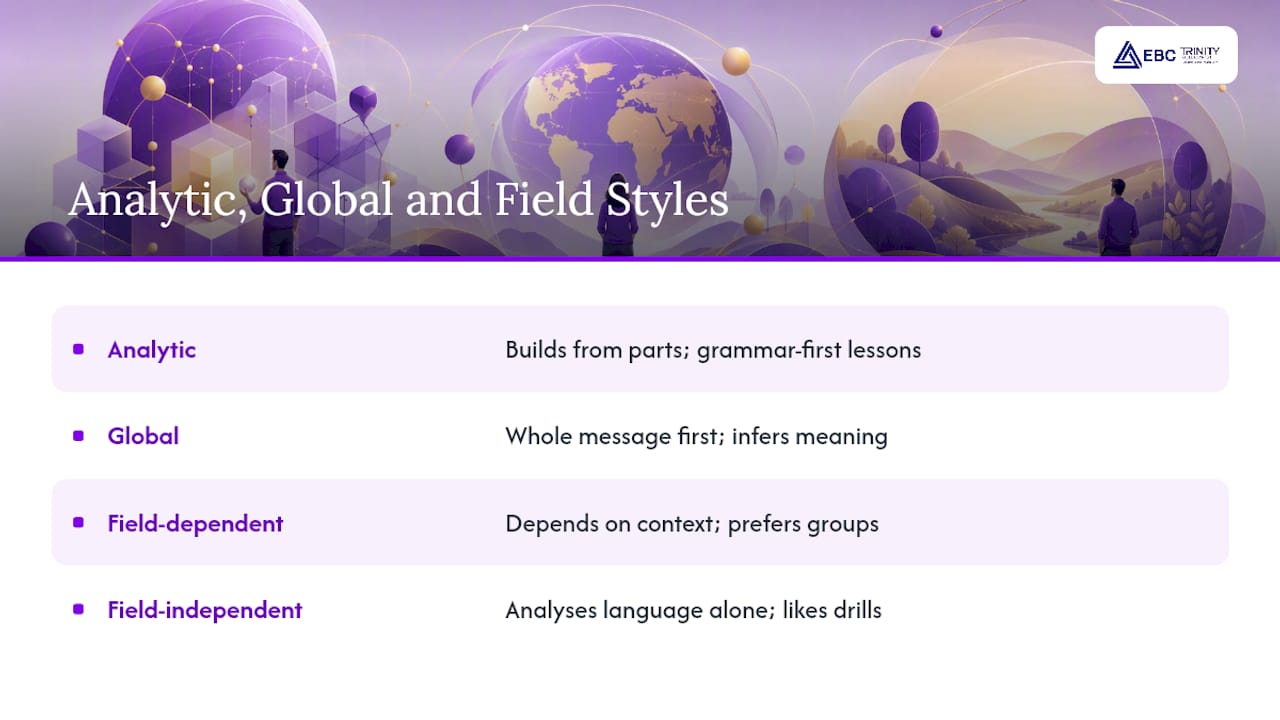
Analytic learners prefer to build language from parts: grammar rules first, then vocabulary, then assembling sentences piece by piece. Global learners prefer the opposite route: hear or read the whole message first, guess the meaning from context, then worry about the mechanics afterwards. A grammar-translation heavy lesson suits the analytic learner and frustrates the global one, and the reverse is just as true for a purely communicative, meaning-first task.
Field-dependent learners rely heavily on context, tone, and the people around them to interpret meaning; they often do well in group tasks and struggle when language is presented in isolation, stripped of any situation. Field-independent learners are comfortable analysing language on its own terms, without needing a rich surrounding context, and often do well with isolated grammar exercises that field-dependent learners find dry and confusing.
Neither style is better than the other, and most learners sit somewhere between the two poles rather than at an extreme. The practical move is the same one that works for cognitive styles: build variety into every lesson rather than choosing one approach and applying it uniformly. Offer a rule explanation for the analytic learners, then a whole-text example for the global learners, then a group discussion that gives the field-dependent learners the context they need to make sense of both.
Anxiety, motivation, and the emotional side of learning a language
Language anxiety is one of the strongest predictors of whether a learner speaks up in class, independent of how much English they actually know. A learner frozen by fear of making a mistake in front of peers will often underperform badly on a speaking task despite scoring well on a written one covering the same material. Lowering the stakes, using pair work before whole-class output, and responding to errors without visible correction in front of the group all reduce this effect measurably in practice.
Motivation splits broadly into two types that behave differently in the classroom. Learners driven by genuine interest in the language or culture, sometimes called intrinsic motivation, tend to persist through difficulty and plateaus better than learners driven purely by external pressure, such as a required exam or a work requirement. Both types can succeed, but they need different encouragement: intrinsically motivated learners benefit from autonomy and choice in tasks, while extrinsically motivated learners benefit from clear, visible progress markers tied to their actual goal.
Confidence and motivation feed each other in both directions. A small early success, even something as modest as one correctly ordered sentence read aloud without hesitation, can shift a nervous learner’s willingness to try again far more than another explanation of the grammar rule ever will.
Build these skills through EBC TEFL’s accredited training
Recognising these learner categories on paper is one thing. Applying them under real classroom pressure, with a mentor watching and correcting your approach, is what actually prepares you for a paid teaching post. That is the gap EBC TEFL’s certification is built to close, through Trinity College London accredited training that puts you in front of real learners well before you finish the course.

The Trinity CertTESOL pathway pairs classroom theory with hands-on practice teaching, so you leave with genuine experience differentiating lessons for mixed-proficiency, multilingual, and low-literacy groups, not just a certificate describing the theory. Graduates receive worldwide job-placement support, and one-year study and work abroad programmes combine that training with structured language study and part-time teaching opportunities. Visa processes vary by country and are never guaranteed, but the accreditation and the practical skillset travel with you regardless of where you end up teaching. If you want to see how the course structure maps onto the learner types covered here, book a free consultation through EBC TEFL’s course listings and talk through which pathway fits your plans.
Sources
- Understanding learners (British Council / TeachingEnglish)
- Differentiated instruction: integrating content, process, product and learning environment in ELT
- The knowledge base of teaching in linguistically diverse contexts: principles of multilingual classroom pedagogy
- Differentiated instruction in linguistically diverse classrooms (expert perspective)