
Teaching methodologies split into two broad families: teacher-centred and student-centred. Within those families sit the approaches you’ll actually use in a classroom: direct instruction, project-based learning, inquiry and problem-based learning, cooperative and collaborative learning, flipped and blended technology-enhanced models, experiential and kinaesthetic learning, and specialised approaches such as Montessori. This guide breaks each one down with practical examples, tells you when to reach for it, and shows how to choose between them.
Key Points
- Direct instruction is most effective for quick, factual content delivery but risks passive engagement and limited pacing options for learners.
- Project-based learning requires clear phases and assessments to ensure students produce tangible outputs that reflect their skills and understanding.
- Inquiry and problem-based approaches build reasoning and transferable skills, especially suited for science and social studies, but depend on prior foundational teaching.
- The success of methodologies depends heavily on cultural norms, resource availability, and class size, which may necessitate adjustments for optimal fit.
- Employing a range of methods, supported by proper assessment techniques, enhances teaching flexibility and improves employability in diverse international settings.
Table of Contents
- Types of teaching methodologies: definitions, evidence and classroom examples
- How to choose and adapt a methodology for your class
- Lesson snapshots you can adapt today
- Why methodological range strengthens your employability
- Where these methodologies actually came from
- Weighing up the strengths and limits of each approach
- How culture and context shape which method actually works
- Assessment and feedback look different in every methodology
- Turn methodology knowledge into a teaching career abroad
- Sources
Types of teaching methodologies: definitions, evidence and classroom examples
Before comparing individual methods, it helps to separate three terms that get used interchangeably but mean different things. A strategy is your overall philosophy of teaching. A method is the systematic plan you build from that philosophy, shaped by your subject, your materials and the students in front of you. A technique is the specific tool you deploy inside a method, such as a think-pair-share or an exit ticket. Research on instructional design treats methods as adaptable blueprints built from techniques, not fixed recipes, which is exactly why the best teachers mix and match rather than picking one approach for life.
Methodologies also split into two broader families. Teacher-centred approaches put the instructor at the front, controlling pace and content. Student-centred approaches shift ownership of learning onto the class, with the teacher facilitating rather than directing. Effective teaching usually blends both according to the learning objectives and the learners in the room.
Direct instruction (lecture and explicit teaching)
A teacher-centred method where you explain a concept clearly, model it, then check understanding before moving on. It suits introducing new vocabulary, grammar rules or factual content where learners have little prior knowledge. Segmenting lectures into 12 to 20 minute blocks with a quick concept check keeps attention from drifting, a practice confirmed by instructional design guidance. Try this: explain the past simple tense for eight minutes, then ask students to correct five deliberately wrong sentences on the board before you continue.
Project-based learning (PBL)
Students work over days or weeks towards a tangible product, such as a class magazine or a short documentary. It works well once learners have foundational skills and can apply them independently. PBL needs explicit phases, launch, enquiry, product development and public presentation, plus a rubric that grades both the process and the final output, otherwise assessment drifts away from what students actually did. A language class might spend two weeks producing a “guide to our town” booklet for new arrivals, researching, drafting and presenting it aloud.
Inquiry-based and problem-based learning
Here, students investigate a question or solve a real problem with the teacher guiding rather than lecturing. It suits science, social studies and any subject where reasoning matters more than memorising. A useful evidence note: active and enquiry-driven approaches recur across 15 years of research as consistently effective at building transferable skills. Example: give a group a case study of a fictional town’s water shortage and ask them to propose a solution using vocabulary from the unit.
Cooperative and collaborative learning
Small groups work towards a shared goal, with individual accountability built in. It fits almost any subject and age group, provided roles are clearly assigned. Cooperative learning appears repeatedly among the most consistently used global methodologies. A jigsaw activity, where each student researches one part of a topic and then teaches it to their group, is a reliable starting point.
Flipped classroom and blended/technology-enhanced learning
Students engage with input material, a video, a reading, a podcast, before class, then use class time for practice and discussion. Blended learning surged in prominence between 2020 and 2023, and the lesson from that period is clear: don’t just transfer a lecture online, redesign the activity around active participation. A flipped grammar lesson might have students watch a five-minute explainer at home, then spend the full lesson producing and correcting sentences together.
Experiential and kinaesthetic learning
Learning through doing, role play, simulations, movement, physical tasks, suits younger learners and skills-based subjects particularly well. A simple version: act out a restaurant ordering scenario physically rather than just reading the dialogue from a textbook.
Montessori and child-centred approaches
Common in early years settings, these let children choose activities within a structured environment, with the adult observing and guiding rather than instructing directly.
Differentiated instruction and scaffolding
Rather than one worksheet for the whole class, tasks are tiered by difficulty, with frequent low-stakes checks informing who needs more support. This only works with regular, light-touch assessment feeding grouping decisions in real time.
Retrieval practice and formative feedback
These aren’t standalone methods so much as techniques that boost almost any method above. Low-stakes quizzing and quick feedback loops are consistently cited as high-impact additions to whatever approach you’re already running, including peer instruction, where concept tests paired with peer discussion sharpen understanding inside a lecture.
How to choose and adapt a methodology for your class
Picking a method isn’t guesswork if you work through it in order.
- Define the outcome. What should students know or be able to do by the end? Write it as a verb: explain, produce, analyse, negotiate.
- Assess the cognitive demand. Use Bloom’s taxonomy as a rough guide. Recall and understanding often suit direct instruction; analysis, evaluation and creation lean towards project-based or inquiry-based work.
- Check prior knowledge. A class with no foundation in a topic needs more direct teaching before it can handle open-ended enquiry.
- Pick your method, or combination. Most real lessons blend two, a short explicit-teaching opening followed by cooperative practice, for instance.
- Plan techniques and assessment together. Decide how you’ll check learning as you go, not just at the end.
Practical checks matter as much as theory. Class size affects whether group work is manageable. Time available limits how ambitious a project can be. Resources, access to devices, printing, space, shape what’s realistic. Inclusion needs mean some learners will need scaffolded tasks or extra processing time regardless of the method chosen.
Pro Tip: Avoid cognitive overload by chunking new material into short segments with a quick concept check between each one, then scaffold the next step only once most of the class has shown they’ve grasped the last. This single habit prevents more lessons from collapsing than any single methodology choice.
Lesson snapshots you can adapt today
- Primary literacy: Objective, sequence a story correctly. Method, cooperative learning. Activity, groups reorder scrambled story cards, then retell the story aloud. Assessment, teacher observation plus a simple oral recount.
- Secondary STEM: Objective, explain photosynthesis. Method, inquiry-based. Activity, students design a mini experiment testing light exposure on plant growth. Assessment, a written hypothesis-and-conclusion report.
- Language teaching (multilingual group): Objective, order food in English. Method, experiential/kinaesthetic. Activity, a physical role-play restaurant with real menus. Assessment, peer checklist plus teacher spot-checks. For larger or mixed-level groups, pair stronger and weaker speakers and keep groups small enough that everyone gets speaking time.
- University seminar: Objective, critique a theory. Method, problem-based learning. Activity, small groups debate a case study, then present a joint position. Assessment, a graded argument rubric covering evidence and reasoning.
Why methodological range strengthens your employability
Employers hiring English teachers look for exactly this kind of range: proof you can select and adapt methods to fit different learners, not just deliver one style of lesson on repeat. A CV that shows observed teaching practice, a completed practicum and recognised accreditation carries far more weight than a certificate alone, because it demonstrates you’ve actually applied these methods under supervision. Specialised training in areas like CLT or CLIL adds further credibility for international roles. EBC TEFL Course builds this kind of evidence into its programmes through Trinity College London accreditation and hands-on practicum hours, which employers can check against a recognised standard rather than take on trust.
Where these methodologies actually came from
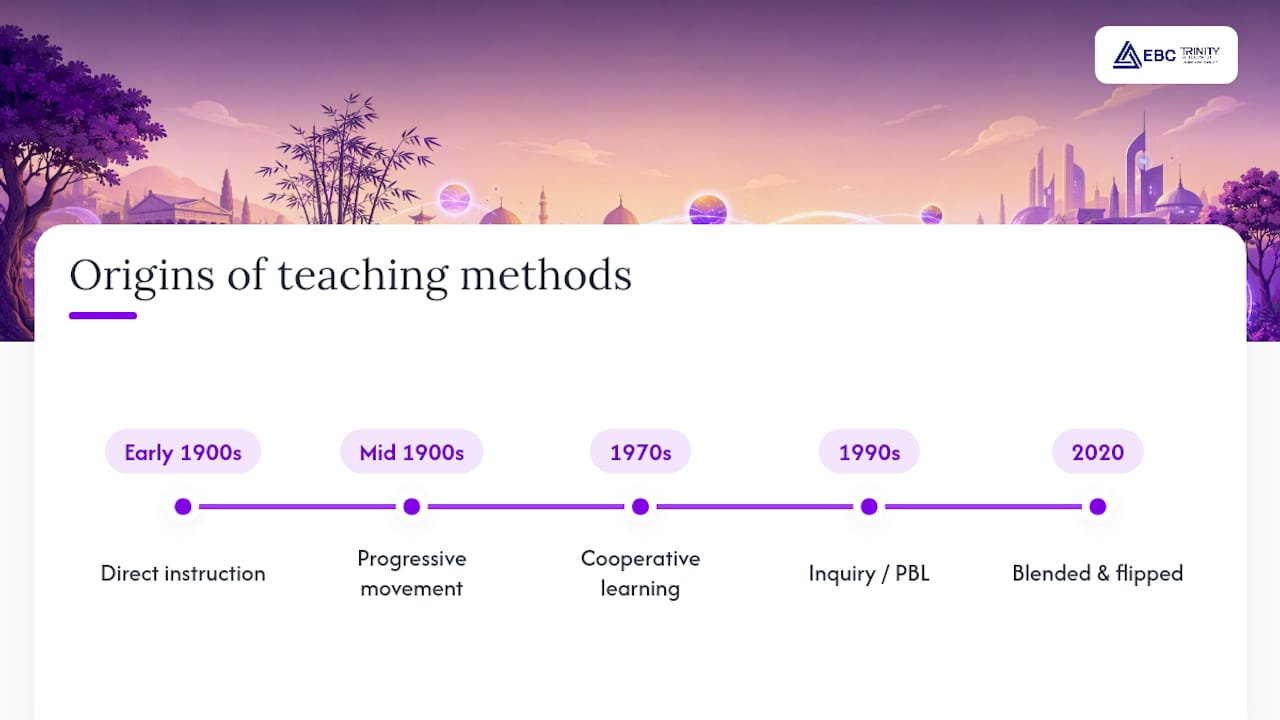
Formal teaching methodology has shifted dramatically over the past century. Early twentieth-century classrooms leaned almost entirely on direct instruction, rote learning and teacher authority, a model shaped by industrial-era assumptions about efficiency and uniform outcomes. The mid-century progressive education movement, drawing on theorists such as Dewey and later Piaget, pushed back with child-centred and experiential ideas, arguing that learners construct understanding through activity rather than absorbing it passively.
Cooperative learning gained academic traction from the 1970s onwards as researchers found structured group work produced stronger retention than solitary study for many tasks. Inquiry and problem-based learning followed a similar trajectory, moving from medical education into mainstream schooling by the 1990s. The most recent shift is technological rather than philosophical: blended and flipped models, largely theoretical before 2020, became mainstream practice almost overnight when classrooms worldwide had to move online, and the best evidence from that period shows active learning principles, not just digitised lectures, drove the results that stuck. None of these shifts replaced what came before entirely; they layered on top, which is why a modern classroom can reasonably use direct instruction, group work and digital tools inside the same hour.
Weighing up the strengths and limits of each approach
No single method wins across every context, which is precisely why the classification matters more than any individual favourite.
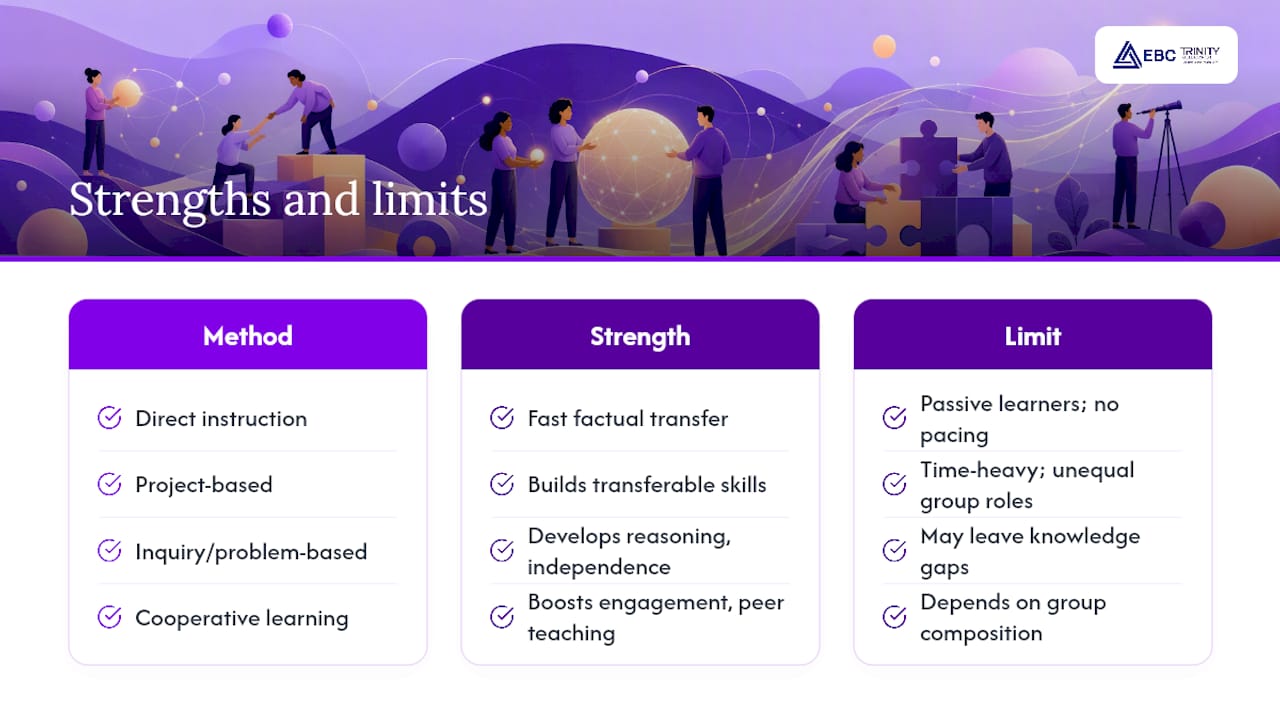
Direct instruction is efficient for transferring large amounts of factual content quickly, but it risks passive learners and offers little room for individual pacing. Project-based learning builds durable, transferable skills and genuine motivation, yet it demands significant planning time and can let weaker students hide behind stronger group members if roles aren’t assigned carefully. Inquiry and problem-based learning develop reasoning and independence, though they can leave learners with knowledge gaps if prior teaching hasn’t laid sufficient groundwork.
Cooperative learning boosts engagement and peer teaching, but it depends heavily on group composition and clear accountability structures to stop free-riding. Flipped and blended models free up class time for practice, yet they assume reliable access to devices and a level of learner self-discipline that not every group has. Experiential and kinaesthetic learning suits younger or lower-level learners brilliantly, but it scales poorly in very large classes with limited physical space. Montessori-style approaches respect individual pace exceptionally well, though they need low student-to-teacher ratios to function properly, a genuine constraint in many state-funded settings worldwide.
How culture and context shape which method actually works
A method that thrives in one setting can fall flat in another, and that has nothing to do with the method’s quality. Classrooms shaped by strong teacher-authority traditions may see open-ended inquiry work resisted at first, not because students can’t handle it, but because it contradicts what “good learning” is supposed to look like to them. Group-work methods that assume equal participation can clash with cultural norms around hierarchy, gender or age, particularly in mixed international classes.
Resource context matters just as much as culture. A flipped classroom model depends on device access outside school hours, which cannot be assumed in every setting worldwide. Large class sizes, common in many countries, make small-group cooperative work harder to manage without strong routines already in place. None of this means avoiding student-centred methods outside the contexts where they were developed; it means introducing them gradually, explaining the “why” explicitly, and adjusting group sizes and task structures to fit the room you’re actually teaching in rather than the room the method was designed for.
Assessment and feedback look different in every methodology
Direct instruction typically pairs with frequent, short formative checks, quizzes, cold-calling, quick written responses, that verify recall before moving to the next chunk. Project-based and inquiry-based learning need rubrics that assess both the final product and the process behind it, since a strong presentation can mask weak individual understanding if the rubric only looks at output.
Cooperative learning requires a dual approach: a group grade for the shared task plus an individual accountability measure, otherwise it’s impossible to tell who actually learned what. Flipped and blended models often use pre-class quizzes to confirm learners engaged with the input material, then in-class observation to assess how they apply it. Differentiated instruction leans hardest on this principle: regular, low-stakes assessment isn’t optional, it’s the mechanism that decides which tier of task a student receives next, which is why the framework only works when feedback loops stay tight and frequent rather than saved for a termly test.
Turn methodology knowledge into a teaching career abroad
Knowing these methods matters, but showing you can apply them is what actually gets you hired. That’s the gap EBC TEFL Course is built to close. Trinity College London accreditation gives employers a recognised standard to check against, and the hands-on teaching practicum means you leave with observed classroom hours in methods like cooperative learning and direct instruction, not just theory on paper.

For readers drawn to specific classroom approaches, CLIL and CLT pathways let you specialise further, useful if you want to stand out in international markets that value subject-specific language teaching. There are also one-year study and work programmes in Spain, France and Italy, combining accredited training with language study, postgraduate study options and support navigating visa applications, alongside opportunities to teach or work part-time. Some providers offer lifetime job placement support to assist graduates in finding teaching work as their careers develop, wherever in the world they decide to teach. If you’re weighing up certification against a bundled study and work year abroad, the certification programme overview is the clearest place to compare your options and start an application.
Sources
- Teaching Methods – Office of Curriculum, Assessment and Teaching Transformation – University at Buffalo
- Teaching methods, learning and development: a 15‑year research perspective (MDPI, 2023)
- A framework for examining instructional strategies, methods and techniques (SAGE, 2023)
Recommended
- Top teaching methods for TEFL success in 2026
- Best practices for new TEFL teachers: 2026 guide
- Essential skills every TEFL teacher needs to succeed
- Teaching Practice: Everything You Need to Know
This page provides commentary based on information, facts, and experiences available at the time of publication. It does not constitute legal advice, and EBC accepts no liability for decisions made based on the information provided. If you require legal advice, please consult a qualified lawyer.