
TESOL, TEFL, and TESL are three terms that confuse almost everyone entering the world of English language teaching. Many people use them interchangeably, yet each carries a distinct meaning that shapes your career options, the jobs you qualify for, and the training you need. TESOL stands for Teaching English to Speakers of Other Languages, making it the broadest of the three terms. Whether you want to teach in a European classroom, work online with international students, or build a long-term career across multiple countries, understanding TESOL is the essential first step. This guide covers the definition, the certification pathways, the teaching methods, and the global career opportunities that come with it.
Table of Contents
Key Takeaways
| Point | Details |
|---|---|
| TESOL is an umbrella term | TESOL covers teaching English to non-native speakers in a wide range of educational contexts. |
| Accreditation is essential | Only TESOL certificates with at least 120 hours and practical teaching experience are widely recognised. |
| Multiple career paths | TESOL unlocks diverse international teaching opportunities, including online and in-person roles. |
| Modern methods matter | Current TESOL teaching demands communicative, tech-savvy approaches alongside traditional grammar methods. |
What TESOL means in education
With confusion around the terminology clarified, let’s take a closer look at what exactly TESOL represents in education.
TESOL is an umbrella term that includes teaching English to non-native speakers in various countries and contexts. It sits above both TEFL and TESL, meaning that a TESOL-qualified teacher is prepared for a wider range of environments than someone trained in only one specialism. This breadth is precisely why employers and institutions worldwide recognise TESOL as a strong baseline qualification.
“TESOL encompasses the full spectrum of English language teaching, from primary schools in Spain to adult education centres in the United States, making it one of the most versatile qualifications in modern education.”
To understand the distinctions clearly, it helps to look at all three terms side by side. Our TEFL vs TESOL guide breaks this down in detail, but here is a practical summary:
| Term | Full name | Primary context |
|---|---|---|
| TESOL | Teaching English to Speakers of Other Languages | Global umbrella term |
| TEFL | Teaching English as a Foreign Language | Non-English-speaking countries |
| TESL | Teaching English as a Second Language | English-speaking countries |
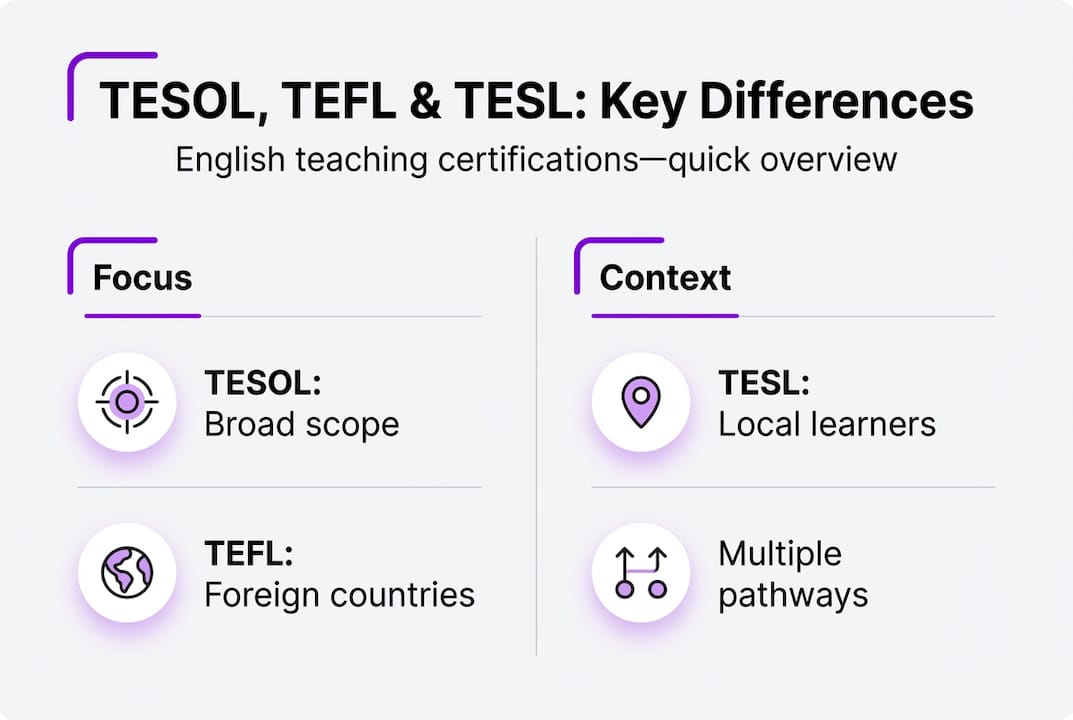
In practice, TEFL applies when you teach English in a country where English is not the official language, such as France, Japan, or Brazil. TESL applies when you support non-native speakers living in an English-speaking country, such as the UK or Australia. TESOL covers both scenarios, which is why the TESOL and TEFL meaning often overlaps in job advertisements.
TESOL operates across a broad range of educational settings. Key environments include:
State schools and secondary education systems
Universities and higher education institutions
Private language centres and academies
Adult education and community learning programmes
Corporate and business English training
Online teaching platforms and virtual classrooms
For a deeper look at how TESOL, TEFL and CELTA differences affect your career choices, it is worth exploring each qualification’s specific requirements before you commit to a training path.
How TESOL certification works
Now that you understand what TESOL encompasses, it’s important to know how certification opens doors in the teaching profession.

Not all TESOL certificates carry equal weight. A 120-hour minimum is the standard recognised by serious employers, with 100-hour certificates generally considered insufficient for professional teaching roles. The structure of a credible TESOL programme typically includes language analysis, lesson planning, observed teaching practice, and reflective feedback from qualified trainers.
| Certificate level | Hours | Key components |
|---|---|---|
| Foundation certificate | 120 hours | Theory, lesson planning, 6 observed teaching hours |
| Advanced certificate | 150+ hours | Specialised skills, extended practicum |
| Diploma level | 300+ hours | Research, advanced methodology, mentored teaching |
Here are the steps to getting started with TESOL certification:
Research accredited providers and confirm they meet the 120-hour minimum standard.
Choose between an in-person, online, or blended format based on your schedule and learning style.
Complete the theoretical modules covering linguistics, grammar, and lesson design.
Carry out observed teaching practice with real learners and receive structured feedback.
Submit your assessed assignments and receive your internationally recognised certificate.
One question that comes up repeatedly is whether an online TESOL certificate is as valid as an in-person one. Online and in-person certificates are equivalent when the programme is properly accredited and includes a supervised teaching practicum. The delivery format matters far less than the quality of the accreditation body behind it.
You can also get certified for online and face-to-face teaching through specialist pathways, which is increasingly valuable as the demand for hybrid and digital English teaching grows. For a full breakdown of formats, the online vs onsite TESOL certification comparison is a useful resource.
Pro Tip: Always verify that your chosen TESOL programme is accredited by a recognised body such as Trinity College London. Accreditation is the single most important factor in whether your certificate is accepted by schools and employers globally.
Modern teaching methods in TESOL
Once you’ve chosen a path for certification, understanding teaching methods used in TESOL will boost your effectiveness in the classroom.
The contrast between old and new approaches in TESOL is striking. Traditional Grammar-Translation methods focused heavily on written exercises, translation tasks, and memorisation of grammatical rules. While this approach has its place, modern TESOL has largely shifted towards Communicative Language Teaching, or CLT, which prioritises real-world interaction, speaking practice, and meaningful communication over rote learning.
CLT encourages students to use English in authentic situations from the very first lesson. Role plays, group discussions, problem-solving tasks, and project-based activities all form part of a communicative classroom. The result is faster fluency development and greater learner confidence, which is what most students and employers actually want.
Technology has also transformed TESOL practice. Blended learning models combine face-to-face instruction with digital tools such as interactive platforms, video conferencing, and adaptive learning software. Teachers who are comfortable with both environments are significantly more employable in 2026.
Essential skills for modern TESOL teachers include:
Strong classroom management and learner engagement techniques
Ability to adapt lessons for mixed-ability groups
Confidence with digital teaching tools and online platforms
Understanding of assessment and feedback methods
Cultural sensitivity and awareness in multilingual classrooms
Reflective practice and ongoing professional development
A quality TESOL course does not just teach you theory. It places you in real classrooms, gives you feedback on your performance, and helps you build the practical confidence that textbooks alone cannot provide. If you want to teach in an online environment specifically, an accredited online TESOL course will give you the targeted skills to succeed in that setting.
Pro Tip: Prioritise teaching practice hours over the number of theory modules when evaluating a TESOL course. Employers consistently report that practical classroom experience is what separates strong candidates from average ones.
Career pathways with TESOL in education
With a modern skill set from TESOL, the next step is understanding where your qualification can take you around the world.
TESOL opens doors to teaching positions in both English-speaking and non-English-speaking countries, making it one of the most geographically flexible qualifications available. The global demand for qualified English teachers remains strong, particularly in Europe, Asia, and Latin America.
Here are the steps to launching a global TESOL career:
Complete an accredited TESOL certification with a minimum of 120 hours and observed teaching practice.
Build a professional CV that highlights your qualification, teaching hours, and any specialist skills.
Research your target country’s specific visa and work permit requirements.
Apply to language schools, state education systems, or online teaching platforms.
Consider a structured study and work abroad programme, such as EBC’s one-year programmes in Spain, France, and Italy, which combine teaching, language study, and cultural immersion.
For those interested in Europe specifically, EBC’s one-year programmes offer a particularly well-supported route. You receive accredited teacher training, visa assistance, language study, and part-time work opportunities all within a single structured programme. It is an efficient way to build experience and income simultaneously.
Advantages of TESOL for non-native English speakers include:
Globally recognised qualification that demonstrates professional competence
Access to jobs in both native and non-native English-speaking countries
Increased credibility with employers who value accredited training over native-speaker status
Opportunities to teach in your own country or region using internationally recognised methods
For more on this topic, our articles on non-natives teaching English and non-native English teacher success show clearly that accreditation and skill matter far more than passport nationality in today’s job market.
A fresh perspective on building a TESOL teaching career
Having seen the opportunities, it’s valuable to step back and learn from those with years in the field.
One pattern we see repeatedly is that aspiring teachers underestimate how much rigorous, accredited training matters in practice. Many assume that a short online course is sufficient to compete for quality positions. It rarely is. Schools in Spain, Italy, France, and beyond are increasingly specific about the qualifications they accept, and a 60-hour certificate simply does not meet that bar.
The other common mistake is over-focusing on theory at the expense of real classroom experience. Understanding what TEFL and TESOL really mean is a starting point, not a finishing line. The teachers who build lasting international careers are those who treat their qualification as the beginning of a learning journey, not the end of one. Adaptability, cultural curiosity, and a willingness to keep developing are what employers notice after the certificate.
Pro Tip: When evaluating TESOL programmes, ask specifically how many observed teaching hours are included and who supervises them. Programmes with experienced, qualified supervisors produce far stronger graduates than those where observation is minimal or self-directed.
Get started with accredited TESOL pathways
If you’re ready to act, there are reputable, supported certification paths waiting.
EBC TEFL offers Trinity College London accredited TESOL and TEFL programmes designed for people who want to teach globally, not just locally. Whether you are looking for international TESOL certification or want to follow a clear set of TESOL certification steps, EBC provides structured guidance at every stage.
Our one-year study and work abroad programmes in Spain, France, and Italy combine accredited training with real teaching experience, visa support, and lifetime job placement assistance. You gain a qualification and a career foundation at the same time. Ready to find out which pathway suits you best? Speak with an EBC advisor for a free consultation tailored to your goals.
Frequently asked questions
What is the minimum TESOL certification required for teaching jobs?
A 120-hour TESOL certification with observed teaching practice is the minimum standard accepted by most reputable schools worldwide. Shorter courses are generally not sufficient for professional teaching roles.
Are online TESOL certificates accepted for teaching in Europe?
Yes, provided the course is properly accredited and includes a teaching practicum. Accredited online certificates are widely recognised across European schools and language institutes.
Can non-native English speakers earn a TESOL certificate and teach abroad?
Absolutely. TESOL opens teaching positions in countries worldwide for non-native speakers, particularly when they hold an accredited qualification and demonstrate strong English proficiency.
What is the difference between TESOL, TEFL, and TESL?
TESOL is the umbrella term covering both TEFL, which applies in non-English-speaking countries, and TESL, which applies in English-speaking countries. Each has specific contexts but TESOL qualifications are recognised across all of them.