
Key Points
- Virtual English teaching is a professional career involving structured lessons, learner needs assessment, and digital skills.
- Certification like TEFL or Trinity CertTESOL enhances credibility, earning potential, and job opportunities.
- Success requires adaptability, strong technical setup, engagement techniques, and continuous reflection.
Teaching English online is not simply chatting with strangers over a video call. It is a structured, professional career that draws on the same principles as classroom teaching, combined with digital literacy, cultural sensitivity, and a genuine commitment to learner outcomes. The demand for qualified virtual English teachers is growing rapidly across every continent, and the opportunities available today go far beyond what most people imagine. Whether you are considering your first steps into teaching or looking to formalise your practice, this guide covers everything you need to know to enter this field with confidence and clarity.
Table of Contents
- Understanding virtual English teaching
- Platforms and career paths in virtual English teaching
- Skills and technology for effective virtual teaching
- Classroom management and engagement techniques
- Getting qualified: training and certification for virtual English teaching
- What most guides miss about virtual English teaching
- Take the first step: become a certified virtual English teacher
- Frequently asked questions
Key Takeaways
| Point | Details |
|---|---|
| Virtual teaching is a professional career | Teaching English virtually requires planning, credentials, and engagement skills, not just a webcam and internet connection. |
| Accreditation expands opportunities | Proper training and certification boost your earning potential and access to top teaching jobs online. |
| Flexible options and strong demand | Teachers can work for platforms or freelance, with high global demand driving new opportunities in 2026. |
| Engagement and adaptability matter most | Effective online teachers stand out by managing class dynamics, overcoming tech challenges, and building rapport with diverse students. |
Understanding virtual English teaching
Virtual English teaching means delivering structured, planned English language instruction through digital platforms. It is not tutoring in the casual sense. It involves lesson planning, needs analysis, feedback cycles, and professional conduct, all carried out via video conferencing tools, shared digital whiteboards, and interactive applications.
As a virtual English teacher, your role depends on the context. You might teach young learners in Asia through a platform that connects students with native-speaking tutors. You might work with adult business professionals across Europe who need to improve their presentation English. You might run group conversation classes or provide one-to-one intensive exam preparation. Each context demands a different skill set, and understanding your learner profile before entering a role is essential.
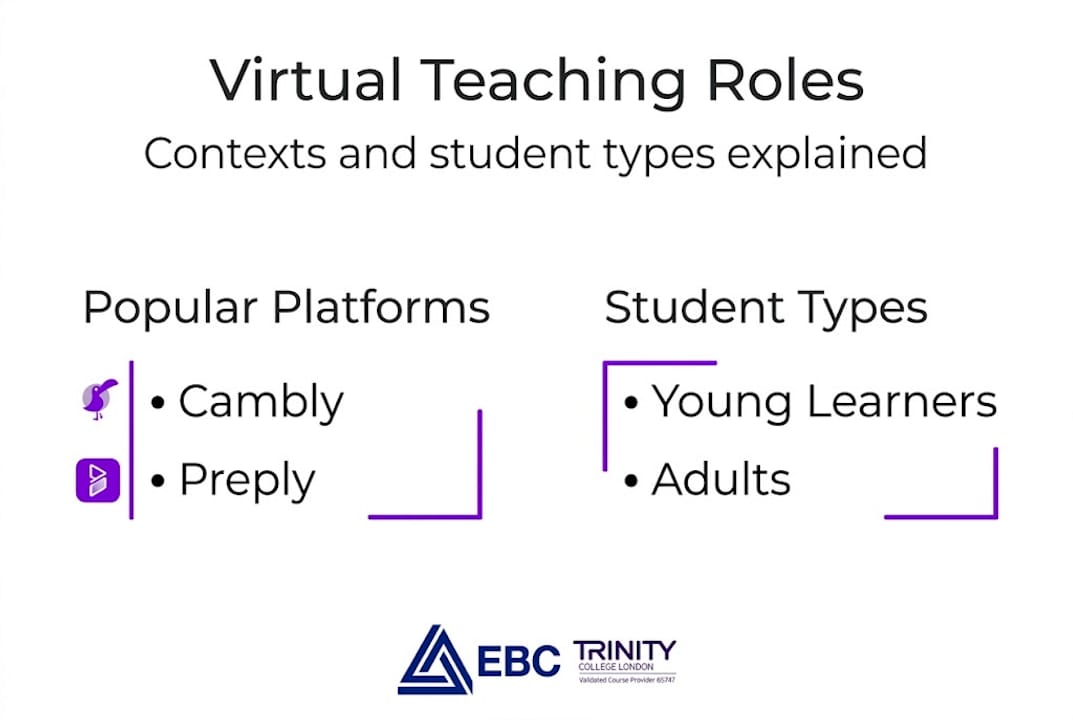
Common platforms include Cambly, Engoo, italki, Preply, and 51Talk. Each serves a different market and carries different expectations. Some platforms are fully structured and provide lesson materials. Others ask you to design your own curriculum. The more autonomy a platform offers, the more planning and professional knowledge you need.
There are several persistent misconceptions about this field. Many people assume it requires no qualifications, no structure, and no real effort beyond showing up. In reality, the most successful virtual English teachers are trained professionals who plan thoughtful lessons, manage diverse learner needs, and adapt their delivery in real time.
Here is what virtual English teaching actually involves:
- Designing or following structured lesson plans
- Assessing student needs before and during instruction
- Adapting materials to different proficiency levels
- Providing consistent, constructive feedback
- Managing classroom dynamics in an online environment
- Maintaining professional communication with students and platforms
The demand for online English instruction has risen sharply since the pandemic, and that growth has not reversed. Countries across Asia, Latin America, and Europe continue to produce high numbers of learners who want access to English-speaking teachers outside their local schools.
“Virtual English teaching is not a backup plan. It is a fully developed profession with career ladders, specialisations, and international scope.”
If you want to understand why teach English online from both a lifestyle and professional perspective, or how teaching English online in the age of AI is shifting practice, these are questions worth exploring before committing to a path. You can also build your toolkit early by exploring digital resources for English classes that experienced teachers rely on daily.
Platforms and career paths in virtual English teaching
Knowing where to work is as important as knowing how to teach. The virtual English teaching market spans a wide spectrum, from large corporate platforms to independent freelance arrangements.

Here is an honest comparison of the main options:
| Platform type | Typical pay | Requirements | Flexibility |
|---|---|---|---|
| Large platforms (Cambly, Engoo) | $3 to $12 per hour | Varies; often native speaker preferred | High, pick your hours |
| Mid-tier platforms (Preply, italki) | $10 to $25 per hour | Certification preferred | Moderate |
| Corporate/B2B platforms | $20 to $40 per hour | Certification often required | Lower, fixed schedules |
| Freelance (independent) | $25 to $80+ per hour | Portfolio and qualifications needed | Very high |
The pay gap between platforms and freelancing is significant. According to industry reporting, large platforms like Cambly and Engoo typically pay between $3 and $12 per hour, while experienced freelance teachers can charge $25 to $80 or more. The 51Talk platform alone hosts over 30,000 Filipino tutors, illustrating both the scale of the market and the level of competition you will encounter.
To build a sustainable career, consider following these four steps:
- Start on a structured platform to gain experience and student reviews.
- Complete an accredited certification to increase your market value.
- Build a niche, such as business English, exam preparation, or young learners.
- Transition to freelance or premium platforms once you have a strong profile.
The freelance route, explained in detail on becoming a freelance teacher, offers the highest earning potential but also requires you to handle your own marketing, scheduling, and materials. It suits teachers who have already developed confidence in their delivery.
Pro Tip: Set your rates based on your qualifications and preparation time, not just what the market minimum offers. Teachers who undercharge often burn out quickly because low pay leads to high lesson volume with little time for planning or professional growth.
Finding the right role is also about fit. Use resources like finding online teaching jobs to research which platforms align with your goals, schedule, and experience level before applying.
Skills and technology for effective virtual teaching
Strong teaching instincts must be paired with solid technical preparation. A slow internet connection or poor audio quality can destroy an otherwise excellent lesson. Your first responsibility is ensuring your setup is professional.
Here is a breakdown of the core technical requirements:
| Tool | Minimum standard | Recommended upgrade |
|---|---|---|
| Internet connection | 10 Mbps download | 50 Mbps fibre, wired connection |
| Computer | Any laptop with webcam | Dedicated desktop with external camera |
| Microphone | Built-in laptop mic | USB condenser or headset mic |
| Lighting | Natural daylight | Ring light or softbox |
| Backup plan | Mobile hotspot | Secondary router or SIM card |
Beyond hardware, the teaching skills that matter most in a virtual environment are slightly different from those needed in a physical classroom. Eye contact is harder to maintain, silence reads differently, and engagement signals are limited to what you can see on a small screen.
The essential skills include:
- Digital communication: Being clear, warm, and engaging through a screen requires deliberate effort.
- Lesson pacing: Online learners tire faster. Shorter activities with frequent transitions keep energy high.
- Adaptive instruction: Learners come from vastly different backgrounds, proficiency levels, and cultural norms.
- Feedback delivery: Written, verbal, and visual feedback must be immediate and specific.
Common challenges in online ESL teaching include technical glitches, time zone differences, student distractions, unexpected no-shows, and low engagement. Each of these requires a rehearsed response. Have a backup lesson activity ready for when technology fails. Set a clear cancellation policy from day one to reduce no-shows. Use movement and interaction to counter short attention spans, particularly with young learners.
Pro Tip: Record a short test lesson and watch it back. Most teachers are surprised by how their energy and pace change on screen. Watching yourself teaches you more in ten minutes than any written guide.
Resources on how to motivate students online and warm-up activities can dramatically improve lesson quality from your very first class.
Classroom management and engagement techniques
Managing a virtual classroom is a skill that takes deliberate practice. Without physical presence, teachers lose many of the natural cues they would use to read and redirect a room. This means you need to compensate with structure, rapport, and variety.
Here are five proven strategies for keeping your virtual students engaged:
- Open every lesson with a brief warm-up. A two-minute activity focused on something familiar creates a safe space before the challenge of new content.
- Use gamification where appropriate. Points, timers, and friendly competitions work especially well with younger learners and can be introduced in most platforms.
- Set clear expectations at the start of each lesson. Tell students what you will cover, how long each part will take, and what they need to do.
- Build personal rapport consistently. Remember small details about each student and reference them naturally in lessons.
- Vary your delivery every 10 to 15 minutes. Switch between speaking, reading, writing tasks, and discussion to maintain attention.
Managing distractions is a genuine challenge. Students at home face interruptions from family members, pets, notifications, and household noise. You cannot control their environment, but you can shape your lessons to make engagement the path of least resistance.
Key strategies for reducing disengagement:
- Keep instructions short and clear
- Use breakout tasks that require active response
- Avoid long teacher monologues
- Ask open questions that require more than a yes or no answer
- Use screen sharing to give visual anchors
According to research on ESL online challenges, low engagement responds well to gamification, rapport-building, total physical response (TPR), and clear classroom rules. These are not gimmicks. They are established pedagogical approaches adapted for the virtual space.
Pro Tip: Avoid the common mistake of treating silence as a problem. A brief pause after a question gives students time to think. Jumping in too quickly sends the message that silence is wrong, which discourages participation.
Additional guidance on teaching senior learners online and keeping students focused offers practical techniques tailored to specific learner groups.
Getting qualified: training and certification for virtual English teaching
Certification is the single most effective way to increase both your earning potential and your credibility as a virtual English teacher. It signals to platforms, schools, and private students that you have been trained to a recognised standard.
The main certification routes are:
- TEFL (Teaching English as a Foreign Language): A broad category of courses, ranging from 40-hour online programmes to 120-hour intensive qualifications. Quality varies enormously, so accreditation matters.
- TESOL (Teaching English to Speakers of Other Languages): Similar scope to TEFL; the two terms are often used interchangeably, though some institutions distinguish between them by context.
- Trinity CertTESOL and Trinity CertPT: Internationally recognised qualifications awarded by Trinity College London, widely respected by employers across Asia, Europe, Latin America, and beyond.
The pay and demand for qualified teachers is strongly linked to the level and recognition of their accreditation. Platforms that pay premium rates consistently require evidence of formal training. Private students and corporate clients are equally selective.
When choosing a programme, consider these factors:
- Global recognition: Is the awarding body known to employers in the countries where you want to work?
- Practical teaching hours: Does the course require observed teaching practice, not just theory?
- Online readiness: Does the programme address digital pedagogy and virtual classroom management?
- Support after completion: Does the provider offer job placement assistance, ongoing resources, or community access?
The Trinity CertPT Online course is specifically designed for teachers who want to work in digital environments. It is accredited by Trinity College London, which ensures that your qualification is recognised globally and holds genuine weight with employers.
Pro Tip: Avoid selecting a course based on price alone. A poorly accredited TEFL certificate can be a barrier rather than a door opener. Invest in a qualification that employers worldwide will respect, and it will pay for itself many times over throughout your career.
What most guides miss about virtual English teaching
Most articles on this topic focus on setup, platforms, and pay rates. Those details matter, but they miss something more fundamental. The teachers who genuinely thrive in virtual English teaching are not the most technically proficient. They are the most adaptable.
You will have students who do not show up. You will have lessons that fall flat despite careful planning. You will face technology failures at the worst possible moments. None of this is unique to virtual teaching, but the isolation of online work means you have fewer colleagues to debrief with afterwards. That isolation can become demoralising if you are not prepared for it.
The most successful virtual teachers treat their practice as a craft. They reflect after every lesson, refine their materials, and invest in their own professional development continuously. They do not chase the highest-paying platform or the most students. They build genuine relationships with learners over time, and those relationships generate referrals, loyalty, and long-term income.
If you are curious about the deeper reasons to teach online beyond income, including the cross-cultural impact and sense of professional purpose, that clarity will sustain you through the difficult lessons.
Virtual English teaching is not a shortcut. It is a career that rewards those who approach it seriously.
Take the first step: become a certified virtual English teacher
If this guide has clarified what virtual English teaching involves, the next practical step is getting the right qualification behind you.
At EBC TEFL, we offer internationally recognised certification programmes designed for the modern teaching landscape, including courses built specifically for online educators. Whether you are starting from scratch or building on existing experience, we provide the training, support, and global job placement assistance to launch your career with confidence. Explore your TEFL introduction, compare your international certification options, and review the online certification requirements to find the path that fits your goals. Book a free consultation with our team today and take the first step.
Frequently asked questions
What equipment do I need to teach English virtually?
At minimum, you need a stable internet connection, a computer with a webcam, headphones with a microphone, and access to the teaching platform your students use. A ring light and a wired connection will significantly improve your professional appearance and reliability.
Do I need a certification to become a virtual English teacher?
While some platforms hire without certification, accredited qualifications such as TEFL or TESOL increase your job opportunities and earning potential considerably. According to industry data, pay rates and employer demand are strongly linked to the level of recognised accreditation a teacher holds.
How much can I earn teaching English online?
Earnings vary widely depending on the platform and your experience. Large platforms typically pay $3 to $12 per hour, while experienced freelance teachers can charge $25 to $80 or more per hour by working directly with students or corporate clients.
What are common challenges in virtual English teaching?
The most frequent challenges include technical issues, time zone differences, student distractions, low engagement, and unexpected no-shows. Preparing backup activities, setting clear policies, and using engagement techniques consistently helps manage all of these effectively.
Can I teach English online without previous teaching experience?
Yes. Many platforms accept motivated new teachers, and some provide structured materials to help you get started. However, completing a recognised training programme before you begin will make your lessons more effective and help you stand out in a competitive market from the very start.