
Teaching methods are the organised ways you present learning, strategies are the broader instructional orientations that guide your planning, and techniques are the specific classroom moves that make them work. The methods that matter most for daily practice are direct instruction, inquiry learning, collaborative learning, project or problem-based learning, flipped and blended learning, and experiential learning. Below, you’ll find an evidence-based lesson sequence, ready-to-use classroom templates, and guidance on turning these skills into a stronger teaching career.
Key Points
- Most effective teachers combine multiple methods such as direct instruction, inquiry, and collaborative learning, tailoring each to specific lesson objectives and learner needs.
- A typical lesson sequence includes activating prior knowledge, setting clear objectives, presenting content in manageable steps, and using retrieval and spaced practice for retention.
- Differentiation requires planning flexible core tasks with built-in adjustments for varying ability levels, rather than improvising during lessons.
- Using structured group roles, routines, and varied activity formats helps maintain engagement and manage classroom behavior efficiently.
- Incorporating metacognition and cultural responsiveness enhances learner independence and inclusivity, while practical experience solidifies method application for employability.
Table of Contents
- Strategy, method and technique: a practical taxonomy
- An evidence-based lesson sequence you can use tomorrow
- Core teaching methods and when each one earns its place
- Classroom management strategies that protect learning time
- Assessment and feedback: checks, worked examples and reflection
- Inclusive teaching and the sensible use of classroom technology
- Ready-to-use classroom activities and quick templates
- How these methods strengthen your employability
- Metacognition and explicit strategy instruction
- Differentiated instruction strategies to meet diverse learner needs
- Strategies for motivating and engaging students effectively
- Strategies for developing critical thinking and problem-solving skills
- Methods for fostering communication and collaboration skills
- Approaches to culturally responsive teaching
- Next steps: learn these methods with EBC
- Sources
- FAQ
Strategy, method and technique: a practical taxonomy
Getting these three terms right helps you plan lessons and describe your skills clearly, whether in a staffroom conversation or a job application. A strategy is your overall instructional orientation for a unit, such as favouring student-centred inquiry. A method is the organised approach you choose for a lesson, like collaborative learning or direct instruction. A technique is the specific classroom move you use within that method, such as a think-pair-share or a worked example.
- Strategy: build learner independence over a term through gradually increasing student-led tasks.
- Method: choose project-based learning for a unit on describing your town.
- Technique: use a jigsaw activity to divide research roles among groups.
Teachers who separate these levels plan more coherently and describe their practice with precision on a CV or in an interview, which matters when panels are comparing candidates on their grasp of teaching methods.
An evidence-based lesson sequence you can use tomorrow
A well-sequenced lesson does more than fill a class period. It follows a pattern shown to support learning and long-term retention, as set out in the Institute of Education Sciences practice guide on organising instruction.
- Activate prior knowledge with a quick question or short discussion.
- State the objective and success criteria so learners know the target.
- Present or model new content in small, manageable steps.
- Provide guided practice with scaffolding that you gradually remove.
- Set independent application once learners show they can manage alone.
- Check understanding, give corrective feedback, and revisit the material later through retrieval and spaced practice.
Short quizzes fit naturally at the start of a lesson, as retrieval of previous learning, and again near the end, as a check on the day’s new content. For learners with less background knowledge, spend longer on modelling before moving them towards independent work, a principle the same guide describes as the expertise reversal effect. You can find a structured lesson-sequence template that maps directly onto these six steps.
Pro Tip: Keep your modelling step under five minutes; if you are still explaining after that, the task probably needs breaking into smaller pieces.
Core teaching methods and when each one earns its place
No single method suits every lesson, and the strongest teachers combine several rather than committing to just one, a point made clearly in the UCF teaching methods overview. Matching the method to your objective, your learners’ prior knowledge and the time available matters more than following a trend.
- Direct instruction suits new vocabulary, grammar rules or anything learners have no prior schema for, but overusing it leaves little room for learner talk.
- Inquiry learning works well when you want learners to discover a language pattern themselves, though it takes longer and needs careful guidance to avoid confusion.
- Collaborative learning builds speaking fluency and negotiation skills, but needs clear roles or stronger learners can dominate.
- Project-based learning suits extended units with a real output, such as a class magazine, though it demands more planning time upfront.
- Flipped or blended learning frees classroom time for practice when learners can access materials beforehand, but assumes reliable access to devices or printed materials.
- Experiential learning, such as role-plays or simulated job interviews, builds confidence for real-world use but works best once foundational language is secure.
A common hybrid worth trying: a short mini-lecture on a grammar point, followed by peer instruction where learners explain the rule to each other in pairs.
Classroom management strategies that protect learning time
Strong management is proactive rather than reactive. Teachers who teach and rehearse routines in the first weeks of a course spend far less time repeating instructions later, a point emphasised in the NSW Education classroom management guide. Routines only stick when you model them, practise them, and revisit them regularly rather than assuming one explanation is enough.
- Teach entry and exit routines explicitly, then rehearse them until they run without instructions.
- Plan transitions between activities so learners always know what to do next.
- Use high-rate, behaviour-specific praise (“well done for waiting your turn”) rather than vague comments.
- Keep corrections brief and private where possible, so the lesson keeps moving.
- Design tasks that maximise participation, such as entry tickets or frequent opportunities to respond.
Pro Tip: Circulate the room in a loop rather than staying at the front; learners stay on task longer when they know you might be nearby.
You’ll find further detail on routines, relationships and transitions in this guide to classroom management.
Assessment and feedback: checks, worked examples and reflection
Assessment works best when it feeds directly back into your next teaching decision rather than sitting at the end of a unit as a final score. A short formative quiz tells you within minutes which learners need more support before you move on.
- Use brief retrieval quizzes at the start of lessons to surface what learners still remember.
- For complex skills like writing or grammar, show a worked example first, then hand over guided practice before independent work.
- Follow a model-practice-reflect cycle: demonstrate the skill, let learners practise it with support, then have them reflect on what worked, a sequence recommended in the IES guide on teaching secondary students to write effectively.
- Use what the assessment shows you to decide whether to reteach, move on, or adjust pace for specific learners.
Inclusive teaching and the sensible use of classroom technology
Inclusive teaching means offering multiple ways for learners to access material, engage with it and show what they have learned, an approach close to Universal Design for Learning. Technology only helps when it removes a genuine barrier rather than being used because it looks modern.
- Offer more than one way to access content: visual, spoken and written versions of the same instructions.
- Give learners choices in how they demonstrate learning, such as a spoken summary instead of a written one.
- Keep low-tech alternatives ready for learners without reliable device access.
- Check before every activity: can every learner see, hear, and physically take part?
When digital tools genuinely add value, such as recording a speaking task for later feedback, they are worth using. This guide to classroom technology in TEFL explains when tools help and when a simpler approach works better.
Ready-to-use classroom activities and quick templates
These templates translate the methods above into moves you can run in your next lesson.
- Think-pair-share: pose a question, give 30 seconds of silent thinking, two minutes of pair discussion, then invite two or three pairs to share with the class.
- Jigsaw: split a reading or topic into four parts, assign one part per group for 10 minutes, then reshuffle groups so each new group has one expert on every part, and have them teach each other for 15 minutes.
- Worked example plus practice: demonstrate one grammar or pronunciation problem fully on the board, then set three near-identical practice items before learners attempt a new one alone.
- Mini retrieval quiz: three quick questions on the previous lesson, answered on paper or aloud, followed by immediate feedback on the correct answer and a brief reason why.
For younger classes, adapt timings and add movement between steps; this step-by-step guide to teaching young learners shows how.
How these methods strengthen your employability
Employers and interview panels notice when a candidate can describe a lesson sequence clearly and explain why they chose a particular method for a particular objective. Being able to talk through a worked example, a think-pair-share, or a classroom management routine in concrete detail during a demo lesson or interview sets you apart from candidates who can only describe teaching in general terms.
- Bring one or two lesson sequences you can describe step by step, including how you checked understanding.
- Mention specific techniques by name (jigsaw, worked example, retrieval quiz) rather than saying “group work” or “activities”.
- Explain how you adapted a method for a mixed-ability class, since panels often ask about differentiation directly.
EBC’s Trinity CertTESOL builds this kind of practical, classroom-ready experience into the course itself, backed by Trinity College London accreditation and lifetime worldwide job placement support once you qualify.
Metacognition and explicit strategy instruction
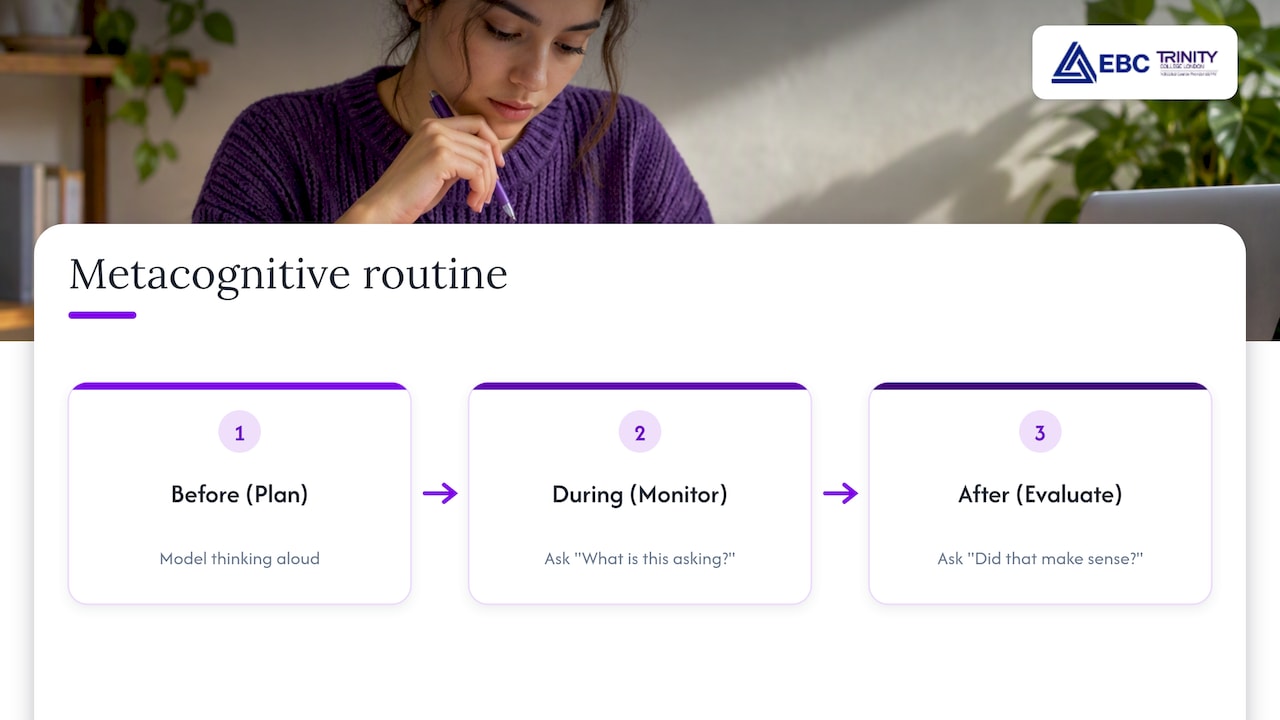
Metacognition means teaching learners to plan, monitor and evaluate their own learning, rather than only teaching them content. An EEF update on metacognition treats this as one of the more consistently high-impact strategies available when it is embedded directly into subject teaching rather than taught as a stand-alone skill.
In practice, this means modelling your own thinking aloud before a task: “I’m going to check the instructions again before I start writing, because I want to make sure I answer both parts of the question.” It also means prompting learners to ask themselves similar questions before, during and after a task, such as “What is this question actually asking me?” during a reading activity, or “Did that answer make sense given the context?” once they’ve finished.
Explicit strategy instruction works alongside this. Rather than assuming learners will pick up good study or language-learning habits on their own, you name the strategy directly: “This is called skimming, and we use it to get the general idea before reading closely.” Over time, learners internalise these prompts and begin using them without being asked, which is the goal, according to guidance on embedding metacognition in classroom practice.
A simple planning heuristic helps here: pick one primary strategy for the lesson, choose one or two complementary methods, and prepare two or three small techniques, such as an entrance ticket or a two-minute pair discussion, to build in checks along the way.
Differentiated instruction strategies to meet diverse learner needs
Differentiation means adjusting content, process or output so learners with different starting points can all make progress in the same lesson, without running three separate classes at once. The most sustainable way to do this is to plan one core task with built-in flexibility, rather than writing entirely separate materials for every ability level.
Adjusting content might mean giving stronger learners a slightly more complex text on the same topic, while weaker learners get a simplified version with the same vocabulary target. Adjusting process might mean some learners work through guided questions with a partner while others attempt the same task independently. Adjusting output could mean allowing one learner to respond in writing and another to respond verbally, while both demonstrate the same underlying skill.
Grouping flexibly also matters. Mixed-ability pairs work well for peer teaching moments, such as a jigsaw task, while similar-ability groups suit targeted practice where learners need the same level of support. Rotating between these groupings across a term keeps differentiation from becoming a fixed label attached to particular learners.
The key discipline is deciding differentiation at the planning stage, not improvising it mid-lesson. Before teaching, ask which learners will find the core task too easy, which will find it too hard, and what small adjustment addresses each case without creating extra marking or entirely new resources.
Strategies for motivating and engaging students effectively
Engagement drops when learners cannot see the point of a task or when the same activity format repeats lesson after lesson. Varying the format, pace and level of challenge across a lesson keeps attention higher than any single trick applied on its own.
Giving learners some choice, even a small one such as picking which of two topics to write about, tends to increase investment in the task. Clear, achievable success criteria also help, since learners engage more readily when they know exactly what a good answer looks like rather than guessing at an unstated standard.
Frequent opportunities to respond, whether through quick polls, mini whiteboards or paired discussion, keep more learners actively involved rather than only the confident few who volunteer answers. Behaviour-specific praise reinforces this further: telling a learner precisely what they did well encourages them to repeat it, more effectively than a general “good job”.
Real-world relevance matters too. A task connected to something learners will actually use, such as writing a message to a friend rather than an abstract paragraph, tends to hold attention better because the purpose is visible.
Strategies for developing critical thinking and problem-solving skills
Critical thinking develops when learners are regularly asked to justify an answer, compare options or solve a problem with more than one possible solution, rather than only recalling information. Questions that start with “why” or “how do you know” push learners past simple recall into reasoning.
Open-ended tasks with genuine ambiguity work well here. A debate task, a ranking exercise where learners must justify their order, or a problem-based scenario with no single correct answer all require learners to weigh evidence and defend a position. Problem-based learning fits naturally into this, particularly when the problem has some connection to learners’ own lives or interests.
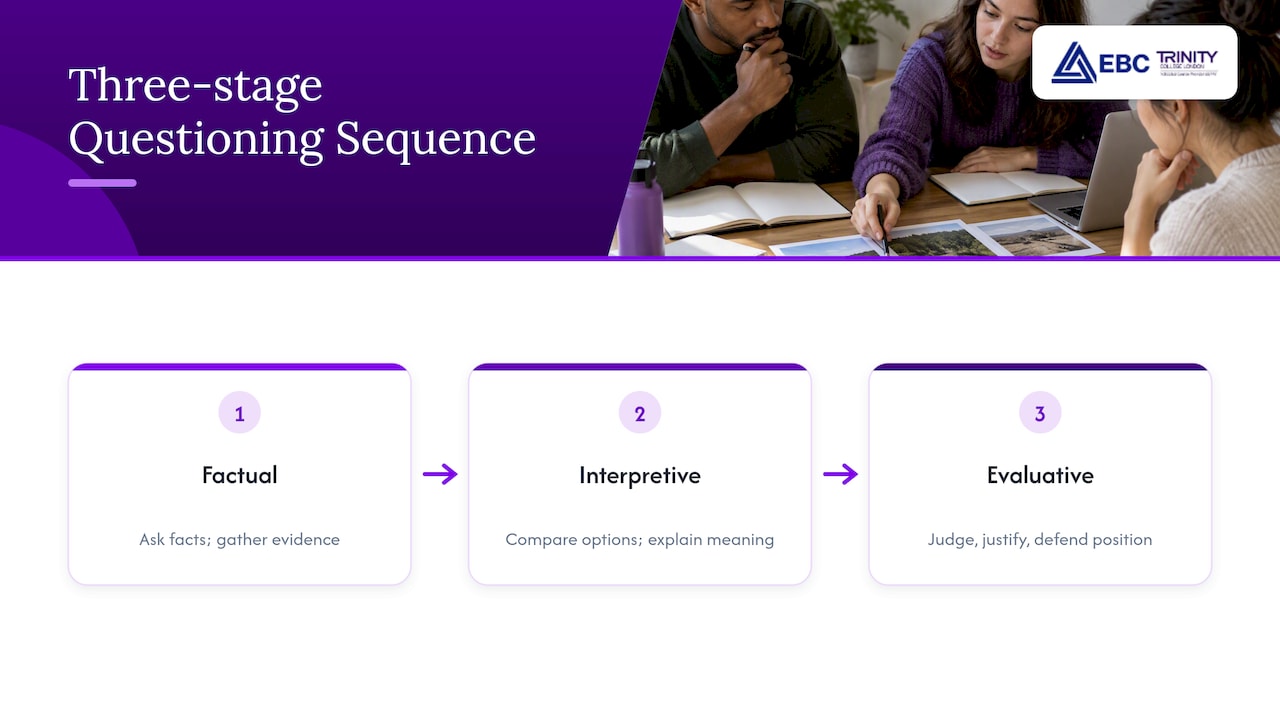
Structured questioning sequences help scaffold this skill for learners who are not used to it. Starting with a factual question, moving to an interpretive question, and finishing with an evaluative question gives learners practice building an argument step by step rather than being asked to reason from nothing.
Giving learners time to think before answering matters as much as the question itself. A few seconds of silent thinking time, or a brief written note before discussion, produces noticeably more considered responses than expecting an instant answer.
Methods for fostering communication and collaboration skills
Communication and collaboration skills develop through structured practice, not simply by putting learners in groups and hoping conversation happens. Techniques like think-pair-share and jigsaw work because they give every learner a defined speaking role, rather than leaving participation to whoever feels confident enough to talk.
Assigning roles within group tasks, such as note-taker, timekeeper or spokesperson, ensures that quieter learners still have a concrete responsibility rather than fading into the background. Rotating these roles across tasks means every learner eventually practises leading, negotiating and presenting.
Peer feedback tasks build collaboration skills alongside communication. Asking learners to review a partner’s work against clear criteria, rather than giving a vague opinion, teaches them to give and receive feedback constructively, a skill that transfers well beyond the classroom.
Active-learning techniques such as structured discussion, peer instruction and short collaborative writing tasks consistently push learners to explain, decide and apply rather than passively listen, according to active learning resources from the University of Michigan’s teaching centre.
Approaches to culturally responsive teaching
Culturally responsive teaching means recognising that learners bring different backgrounds, experiences and ways of communicating into the classroom, and building on that rather than treating one cultural norm as the only correct standard. This matters particularly when teaching English to learners from a wide range of countries and educational traditions.
Choosing materials and examples that reflect a range of cultural contexts, rather than defaulting only to examples from one country or region, helps every learner see relevance in the content. Inviting learners to share their own perspectives or examples during a topic, rather than only presenting the teacher’s chosen viewpoint, also signals that their experience is valued.
Being aware of different norms around participation matters too. In some educational traditions, volunteering an answer unprompted is unusual, while in others it is expected. Building in structured opportunities to respond, such as think-pair-share, gives every learner a route into participation regardless of their prior classroom experience.
Language itself is part of this. Being patient with a range of accents and communication styles, and correcting errors without shaming, keeps the classroom a space where learners feel safe attempting to communicate rather than staying silent to avoid mistakes.
Next steps: learn these methods with EBC
Reading about methods is useful, but applying them under guidance is what actually builds confidence in front of a class. EBC’s Trinity CertTESOL combines Trinity College London accreditation with hands-on teaching practice, so you leave the course having already tried these sequences and techniques with real learners, not just read about them.

If you already hold a certificate and want to sharpen a specific area, the CertPT courses in Business English, CLIL, CLT and Teaching Online build on these foundations. For a longer commitment, the Road2Spain programme combines language study with practical teacher training and lifetime worldwide job placement support once you graduate. Book a free consultation at EBC to talk through which route fits your goals.
Sources
- Teaching Methods Overview — UCF Faculty Center
- Active learning resources — University of Michigan CRLT
FAQ
What are methods and strategies in teaching?
A teaching strategy is your broader instructional orientation for a unit or course, while a method is the specific organised approach used in a lesson, such as direct instruction or collaborative learning. Techniques, such as a think-pair-share or worked example, are the individual classroom moves that carry a method out.
What are the 5 methods of teaching?
There is no single fixed list, but the methods most consistently referenced by teaching centres are direct instruction, inquiry learning, collaborative learning, project or problem-based learning, and flipped or blended learning, as outlined in the UCF teaching methods overview. Experiential learning is often added as a sixth, particularly for language and skills-based teaching.
What are 5 teaching strategies and examples?
Common strategies include activating prior knowledge before new content, modelling in small steps with worked examples, guided practice with scaffolding that is gradually removed, formative checks such as short retrieval quizzes, and embedding metacognitive prompts like planning and self-checking into subject lessons. Each of these appears in the lesson sequence recommended by the IES practice guide.
What are the types of methods of teaching?
Methods generally sit on a continuum from teacher-directed to student-directed, including direct or explicit instruction, discussion and questioning, demonstration and worked examples, collaborative learning, problem or project-based learning, experiential learning, case-based learning, and flipped or blended learning. Most experienced teachers combine several of these within a single lesson rather than relying on just one.
Does an accredited TEFL course teach these methods in practice?
EBC’s Trinity CertTESOL builds these methods into hands-on teaching practice rather than theory alone, backed by Trinity College London accreditation and lifetime worldwide job placement support for graduates seeking teaching work internationally.
Recommended
- How to Teach Business English for Global Career Success
- 9 Teaching Methodologies That Boost Classroom Practice and Your Career
- Top teaching methods for TEFL success in 2026
This page provides commentary based on information, facts, and experiences available at the time of publication. It does not constitute legal advice, and EBC accepts no liability for decisions made based on the information provided. If you require legal advice, please consult a qualified lawyer.