
Many people assume that being a fluent English speaker is enough to walk into a classroom abroad and start teaching. It is not. Schools and language academies worldwide are increasingly selective, and without a recognised, accredited ESL certificate, your applications will be overlooked in favour of candidates who hold proper qualifications. The good news is that the right certificate does far more than tick a box. It builds genuine teaching skills, signals professional credibility, and opens doors to roles across Europe, Asia, South America, and beyond. This guide explains exactly what an ESL certificate is, which qualifications carry the most weight, and how to choose the route that best fits your goals.
Table of Contents
- What is an ESL certificate?
- The main types of accredited ESL certification
- What makes an accredited ESL certificate stand out?
- Where can you use an ESL certificate?
- What will you learn during an accredited ESL course?
- Take the next step towards global teaching
- Frequently asked questions
Key Takeaways
| Point | Details |
|---|---|
| Definition clarified | An ESL certificate verifies you have the skills and training to teach English to non-native speakers. |
| Accreditation matters | Accredited certificates like Trinity CertTESOL and CELTA are preferred by employers and unlock more global opportunities. |
| Practical experience required | Top courses include 120+ hours with observed teaching practice, not just theory or online quizzes. |
| Career opportunities | You can teach in schools, online, or abroad and take part in immersive international programmes. |
| Course content overview | Expect comprehensive training in methodology, classroom management, grammar, and phonology, preparing you for real-world teaching. |
What is an ESL certificate?
ESL stands for English as a Second Language. An ESL certificate is a formal qualification that proves you have been trained to teach English to speakers of other languages. It is not simply a language proficiency test or a short online quiz. It is a structured course that covers teaching methodology, lesson planning, grammar instruction, and classroom management.
You will often encounter several related acronyms, and it helps to know the difference. TESL, TEFL, and TESOL are distinct terms: TESL refers to teaching English in English-speaking countries, TEFL refers to teaching in countries where English is a foreign language, and TESOL is the umbrella term covering both contexts. Understanding this distinction matters when you are applying for roles, because job adverts often specify which context they are hiring for.
Accreditation is what separates a credible certificate from a worthless one. An accredited certificate is validated by a recognised external body, such as Trinity College London or Cambridge Assessment English. Unaccredited certificates, regardless of how polished their websites look, are rarely accepted by reputable employers.
Here is what an accredited ESL certificate demonstrates to employers:
- You have completed a minimum standard of training hours
- You have received observed, assessed teaching practice
- You understand core language teaching methodology
- You can plan and deliver structured lessons
- You meet the entry requirements set by an independent awarding body
“Accreditation is not a formality. It is the difference between a qualification that opens international doors and one that collects dust on a shelf.”
If you want to explore the full range of English teaching certificate types available, it is worth reading a detailed comparison before committing to a course.
The main types of accredited ESL certification
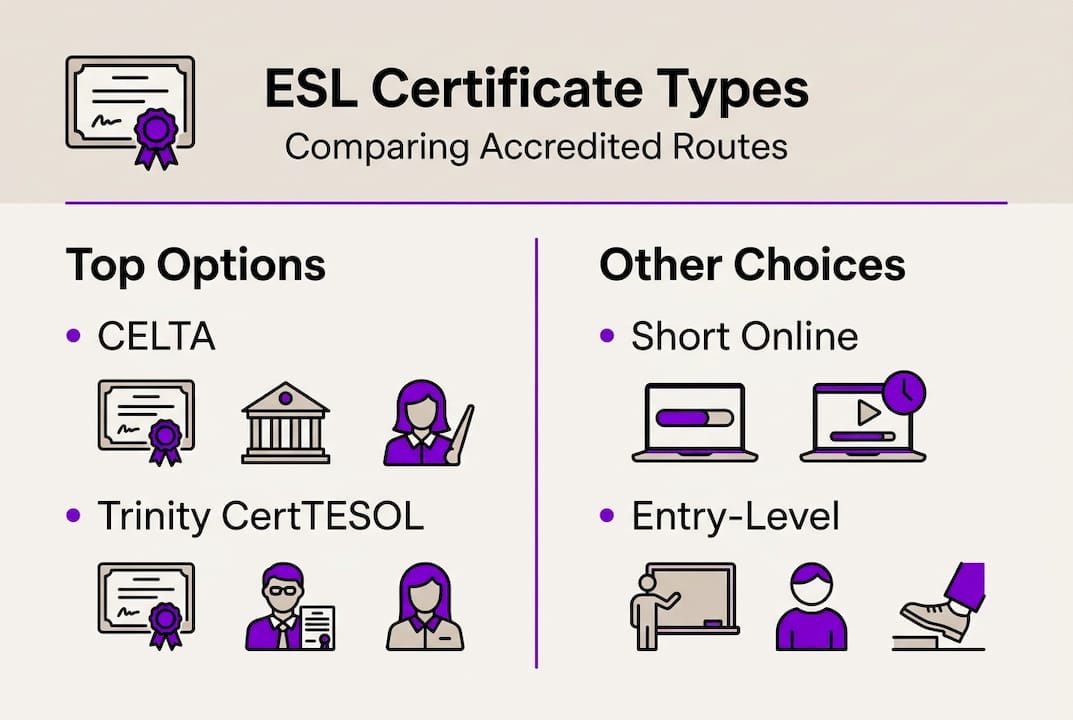
Not all accredited certificates are equal. At the top of the hierarchy sit two Level 5 qualifications that are recognised by employers worldwide: the Trinity CertTESOL and the CELTA (Certificate in English Language Teaching to Adults, awarded by Cambridge Assessment English).
Both Trinity CertTESOL and CELTA require approximately 130 hours of input and include a minimum of six hours of observed and assessed teaching practice. They cover methodology, grammar, and phonology at a rigorous level. These are the qualifications that serious employers look for.

The key difference lies in approach. CELTA is structured and formulaic, which suits candidates who prefer a prescriptive framework. The Trinity CertTESOL, by contrast, places a strong emphasis on reflective practice, learner profiles, and phonology, encouraging teachers to develop their own informed style rather than follow a fixed script. This makes the Trinity CertTESOL particularly well regarded for teachers who want to work across diverse international contexts.
| Feature | Trinity CertTESOL | CELTA |
|---|---|---|
| Awarding body | Trinity College London | Cambridge Assessment English |
| Level | Level 5 | Level 5 |
| Input hours | 130 hours | 120 hours |
| Teaching practice | 6+ observed hours | 6+ observed hours |
| Key focus | Reflective practice, phonology, learner profiles | Structured methodology |
| International recognition | Very high | Very high |
| Career impact | Excellent | Excellent |
Other certificates exist, including shorter online-only options and lower-level qualifications. However, these provide limited career success because employers in competitive markets, particularly in Europe, East Asia, and the Middle East, specifically request Level 5 accredited qualifications. A 40-hour online certificate may satisfy the minimum requirement for some volunteer placements, but it will not get you hired at a reputable language school.
Pro Tip: If you are choosing between the two top qualifications, read the complete Trinity CertTESOL vs CELTA guide and consider the Trinity CertTESOL advantages in detail before deciding.
What makes an accredited ESL certificate stand out?
Accreditation from a body such as Trinity College London or Cambridge Assessment English means your qualification has been independently assessed against a national or international standard. Employers trust these names because they know exactly what the certificate required.
Standard accredited courses run between 120 and 130 hours, require a C1 level of English proficiency, and are available in full-time formats (typically four weeks) or part-time and blended formats over several months. No prior teaching experience is required, which makes them accessible to career changers and recent graduates alike.
Here is what employers typically look for when reviewing your CV:
- A named, accredited awarding body (Trinity College London or Cambridge)
- A minimum of 120 hours of coursework
- Evidence of observed teaching practice
- C1 English proficiency or above
- A pass grade or above on written assignments
Online certificates are frequently criticised for lacking a practical teaching component, and the debate between 100-hour and 120-hour courses is settled in most professional contexts: 120 hours or more is the accepted standard for competitive job applications.
Pro Tip: Be cautious of courses that promise certification in under 60 hours or that charge very low fees. If there is no observed teaching practice and no external accreditation, the certificate is unlikely to be accepted by schools in Europe, Asia, or the Middle East. Explore accredited online TESOL options that include a practical component if you cannot study in person. You can also review the English teacher qualifications in Europe to understand regional requirements.
Where can you use an ESL certificate?
An accredited ESL certificate is genuinely portable. Once you hold a recognised qualification, you can apply for roles across a wide range of contexts and countries.
TEFL and TESOL qualifications cover different teaching environments: TEFL is specifically for teaching in countries where English is not the primary language, while TESOL covers both foreign and second language contexts. This means your certificate is relevant whether you want to teach in Madrid, Tokyo, São Paulo, or online from your living room.
Here are the most common career paths open to certified ESL teachers:
- Language academies and private language schools (Europe, Asia, South America)
- State school assistant programmes (Spain, France, Italy)
- International schools and bilingual education programmes
- Online teaching platforms and private tutoring
- Corporate English training for business professionals
- Volunteer and community teaching programmes
| Destination | Employer types | Typical requirement |
|---|---|---|
| Spain | Language academies, state schools | Trinity CertTESOL or CELTA |
| Japan | Eikaiwa schools, JET Programme | Accredited certificate (Trinity CertTESOL or CELTA preferred), degree |
| South Korea | Hagwons, public schools | Accredited certificate (Trinity CertTESOL or CELTA preferred), degree |
| Italy | Language schools, universities | Trinity CertTESOL or CELTA |
| France | Language centres, assistant programmes | Accredited certificate (Trinity CertTESOL or CELTA preferred) |
| Online | Platforms, private clients | Accredited certificate (Trinity CertTESOL or CELTA preferred) |
For a full breakdown of the TESOL abroad application process, including visa and documentation requirements, we recommend reviewing the step-by-step guide. If online teaching interests you, check the specific teaching English online requirements before applying to platforms.
What will you learn during an accredited ESL course?
One of the most common questions we hear is: what exactly will I be taught, and will it actually prepare me for a real classroom? The answer, for a properly accredited course, is yes.
Accredited Level 5 courses cover approximately 130 hours of input across a structured curriculum. You will study lesson planning, classroom management, grammar analysis, phonology (the sound system of English), and language teaching methodology. These are not abstract topics. They are directly applicable to the lessons you will teach from day one.
The Trinity CertTESOL goes further by incorporating reflective practice and learner profiles. Reflective practice and learner profiling mean you learn to analyse your own teaching, adapt to different student needs, and develop cultural awareness. These skills are particularly valuable when teaching in international settings where your students come from diverse linguistic and cultural backgrounds.
Typical module topics include:
- Lesson planning and materials development
- Grammar for language teachers (not just knowing grammar, but teaching it clearly)
- Phonology and pronunciation teaching
- Classroom management and learner engagement
- Reflective teaching journals and self-assessment
- Observed and assessed teaching practice with real learners
- Written assignments on language analysis and methodology
“The teaching practice component is where theory becomes skill. Six or more hours of observed lessons, with detailed feedback from qualified trainers, is what separates a credible certificate from a paper qualification.”
You can read more about the specific benefits of the Trinity CertTESOL and how its curriculum prepares you for the realities of teaching in diverse global settings.
Take the next step towards global teaching
You now have a clear picture of what an ESL certificate is, which qualifications carry genuine weight, and what the training actually involves. The next step is choosing the right course and getting started.
At EBC TEFL, we offer international ESL certification through Trinity College London, one of the most respected awarding bodies in the world. Our programmes are designed for people who want to teach abroad, teach online, or build a long-term career in English language education. We also offer one-year study and work abroad programmes in Spain, France, and Italy, combining accredited teacher training with language study, visa support, and cultural immersion. Whether you are new to TEFL and what it involves or ready to pursue a TEFL and TESOL dual certification, we are here to guide you every step of the way. Book a free consultation today and find out which programme fits your goals.
Frequently asked questions
Do I need to be a native English speaker to get an accredited ESL certificate?
No. C1 English proficiency is the standard entry requirement, and non-native speakers who meet this level are fully eligible to enrol and succeed.
Are online-only ESL certificates valid for teaching jobs?
Some are accepted for basic roles, but online certificates are widely criticised for lacking observed teaching practice, which most reputable employers require.
How long does it take to complete a reputable ESL certification?
Most accredited courses take four to five weeks full-time or several months part-time, with a minimum of 120 hours of structured coursework required.
Is TESOL the same as TEFL or TESL?
No. TESOL is the umbrella term covering both TEFL (teaching abroad) and TESL (teaching in English-speaking countries), which are distinct contexts.
What job roles can an ESL certificate qualify me for?
With an accredited certificate, you can teach in language schools, state schools, online platforms, or join structured programmes abroad in Europe and Asia, depending on the level of your qualification.