
What is Business English? Over 1.5 billion people now use English to conduct business worldwide, making it the global bridge for international deals and negotiations. For british professionals and learners alike, understanding the real role of Business English is critical in competitive workplaces. This article cuts through common misconceptions and reveals how mastering Business English opens doors to global opportunities and equips you with communication strategies valued across every major industry.
Table of Contents
- Business English Defined And Common Misconceptions
- Types Of Business English For Different Roles
- Core Skills And Real-World Applications
- Trinity Certificate Pathways And Accreditation
- Teaching Business English Abroad: Opportunities And Challenges
Key Takeaways
| Point | Details |
|---|---|
| Understanding Business English | It is a specialised form of communication that goes beyond vocabulary, requiring cultural intelligence and adaptability in professional contexts. |
| Communication Skills Development | Mastery of Business English relies on effective written and verbal communication, including intercultural nuances and emotional intelligence. |
| Tailored Language for Professionals | Different sectors necessitate unique linguistic approaches, highlighting the importance of sector-specific skills in Business English. |
| Continuous Learning and Adaptation | Educators and professionals must remain proficient in evolving communication trends and refine strategies to address multilingual environments. |
Business English Defined and Common Misconceptions
Business English represents a specialised form of communication designed specifically for professional environments worldwide. Unlike standard conversational English, this linguistic approach focuses on precise, clear language tailored to commercial interactions, negotiations, and global workplace communication.
Business English transcends simple language skills, encompassing complex linguistic competencies that enable effective professional dialogue across international contexts. The primary goal is not just grammatical accuracy, but developing communicative strategies that facilitate smooth interactions in corporate settings. Research from EBSCO highlights that Business English has become the predominant language within global business communities, serving as a critical bridge between diverse professional cultures.
Despite its widespread adoption, Business English is often misunderstood. Many professionals assume it merely involves learning industry-specific vocabulary or mastering formal email writing. However, the reality is far more nuanced:
- Communication Skills: Beyond vocabulary, it involves understanding contextual communication styles
- Cultural Intelligence: Recognising subtle communication differences between international business cultures
- Professional Adaptability: Adjusting linguistic approaches based on specific professional scenarios
The criticism surrounding Business English is noteworthy. Some scholars argue that its global prevalence promotes linguistic imperialism, potentially marginalising non-English speaking business cultures. This perspective suggests that while Business English facilitates global communication, it simultaneously risks undermining linguistic diversity.
Professionals seeking to excel in Business English must therefore develop more than technical language skills. They need a comprehensive understanding of:
- Intercultural communication principles
- Professional etiquette across different regions
- Contextual language use in varied business scenarios
Successful Business English practitioners recognise that effective communication transcends literal translation. It requires emotional intelligence, cultural sensitivity, and the ability to navigate complex professional landscapes with linguistic precision.
Types of Business English for Different Roles
Business English is a multifaceted linguistic discipline that adapts precisely to the unique communication requirements of various professional sectors. Far from being a one-size-fits-all approach, it represents a nuanced communication strategy tailored to specific industry contexts, enabling professionals to communicate with exceptional clarity and precision.
Research indicates that Business English manifests differently across multiple professional domains. Each discipline demands its own specialised language skills, creating a rich tapestry of communication strategies. From finance to information technology, human resources to legal services, professionals must develop targeted linguistic competencies that reflect their specific workplace environment.
Key Business English Specialisations
Professional sectors requiring distinct Business English approaches include:
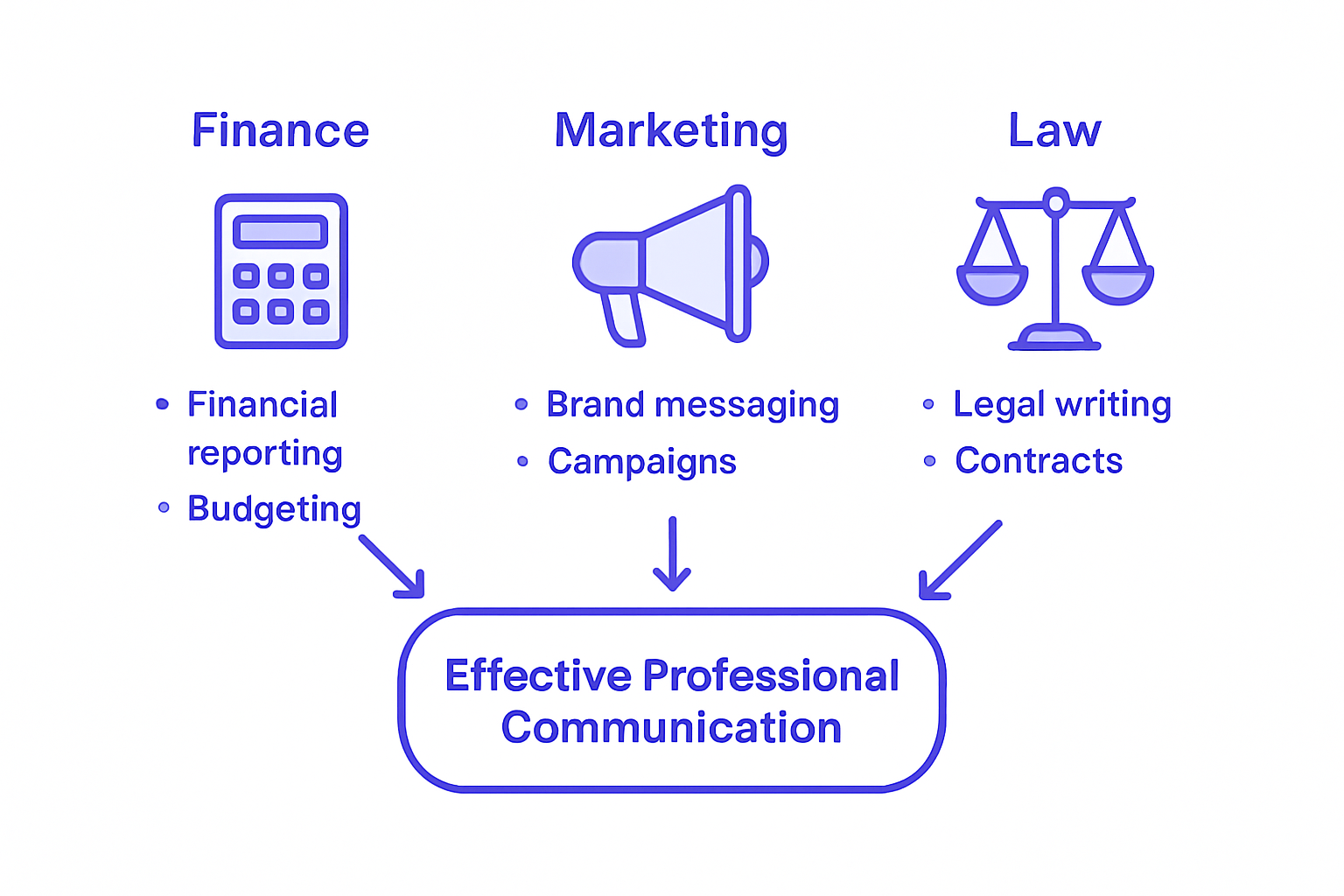
- Finance: Precise terminology for financial reporting, investment strategies, and economic analysis
- Information Technology: Technical language for software development, system architecture, and digital innovation
- Human Resources: Communication skills for recruitment, performance management, and employee relations
- Legal Services: Formal language for contracts, negotiations, and regulatory compliance
- Marketing: Persuasive communication techniques for brand positioning and consumer engagement
- E-Commerce: Digital communication strategies for online transactions and global marketplace interactions
Each specialisation demands unique linguistic nuances. A financial analyst communicates differently from a marketing professional, despite both operating within Business English frameworks. The language must reflect not just technical vocabulary, but also the cultural and professional expectations of each sector.
Successful professionals recognise that mastering Business English goes beyond memorising industry-specific terms. It requires developing adaptive communication skills that can navigate complex professional landscapes. This means understanding contextual communication, recognising subtle cultural differences, and presenting information with precision and confidence across diverse professional environments.
Core Skills and Real-World Applications
Business English encompasses a sophisticated set of communication skills that extend far beyond traditional language learning. Professional success hinges on developing a robust linguistic toolkit that enables effective interaction across diverse business landscapes, transforming language proficiency into a strategic career advantage.

At the core of Business English lie critical communication competencies that professionals must master. These skills are not merely academic exercises but practical tools for navigating complex professional environments. Effective written communication stands as a paramount skill, with research highlighting the significance of precise business correspondence in global workplace interactions.
Essential Communication Skills
Key competencies for Business English practitioners include:
- Written Communication: Crafting clear, concise emails, reports, and formal documents
- Verbal Negotiation: Presenting arguments persuasively and handling professional dialogues
- Intercultural Communication: Understanding non-verbal cues and cultural communication nuances
- Presentation Skills: Delivering compelling business presentations with confidence
- Technical Writing: Creating precise technical documentation and professional reports
Real-world applications of Business English extend across multiple professional scenarios. From international conference calls to multicultural team collaborations, language becomes a critical bridge connecting diverse professional environments. Professionals must develop adaptable communication strategies that transcend literal translation, focusing instead on contextual understanding and nuanced interaction.
Successful Business English practitioners recognise that effective communication requires continuous skill development. This involves not just linguistic competence, but also emotional intelligence, cultural sensitivity, and the ability to interpret complex professional contexts with remarkable precision. The most effective communicators understand that language is a dynamic tool for building relationships, negotiating agreements, and driving organisational success.
Trinity Certificate Pathways and Accreditation
Trinity College London represents a pinnacle of international English language teaching certification, offering sophisticated pathways for professionals seeking to excel in Business English education. These globally recognised qualifications provide educators with comprehensive training that goes far beyond traditional language instruction, equipping them with nuanced skills for diverse professional teaching environments.
The Trinity certification ecosystem comprises multiple levels of professional development, each designed to progressively enhance teaching capabilities. From entry-level qualifications to advanced diplomas, these programmes offer structured progression for language professionals. Key certifications like the CertTESOL provide rigorous training specifically tailored to meet the complex demands of modern business language instruction.
Trinity Certification Pathways
Trinity College London offers several critical certification routes for Business English professionals:
- CertTESOL: Entry-level qualification for aspiring English language teachers
- CertPT: Specialist courses for teaching Business English
- DipTESOL: Advanced diploma for experienced educators seeking specialisation
- Specialist Business English Modules: Targeted training for corporate language instruction
- Professional Development Certificates: Continuous learning opportunities
These qualifications are meticulously designed to address the multifaceted requirements of Business English instruction. They emphasise not just linguistic competence, but also cultural intelligence, adaptive communication strategies, and sector-specific language skills. Professionals who complete these programmes demonstrate a profound understanding of language as a dynamic communication tool.
Accreditation through Trinity College London signals more than technical proficiency. It represents a commitment to excellence in language education, providing educators with internationally recognised credentials that open doors to global teaching opportunities. The rigorous assessment processes ensure that certified professionals possess the highest standards of pedagogical and linguistic expertise.
Teaching Business English Abroad: Opportunities and Challenges
Teaching Business English internationally represents an exciting career pathway that combines linguistic expertise with global professional exploration. Professionals venturing into this field encounter a dynamic landscape of opportunities, challenges, and transformative experiences that extend far beyond traditional language instruction.
The global demand for Business English instructors continues to grow, creating unprecedented opportunities for skilled educators. Professionals with specialised certifications can access diverse teaching environments, from corporate training programmes in multinational companies to specialised language institutes across different continents. Teaching business English online has emerged as a particularly flexible and attractive option for educators seeking international experience without geographical constraints.
Global Teaching Challenges and Strategies
Key challenges for Business English educators include:
- Cultural Communication Barriers: Navigating diverse professional communication styles
- Curriculum Adaptation: Tailoring teaching approaches to specific industry requirements
- Technological Integration: Leveraging digital tools for effective remote instruction
- Professional Contextualisation: Understanding sector-specific language nuances
- Continuous Professional Development: Staying updated with evolving business communication trends
Successful Business English teachers must develop exceptional adaptability and intercultural intelligence. This involves more than linguistic proficiency; it requires a deep understanding of professional communication dynamics across different cultural contexts. Educators must constantly refine their strategies, balancing standardised language instruction with contextually sensitive approaches.
The international Business English teaching landscape offers remarkable personal and professional growth. By embracing challenges and maintaining a commitment to continuous learning, educators can transform potential obstacles into opportunities for meaningful cross-cultural communication and professional development.
Unlock Your Global Career with Expert Business English Teaching Training
Navigating the complex demands of Business English requires more than vocabulary mastery. You need precision, cultural intelligence, and practical skills to succeed in international professional environments. At EBC TEFL, we understand these challenges and offer Trinity College London accredited courses designed to equip you with the specialised teaching strategies that today’s global business world demands. Whether you aspire to teach Business English online or abroad, our comprehensive programmes provide hands-on training, intercultural communication skills, and sector-specific language expertise.
Explore our flexible certification pathways, including the Trinity CertTESOL and specialised Business English modules. Take advantage of our one-year study and work abroad programmes in Spain, France, and Italy that combine accredited training with immersive cultural experiences plus visa support and part-time teaching opportunities. Start building your future with lifetime job placement assistance and a supportive international community. Ready to develop your skills and open doors worldwide? Book your free consultation today at EBC TEFL and take the next step towards a rewarding career in Business English education.
Frequently Asked Questions
What is Business English?
Business English is a specialised form of communication designed for professional environments, focusing on precise and clear language tailored to commercial interactions and global workplace communication.
What skills are essential for mastering Business English?
Essential skills for mastering Business English include written communication, verbal negotiation, intercultural communication, presentation skills, and technical writing. These skills facilitate effective interactions in diverse business landscapes.
How does Business English differ across various professional sectors?
Business English varies by sector, as each industry has its own unique terminology and communication requirements. For instance, finance requires precise terminology for reporting, while IT focuses on technical language for software development.
Why is cultural intelligence important in Business English?
Cultural intelligence is crucial in Business English as it involves understanding subtle communication differences and adapting language use based on cultural contexts, which enhances effective communication and professional relationships.
