
Over 60 percent of international schools now require teachers with CLIL expertise, raising the bar for british graduates who want to work abroad. For aspiring English teachers eyeing Trinity College London certification, understanding CLIL opens life-changing opportunities in Spain and France. This guide breaks down what makes CLIL unique and shows how it combines subject and language mastery, giving you a competitive edge in the global job market.
Table of Contents
- Defining CLIL Teaching And Core Principles
- Types Of CLIL Approaches In English Education
- How CLIL Works In Multilingual Classrooms
- Key Skills And Qualifications For CLIL Educators
- Global Career Outcomes With Accredited CLIL Training
Key Takeaways
| Point | Details |
|---|---|
| CLIL Methodology | Content and Language Integrated Learning (CLIL) combines subject content with language learning, fostering a holistic educational experience. |
| 4Cs Framework | CLIL emphasises Content, Communication, Cognition, and Culture, ensuring students develop critical thinking alongside language skills. |
| CLIL Approaches | Three primary approaches—Soft CLIL, Modular CLIL, and Hard CLIL—allow educators to tailor strategies based on students’ needs and proficiency. |
| Career Opportunities | Accredited CLIL training enhances employability in diverse global educational contexts, expanding career pathways for educators. |
Defining CLIL Teaching and Core Principles
Content and Language Integrated Learning (CLIL) represents an innovative educational approach that fundamentally transforms traditional language instruction by seamlessly blending subject content with language acquisition. Cambridge researchers have identified this methodology as a powerful strategy for enhancing both linguistic proficiency and academic understanding.
At its core, CLIL operates through the foundational 4Cs Framework, which encompasses Content, Communication, Cognition, and Culture. This comprehensive model ensures that language learning transcends mere vocabulary acquisition, instead creating holistic educational experiences where students develop critical thinking skills while simultaneously improving their linguistic capabilities. The framework encourages educators to design lessons that integrate substantive academic subject matter with strategic language development techniques.
The methodology particularly excels in bilingual and international educational contexts, offering students unique opportunities to engage with complex academic concepts through an additional language. By embedding language learning within meaningful contextual frameworks, CLIL approaches help learners develop more nuanced communication skills and deeper cognitive engagement with subject material. Teachers implementing CLIL must possess specialised skills, balancing content expertise with language teaching strategies to create rich, interactive learning environments.
Pro Tip: Language Learning Strategy: When implementing CLIL, focus on creating lesson plans that naturally embed language learning objectives within substantive academic content, ensuring students are simultaneously developing linguistic skills and subject knowledge.
Types of CLIL Approaches in English Education
Content and Language Integrated Learning (CLIL) encompasses multiple implementation strategies, each designed to accommodate diverse educational contexts and learning objectives. Educational researchers have identified distinct CLIL models that range from soft to hard integration approaches, allowing educators significant flexibility in programme design.
Three primary CLIL approaches emerge in contemporary English language education: Soft CLIL, Modular CLIL, and Hard CLIL. Soft CLIL represents a gentle integration strategy where subject topics are subtly woven into language lessons, providing learners with contextualised vocabulary and communication skills. Modular CLIL takes a more structured approach, dedicating specific time periods to teaching subject content through the target language, typically spanning several weeks or months. Hard CLIL represents the most intensive model, where approximately 50% of the curriculum is delivered entirely in the target language, demanding advanced linguistic and pedagogical skills from instructors.
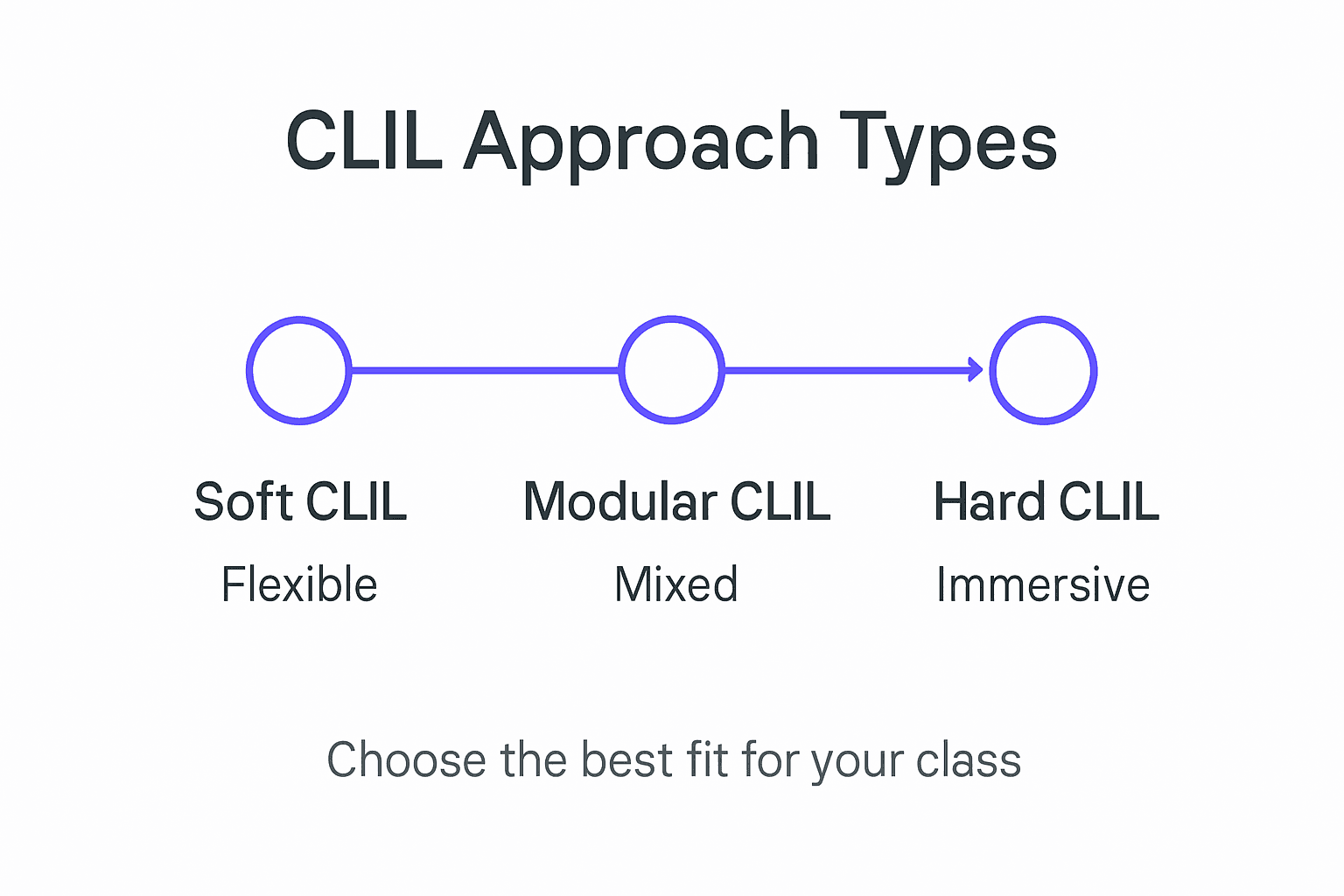
Cambridge research highlights additional nuanced approaches, including language-led and subject-led models. Language-led approaches prioritise language acquisition by incorporating subject content into linguistic instruction, while subject-led models focus on delivering academic content through a foreign language. These approaches share a common goal of developing simultaneous proficiency in both linguistic skills and academic knowledge.
The following table summarises the primary CLIL approaches in English education and their key features:
| CLIL Approach | Integration Level | Typical Duration | Teacher Requirements |
|---|---|---|---|
| Soft CLIL | Minimal content focus | One lesson or short term | Basic subject awareness |
| Modular CLIL | Moderate content focus | Several weeks or months | Balanced subject and language skills |
| Hard CLIL | High content focus | 50% or more of curriculum | Advanced content and language expertise |
Pro Tip: CLIL Implementation Strategy: Select your CLIL approach based on your students’ linguistic proficiency, available resources, and specific learning objectives, ensuring a balanced and supportive educational experience.
How CLIL Works in Multilingual Classrooms
Cambridge researchers highlight that multilingual classrooms represent complex learning environments where traditional language instruction often falls short. CLIL emerges as a sophisticated pedagogical approach designed to address the intricate communication challenges inherent in diverse linguistic settings, transforming potential barriers into dynamic learning opportunities.
The multilingual classroom becomes a rich ecosystem of linguistic exchange through CLIL’s innovative strategies. By integrating subject content with language learning, educators can create inclusive learning environments that leverage students’ existing linguistic repertoires. Key techniques like translanguaging allow students to draw upon multiple language resources simultaneously, enabling more nuanced communication and deeper cognitive engagement. This approach recognises that language learning is not a linear process but a complex, interconnected system of communication and understanding.

Multimodal learning strategies form another critical component of CLIL’s effectiveness in multilingual contexts. Teachers employing CLIL methodologies utilise diverse communication channels beyond verbal language, including visual aids, gestures, digital technologies, and collaborative learning techniques. These strategies help students who might struggle with traditional language instruction, providing multiple entry points for comprehension and expression. By creating flexible, adaptive learning environments, CLIL transforms linguistic diversity from a potential challenge into a significant educational asset.
Pro Tip: Multilingual Classroom Strategy: Embrace linguistic diversity by designing lessons that explicitly value and incorporate students’ multiple language backgrounds, creating a supportive and inclusive learning environment.
Key Skills and Qualifications for CLIL Educators
Cambridge educational researchers emphasise that successful CLIL educators require a sophisticated blend of linguistic, pedagogical, and interdisciplinary skills. Unlike traditional language teachers, CLIL professionals must navigate complex instructional landscapes that demand exceptional adaptability, deep subject knowledge, and advanced language proficiency.
The core competencies for CLIL educators extend far beyond standard teaching qualifications. Professionals in this field must demonstrate advanced linguistic capabilities, typically requiring near-native fluency in the target language and a comprehensive understanding of subject-specific terminology. Disciplinary expertise becomes equally critical, with educators needing robust academic backgrounds that allow them to teach complex content while simultaneously supporting language development. This requires a unique skill set that combines subject matter expertise, language teaching strategies, and innovative pedagogical approaches.
Advanced professional qualifications play a crucial role in preparing educators for CLIL environments. Specialised certifications such as the Trinity CertPT in CLIL provide targeted training in integrated teaching methodologies, multimodal communication strategies, and techniques for supporting linguistic diversity. These qualifications equip teachers with practical skills in designing curriculum that simultaneously addresses content learning objectives and language acquisition goals, ensuring students receive comprehensive, holistic educational experiences.
Here is a quick reference to the essential skills and qualifications for effective CLIL educators:
| Skill Area | Key Competency | Benefit for CLIL Instruction |
|---|---|---|
| Linguistic | Near-native target language fluency | Enables precise language modelling |
| Subject Knowledge | Deep understanding of academic topics | Supports accurate content delivery |
| Pedagogical | Integrated language-content strategies | Fosters holistic student development |
| Professional | Specialist CLIL certifications | Increases employability and impact |
Pro Tip: Professional Development Strategy: Continuously expand your linguistic and subject knowledge through targeted professional development programmes, seeking opportunities that blend disciplinary expertise with advanced language teaching methodologies.
Global Career Outcomes With Accredited CLIL Training
Cambridge educational research demonstrates that accredited CLIL training dramatically expands professional opportunities for educators in an increasingly globalised educational landscape. Professionals with specialised CLIL qualifications position themselves at the forefront of international teaching markets, offering unique skills that bridge content knowledge and language instruction across multiple educational contexts.
The global career pathways for CLIL-trained educators span diverse professional settings, including international schools, bilingual programmes, multinational educational institutions, and private language academies. Specific opportunities emerge in regions with robust multilingual education systems, such as parts of Europe, Asia, and South America, where schools actively seek teachers capable of delivering integrated content and language learning. Qualifications like the Trinity CertPT in CLIL provide recognised credentials that signal advanced pedagogical expertise, making candidates significantly more competitive in competitive international recruitment markets.
Beyond traditional classroom roles, CLIL-trained professionals find exciting career opportunities in curriculum development, educational consultancy, teacher training, and educational technology. The sophisticated skill set developed through accredited CLIL training enables educators to work across sectors, designing innovative learning experiences that address the complex communication needs of contemporary global learners. These professionals become valuable resources in educational institutions seeking to develop sophisticated, integrated language learning programmes that prepare students for international academic and professional environments.
Pro Tip: Career Development Strategy: Continuously expand your professional network through international conferences, online platforms, and professional associations specialising in multilingual and integrated learning approaches.
Elevate Your Teaching Career with Accredited CLIL and TEFL Training
Mastering CLIL teaching requires not only a passion for language and content integration but also advanced skills and recognised qualifications. If you are inspired by the transformative power of CLIL to engage multilingual classrooms and want to develop your expertise with globally accredited training, EBC TEFL offers exactly what you need. Our programmes are Trinity College London accredited, ensuring you gain trusted credentials respected by international employers.
Take the next step with our specialised CLIL certification options and comprehensive 1-year study and work abroad programmes in Spain, France, and Italy. Benefit from hands-on teacher training, visa support, cultural immersion, and lifetime job placement assistance to unlock global teaching opportunities. Ready to combine academic excellence with practical experience and career growth? Get personalised advice and start your journey now by booking a free consultation at EBC TEFL. Explore our Trinity CertPT CLIL course and 1-year study/work abroad programmes designed to prepare you for success in international classrooms.
Frequently Asked Questions
What does CLIL stand for and what is its purpose?
CLIL stands for Content and Language Integrated Learning. Its purpose is to combine subject content teaching with language acquisition, aiming to enhance both linguistic skills and academic understanding simultaneously.
What are the main approaches to CLIL in English education?
The main approaches to CLIL in English education include Soft CLIL, Modular CLIL, and Hard CLIL. Each approach varies in the integration level of content and language, with Hard CLIL being the most intensive, delivering a significant portion of the curriculum in the target language.
How does CLIL benefit multilingual classrooms?
CLIL benefits multilingual classrooms by creating inclusive learning environments that utilise students’ existing language skills. It encourages techniques like translanguaging and multimodal strategies, making language learning more accessible and engaging for diverse learners.
What skills and qualifications are essential for CLIL educators?
CLIL educators need a strong blend of linguistic skills, subject knowledge, and pedagogical expertise. Advanced language proficiency, disciplinary expertise, and specialised certifications in CLIL methodologies are crucial for effective teaching in integrated learning contexts.
