
Key Points
- Course moderation in TEFL is an external process that verifies a course’s assessments and teaching standards to ensure recognition and quality. It involves independent reviews by appointed moderators who confirm assessments, observe teaching practice, and produce reports for continuous improvement. This process guarantees that qualifications meet international standards, boosting employment opportunities worldwide.
Course moderation in TEFL is the formal process of external academic oversight that verifies a course meets standardised quality and assessment criteria, guaranteeing that the certification it awards is valid and credible. This process is distinct from day-to-day course management and sits at the heart of how bodies such as Trinity College London maintain consistent standards across providers worldwide. If you are considering a TEFL qualification, understanding what course moderation means for your certification is one of the most practical things you can do before you enrol.
What is course moderation in TEFL and why does it matter?
Course moderation in TEFL is the structured review of a course’s assessments, teaching practice, and delivery standards by an independent external moderator appointed by an accrediting body. The moderator is not employed by the course provider. That independence is the whole point.

The purpose of moderation is threefold: quality assurance, standardisation, and academic integrity. Quality assurance confirms that the course content and assessment methods meet the accreditor’s published criteria. Standardisation ensures that a candidate who passes in one country receives a qualification of equal weight to one awarded in another. Academic integrity protects trainees from unfair or inconsistent marking.
Recognised regulatory frameworks underpin this process. The Trinity CertTESOL, for example, is an Ofqual-regulated qualification. Ofqual is the UK government body that regulates qualifications, examinations, and assessments. That regulatory status means the external moderation process is not optional or informal. It is a condition of the qualification’s continued recognition.
Trinity College London monitors more than 100 validated providers globally through its external moderation system. That reach means a candidate completing the Trinity CertTESOL in South Korea, Brazil, or Spain receives a qualification assessed against the same standardised criteria.
What does a TEFL course moderator actually do?
A TEFL course moderator carries out a structured set of tasks designed to produce an evidence-based judgement on a course’s academic quality. The role is evaluative, not administrative.
Core moderator responsibilities include:
- Reviewing trainee assessments to confirm that marking is accurate, consistent, and aligned with the accreditor’s grade descriptors.
- Observing teaching practice sessions to verify that trainees are being assessed against the correct criteria and that feedback from tutors is constructive and fair.
- Examining course documentation, including lesson plans, written assignments, and tutor feedback records.
- Conducting discussions with tutors to assess whether they understand and apply the course’s assessment standards correctly.
- Interviewing trainees to gather independent evidence about their learning experience and the quality of course delivery.
- Producing a written moderation report that includes findings, commendations, and recommendations for improvement.
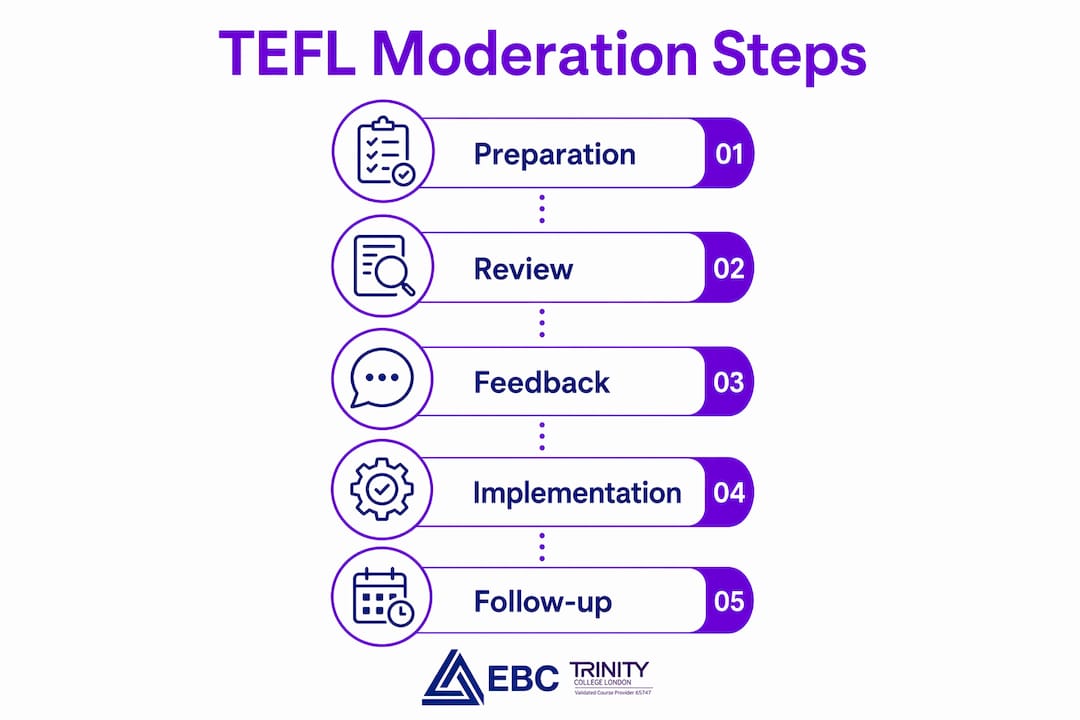
Moderation reports include specific recommendations and timelines for providers to implement changes. This means moderation is not a one-off inspection. It is a cycle of review, feedback, and improvement.
Pro Tip: When you research a TEFL course, ask the provider directly whether their qualification is externally moderated and by whom. A provider that cannot name their accrediting body or moderating organisation is a significant warning sign.
One distinction worth making clear: academic course moderation is entirely separate from the role of a platform moderator or course support coordinator. Academic moderators validate certification standards. They do not answer student queries, manage discussion forums, or provide technical support.
How often does TEFL course moderation occur?
Moderation frequency is set by the accrediting body, not the course provider. This matters because it removes any conflict of interest from the scheduling process.
IATQuO moderation follows a structured cycle that typically occurs every sixth to eighth course run, or at least once annually, whichever comes first. The trigger for a moderation visit is therefore a combination of course volume and time elapsed since the last review.
A typical moderation visit follows these phases:
- Pre-visit documentation review. The moderator examines course materials, assessment records, and tutor feedback submitted in advance by the provider.
- Teaching practice observation. The moderator attends or reviews recorded teaching practice sessions to assess how trainees are evaluated in real classroom conditions.
- Trainee and tutor discussions. The moderator gathers evidence from trainees and tutors independently to cross-reference the provider’s own records.
- Report writing and feedback. The moderator produces a written report with graded findings and specific recommendations.
- Follow-up review. The provider responds to recommendations within a set timeframe, and the accreditor monitors compliance before the next moderation cycle begins.
This phased approach means moderation is not a single snapshot. It is an ongoing quality assurance mechanism that tracks a provider’s performance over time. Providers who consistently meet or exceed standards build a track record that is visible to accreditors. Those who fall short face structured improvement requirements.
Why does moderation matter for your TEFL career?
Externally moderated TEFL courses produce qualifications that employers and immigration authorities worldwide recognise and trust. That recognition has a direct impact on your ability to find teaching work globally.
Externally moderated courses score higher on course quality because of rigorous standardisation, a validated syllabus, and practical teaching assessment. For you as a candidate, this means your qualification carries weight in competitive job markets from Japan to Germany to Colombia.
Pro Tip: Check whether your chosen qualification appears on Ofqual’s Register of Regulated Qualifications or is listed on the Trinity College London{target=‘_blank’} website. Both are publicly searchable and take less than two minutes to verify.
Moderation also protects you from unfair marking. Without external oversight, a tutor could apply marking criteria inconsistently, either too leniently or too harshly, without any mechanism for correction. External moderation catches these discrepancies before they affect your final grade.
The connection between moderation and employment is concrete. Employers in countries with formal English teaching sectors, including South Korea, Japan, the UAE, and across Europe, frequently specify that candidates must hold a recognised, accredited qualification. A qualification backed by external moderation and Ofqual regulation meets that requirement. An unmoderated certificate from an unaccredited provider typically does not.
Moderated courses also prepare you more thoroughly for real classroom conditions. Because teaching practice is observed and assessed against validated criteria, you receive structured, evidence-based feedback during your training. That feedback directly improves your classroom skills before you take your first paid teaching position. You can read more about how this preparation works in EBC’s guide on passing external moderation.
How is academic moderation different from platform moderation?
The word “moderation” appears in two very different contexts in TEFL, and confusing the two leads to poor decisions when choosing a course.
Academic moderation is the external quality assurance process described throughout this article. It is carried out by accreditor-appointed moderators who validate course content, assessments, and teaching practice against regulatory standards. Academic moderators have no contact with learners during the course itself. Their role is entirely focused on certification integrity.
Platform moderation, by contrast, is an operational support function. Platform moderators handle daily learner engagement, technical support, and discussion forum management. They are not responsible for academic quality assurance. Their role is to keep the learning environment running smoothly and to support students who have questions or technical difficulties.
The practical difference looks like this:
- A platform moderator answers your question about how to submit an assignment, resolves a login issue, or facilitates a discussion thread.
- An academic moderator reviews whether the assignment you submitted was marked fairly and whether the marking criteria align with the accreditor’s standards.
Many students confuse academic moderators with platform support staff. Positive reviews that praise a course’s “moderators” often refer to helpful support coordinators rather than the external academics who validate certification quality. When you read course reviews, look specifically for references to external accreditation visits, moderation reports, or named accrediting bodies. Those are the signals that confirm genuine academic oversight is in place.
Remote course moderators engaged for large online TEFL programmes specialise in community and technical support. They are distinctly separate from the accreditor-appointed academic moderators who validate course content. Both roles add value, but only one of them protects your certification.
EBC and accredited TEFL certification
Choosing a TEFL course with genuine external moderation is one of the most important decisions you will make for your teaching career.

EBC offers accredited TEFL certification through Trinity College London, one of the most respected awarding bodies in English language teacher training worldwide. Every course is subject to the external moderation process described in this article, giving you confidence that your qualification meets internationally recognised standards. EBC operates globally, supporting candidates across Europe, Asia, Latin America, and beyond, with free lifetime job placement assistance included. If you want to teach English abroad and need a qualification that opens doors in competitive markets, book a free consultation with the EBC team to find the right certification pathway for you.
Key takeaways
Course moderation in TEFL is the external academic oversight process that protects the value of your certification, ensures fair assessment, and determines whether your qualification is recognised by employers worldwide.
| Point | Details |
|---|---|
| Academic moderation is external | An independent moderator appointed by the accrediting body, not the provider, validates your course. |
| Moderation follows a set cycle | IATQuO moderation occurs every sixth to eighth course run, or at least once annually. |
| Ofqual regulation adds credibility | Qualifications like the Trinity CertTESOL are Ofqual-regulated, making external moderation a legal requirement. |
| Platform moderation is not academic moderation | Support staff who manage forums and answer queries do not affect your certification standards. |
| Moderation improves career prospects | Externally moderated qualifications are recognised by employers in competitive markets across Asia, Europe, and the Americas. |
FAQ
What is course moderation in TEFL?
Course moderation in TEFL is the process by which an independent external moderator, appointed by an accrediting body, reviews a course’s assessments, teaching practice, and delivery standards to confirm they meet regulated quality criteria.
Who carries out TEFL course moderation?
An external moderator appointed by the accrediting body, such as Trinity College London or IATQuO, carries out academic moderation. The moderator is independent of the course provider.
How often is a TEFL course moderated?
IATQuO moderation typically occurs every sixth to eighth course run, or at least once annually. The accrediting body sets the schedule, not the provider.
Does moderation affect my TEFL certificate’s value?
Yes. External moderation protects the integrity and value of your TEFL certificate by confirming that assessments are fair, standardised, and compliant with regulatory requirements, which is what employers in global markets look for.
What is the difference between academic and platform moderation?
Academic moderation validates certification quality through external review of assessments and teaching practice. Platform moderation handles learner support, forum management, and technical assistance. Only academic moderation affects the credibility of your qualification.