
Teachers are in high demand across Spain, France, and Italy, with multilingual classrooms expanding every year. If you are aiming to become a globally employable educator, understanding EAL teaching and key concepts opens new possibilities for personal growth and professional impact. This guide delivers clear strategies for gaining accredited TEFL qualifications and building adaptive skills that make you stand out in competitive European schools.
Table of Contents
- Defining EAL Teaching and Key Concepts
- Types of EAL Learners and Their Needs
- Essential Principles and Effective Strategies
- Qualifications and Classroom Roles in EAL
- Global Employment, Accredited Pathways, and Programmes
Key Takeaways
| Point | Details |
| EAL Teaching Focus | EAL teaching supports multilingual learners’ comprehensive linguistic development across various contexts, requiring adaptive methodologies. |
| Diverse Learner Profiles | EAL learners exhibit varied proficiency levels and educational backgrounds, necessitating tailored interventions that address individual needs. |
| Effective Strategies | Successful EAL instruction integrates language development with curriculum learning, employing techniques like scaffolding and contextualised learning experiences. |
| Professional Qualifications | EAL educators must possess specialised qualifications and engage in continuous professional development to effectively support diverse learning needs. |
Defining EAL Teaching and Key Concepts
English as an Additional Language (EAL) teaching represents a specialised approach to supporting learners who are developing proficiency in English beyond their native language. Unlike traditional language instruction, EAL focuses on comprehensive linguistic development across academic, social, and communicative contexts. Comprehensive research from academic resources highlights the nuanced strategies required to effectively support multilingual students.
EAL teaching recognises that language acquisition is complex and multifaceted. Key concepts include understanding learners’ linguistic backgrounds, identifying individual learning needs, and creating inclusive educational environments that validate diverse communication styles. Educators working in EAL settings must develop adaptive teaching techniques that address both language development and subject matter comprehension simultaneously.
The fundamental principles of EAL teaching centre on recognising linguistic diversity as an asset rather than a deficit. This approach involves developing specialised instructional strategies that support learners in navigating academic content while simultaneously building English language proficiency. Strategies might include scaffolding complex language structures, providing contextual learning experiences, and encouraging metalinguistic awareness among students.
Professional Insight: Successful EAL teaching requires continuous professional development and a deep commitment to understanding the unique linguistic journeys of multilingual learners.
Types of EAL Learners and Their Needs
EAL learners represent a remarkably diverse group with varied linguistic backgrounds and educational experiences. Research indicates a complex spectrum of learner profiles ranging from newly arrived students with minimal English skills to multilingual individuals with sophisticated language capabilities. Understanding these diverse profiles is crucial for developing targeted educational interventions.
Typically, EAL learners can be categorised across several key proficiency bands. These include emergent learners who are just beginning their English language journey, intermediate learners developing functional communication skills, and advanced learners who are approaching native-like fluency. Comprehensive assessments from educational governance frameworks suggest that each group requires nuanced, tailored educational support strategies.
The needs of EAL learners extend beyond simple language acquisition. They encompass psychological, cultural, and academic dimensions that demand holistic educational approaches. Factors such as prior schooling, socio-economic background, age of arrival, and individual learning styles significantly influence language development and academic integration. Effective EAL teaching must therefore be adaptive, recognising each learner’s unique linguistic and educational trajectory.

The following table contrasts key EAL learner profiles and their educational implications:
| EAL Learner Profile | Language Proficiency Characteristics | Main Educational Needs |
| Emergent Learner | Little or no English, new to language | Intensive language exposure and basic support |
| Intermediate Learner | Functional in social situations, developing academic English | Structured practice and targeted vocabulary |
| Advanced Learner | Near-fluent, strong grasp of language | Nuanced feedback and advanced literacy tasks |
Professional Insight: Successful EAL support requires educators to view linguistic diversity as a strength, not a deficit, and to design flexible learning environments that celebrate multilingual competencies.
Essential Principles and Effective Strategies
Language Development demands a sophisticated approach that goes beyond traditional teaching methodologies. Comprehensive educational frameworks highlight key principles for supporting multilingual learners, emphasising the importance of creating meaningful, contextualised learning experiences that bridge linguistic and academic knowledge.
Effective EAL strategies centre on several critical pedagogical approaches. These include explicit language modeling, scaffolding complex linguistic structures, and designing purposeful learning contexts that enable students to develop both communicative and academic language skills. Educators must intentionally create environments that validate learners’ existing linguistic resources while systematically expanding their English language repertoire.
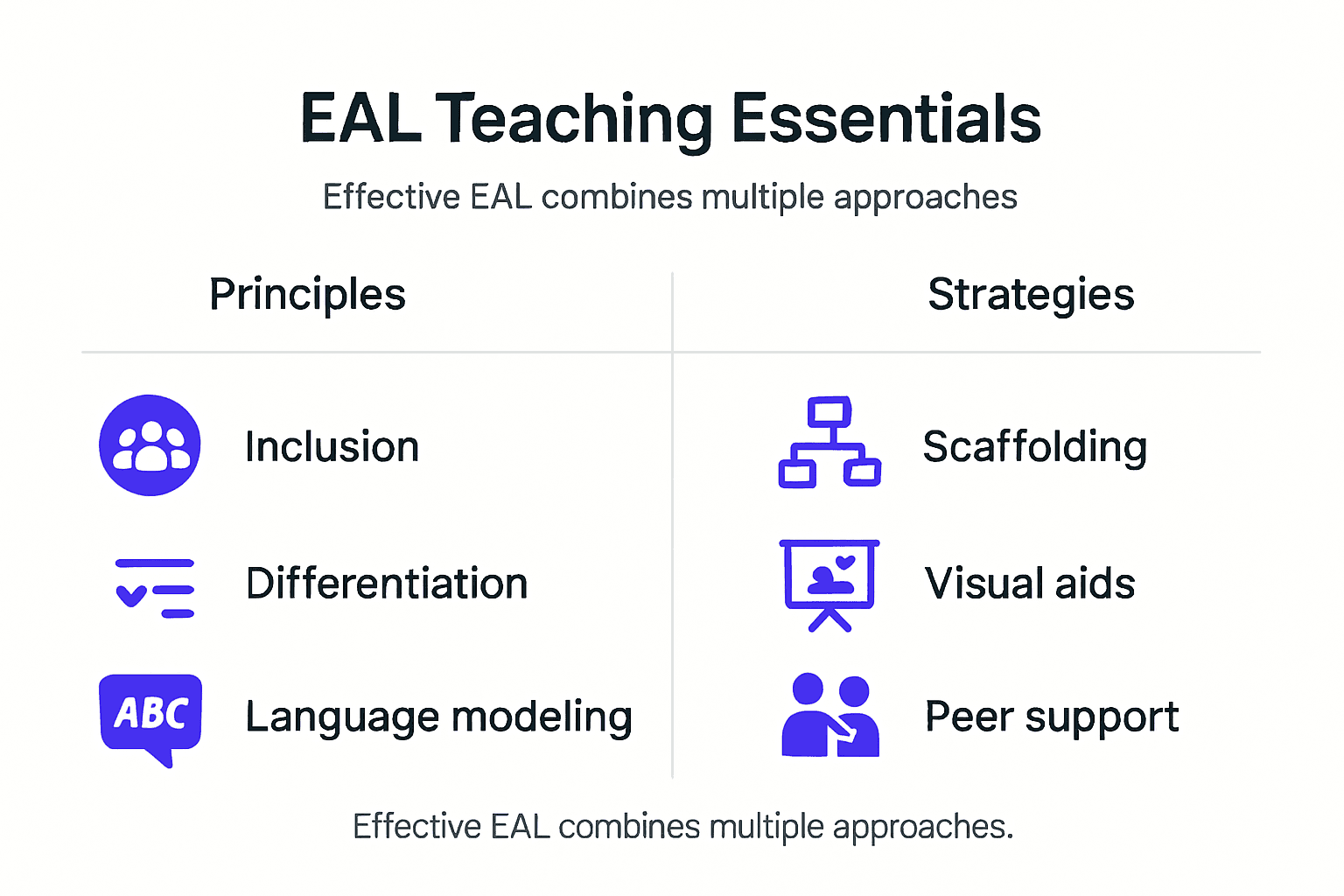
The most successful EAL teaching integrates language acquisition with curriculum learning, recognising that language development is not a separate process but a holistic educational journey. This approach requires differentiated instruction that addresses individual learner needs, considers their prior knowledge, and provides targeted support across subject areas. Critically, educators must maintain learners’ confidence by respecting their cultural and linguistic backgrounds, treating multilingualism as an asset rather than a challenge.
Professional Insight: Successful EAL teaching requires continuous professional development, cultural sensitivity, and a commitment to viewing linguistic diversity as a rich educational opportunity.
Qualifications and Classroom Roles in EAL
EAL teaching requires specialised professional qualifications that go beyond standard language instruction credentials. Professionals working in this field must possess a deep understanding of linguistic diversity, cultural competence, and adaptive pedagogical strategies. Educational policies emphasise the critical roles and responsibilities of qualified EAL support staff in creating inclusive and supportive learning environments.
The primary classroom roles for EAL specialists include comprehensive learner assessment, targeted language support, curriculum adaptation, and collaborative teaching. These professionals work closely with mainstream educators to develop strategies that simultaneously address language acquisition and academic content learning. Their responsibilities extend beyond traditional language teaching, encompassing learner progress monitoring, individualised intervention planning, and creating scaffolded learning experiences that validate students’ linguistic backgrounds.
Qualified EAL practitioners typically hold specialised certifications such as TEFL, TESOL, or specific EAL teaching diplomas. These qualifications equip educators with advanced methodologies for supporting multilingual learners, understanding second language acquisition theories, and implementing differentiated instructional approaches. Continuous professional development is crucial, enabling teachers to stay current with emerging linguistic research, technological tools, and innovative teaching strategies that support diverse learning needs.
This table outlines the pathways and benefits of key EAL teaching qualifications:
| Qualification Type | Typical Accrediting Body | Primary Professional Benefit |
| TEFL | International TEFL organisations | Entry to global English teaching roles |
| TESOL | TESOL International Association | Broader methodology expertise |
| Trinity CertTESOL | Trinity College London | Professional credibility in Europe and Asia |
Professional Insight: Successful EAL educators continuously reflect on their practice, remain culturally responsive, and view linguistic diversity as an educational strength.
Global Employment, Accredited Pathways, and Programmes
EAL teaching offers extraordinary global employment opportunities for educators seeking international careers with meaningful impact. Exploring professional accreditation pathways reveals multiple routes into international language education, including specialised certification programmes that open doors to teaching positions worldwide.
Accredited programmes provide comprehensive training that equips educators with advanced pedagogical skills specifically tailored for multilingual classrooms. These professional pathways typically combine rigorous theoretical preparation with practical teaching experience, ensuring graduates are prepared for diverse educational environments. Key certifications like Trinity CertTESOL and internationally recognised TEFL qualifications enable teachers to secure positions across Europe, Asia, South America, and the Middle East.
The global demand for qualified EAL professionals continues to grow, driven by increased international mobility, globalisation, and educational institutions’ commitment to supporting multilingual learners. Successful candidates can expect opportunities in various settings, including international schools, language institutes, universities, corporate training programmes, and online teaching platforms. Professional development and continuous learning remain crucial, with many programmes offering ongoing support and job placement assistance to help educators navigate international teaching landscapes.
Professional Insight: Strategic career planning in EAL teaching involves selecting accredited programmes, developing cultural competence, and remaining adaptable to emerging global educational trends.
Advance Your EAL Teaching Journey with Trinity-Accredited Training
Mastering English as an Additional Language teaching means understanding complex learner needs and embracing cultural diversity. If you are inspired by the vital role of EAL educators detailed in the article, now is the perfect time to enhance your skills with globally recognised qualifications. At EBC TEFL, our Trinity College London accredited TEFL and TESOL courses provide practical, hands-on training designed to prepare you for working with diverse multilingual learners in supportive and inclusive settings.

Take advantage of our comprehensive 1-year study and work abroad programmes in Spain, France, and Italy that blend accredited teacher training with immersive cultural experiences. Benefit from expert visa support, opportunities to teach or work part-time, and lifelong global job placement assistance. Equip yourself with specialised credentials like Trinity CertTESOL to unlock rewarding international teaching roles with confidence. Start your transformative EAL teaching career today by booking a free consultation at EBC TEFL. Discover how you can make an impact worldwide while enjoying continuous professional growth and community support.
Frequently Asked Questions
What is EAL teaching?
English as an Additional Language (EAL) teaching is a specialized approach aimed at supporting learners who are developing English proficiency beyond their native language, focusing on comprehensive language development across academic, social, and communicative contexts.
Why is EAL teaching important?
EAL teaching is important because it acknowledges and supports the diverse linguistic backgrounds of students, enabling them to succeed academically while developing their English language skills. This approach helps create inclusive educational environments that validate different communication styles.
What are the different types of EAL learners?
EAL learners can be categorized into three main profiles: emergent learners with little or no English, intermediate learners developing functional communication skills, and advanced learners nearing fluency. Each group requires tailored educational support to meet their unique needs.
What qualifications are needed for EAL teaching?
EAL teaching typically requires specialized qualifications, such as TEFL, TESOL, or specific EAL diplomas. These credentials equip educators with the necessary methodologies for effectively supporting multilingual learners in diverse educational settings.
Recommended
- ESL Meaning – Why It Matters For English Teachers
- English language teaching skills for successful TEFL teachers – EBC Trinity CertTESOL and TEFL courses
- Teaching English to children in Asia: All you need to know – EBC Trinity CertTESOL and TEFL courses
- Artificial intelligence: Teaching English online in the age of AI – EBC Trinity CertTESOL and TEFL courses
