
Most advice about learning English overlooks how deeply cultural context shapes progress, especially for british learners and teachers. While many assume mastering daily conversation means true fluency, research shows that only about 40 percent of English language learners reach full academic proficiency. Understanding what separates ESL from EFL, and the unique needs faced by british students, helps both educators and learners find the right path through common misconceptions, specialized programmes, and international opportunities.
Table of Contents
- Defining ESL and Common Misconceptions
- Main Types of ESL Programmes Worldwide
- Essential Skills and Requirements for ESL Teachers
- The Role of International Accreditation
- Career Outcomes and Paths with ESL Certification
- Study and Work Abroad: Spain, France, Italy
Key Takeaways
| Point | Details |
|---|---|
| Understanding ESL vs EFL | ESL instruction occurs in English-speaking countries, focusing on practical integration, while EFL is situated in non-English-speaking contexts, often prioritising theoretical language acquisition. |
| Diverse ESL Programmes | ESL programmes vary from immersion and sheltered instruction to transitional bilingual education, catering to different learner needs and contexts. |
| Essential Skills for ESL Teachers | ESL educators must possess linguistic expertise, cultural understanding, and adaptive teaching strategies to support diverse student populations effectively. |
| Career Opportunities with ESL Certification | Obtaining ESL certification opens various career paths, including roles in academic institutions, corporate training, and online education, enhancing global employability. |
Defining ESL and Common Misconceptions
English as a Second Language (ESL) represents a comprehensive educational approach focused on teaching English to individuals whose primary language is not English. Unlike casual assumptions, ESL goes far beyond simple language instruction and encompasses complex linguistic and cultural learning strategies.
Contrary to popular misconception, learners’ conversational abilities do not automatically translate to academic proficiency. Many educators mistakenly believe that students who can communicate conversationally are fully prepared for academic environments. In reality, academic language requires sophisticated vocabulary, complex grammatical structures, and nuanced comprehension skills that extend well beyond everyday communication.
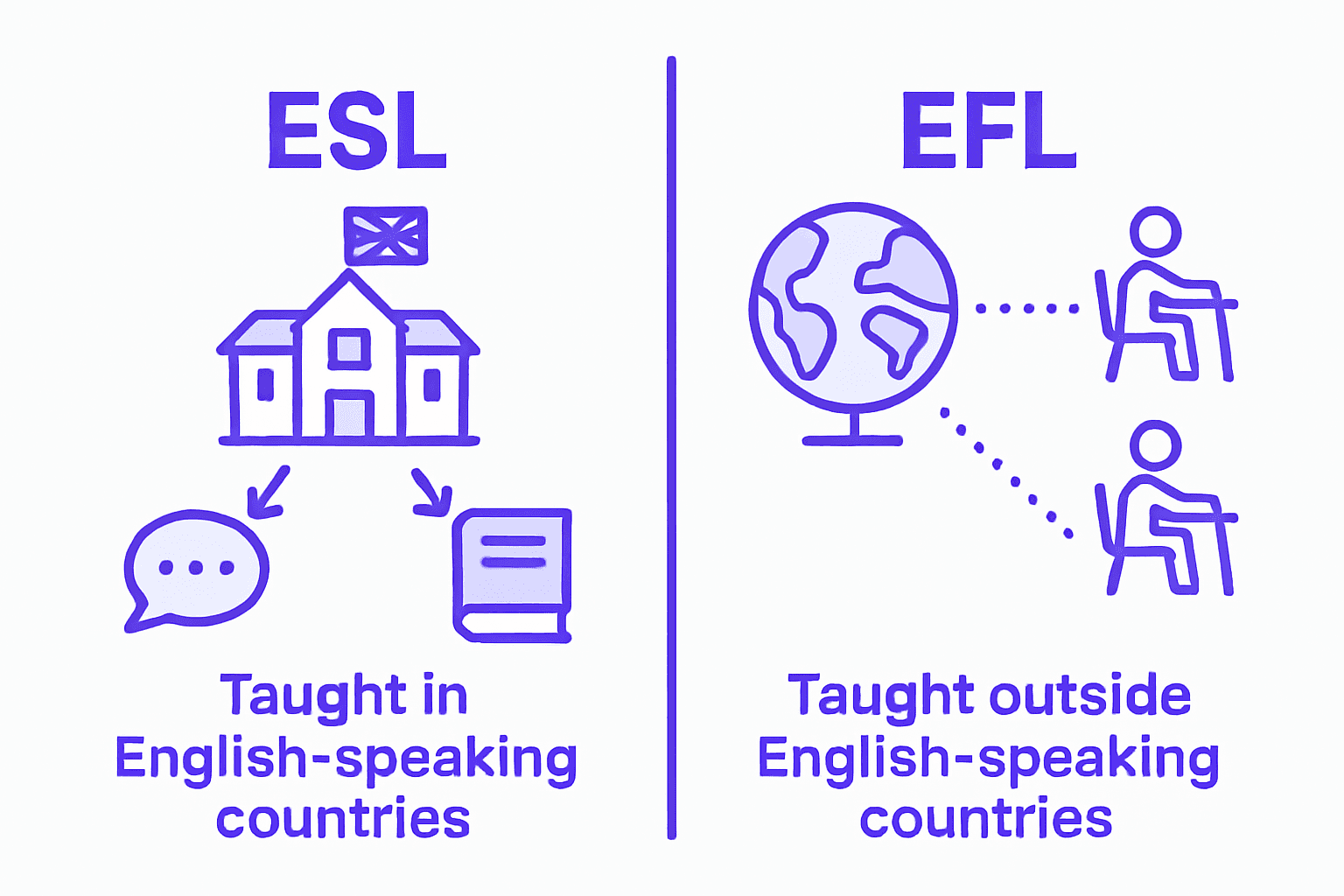
The term ESL specifically refers to language instruction within English-speaking countries, distinguishing it from EFL (English as a Foreign Language), which occurs in non-English speaking nations. Key differences include contextual learning environments, instructional methodologies, and learner objectives. ESL programmes typically focus on immediate practical integration into English-speaking academic or professional settings, whereas EFL programmes often prioritise theoretical language acquisition.
Pro Tip: Research and Verify: Always conduct thorough background research on ESL programmes, understanding the specific linguistic and cultural contexts of your target learning environment before committing to a teaching or learning pathway.
To clarify the main distinctions between ESL and EFL, refer to the comparison below:
| Aspect | ESL (English as a Second Language) | EFL (English as a Foreign Language) |
|---|---|---|
| Location | English-speaking countries | Non-English-speaking countries |
| Learning Context | Real-world immersion in English environment | Classroom-based, limited daily exposure |
| Instruction Focus | Immediate practical communication & integration | Theoretical skills, exam preparation |
| Learner Objectives | Academic or professional success locally | General proficiency or travel abroad |
Main Types of ESL Programmes Worldwide
ESL programmes worldwide represent diverse approaches to language instruction, each designed to meet specific learner needs and contextual requirements. These programmes range from immersive experiences to structured academic environments, offering multiple pathways for English language acquisition.
One prominent model is transitional bilingual education, which provides a strategic approach for learners by initially supporting instruction in their native language before gradually transitioning to full English instruction. This method acknowledges the cognitive complexity of language learning and respects students’ linguistic backgrounds.
The primary categories of ESL programmes include:
- Immersion Programmes: Complete English language environments where instruction occurs entirely in English
- Sheltered Instruction: Academic content taught in English with specialised support for language learners
- Pull-out Programmes: Students receive additional English instruction outside regular classroom hours
- Two-way Bilingual Programmes: Integrated learning involving both native English speakers and English language learners
Each programme type offers unique advantages, with selection depending on factors such as student age, linguistic background, educational goals, and institutional resources. Specialised TEFL courses can provide educators with advanced strategies for navigating these diverse learning environments effectively.
Pro Tip: Programme Selection: Carefully assess individual student needs, institutional capabilities, and cultural contexts when choosing an appropriate ESL programme to ensure optimal language acquisition and academic success.
The following table summarises key considerations when selecting an ESL programme:
| Factor | Why It Matters | Questions to Ask |
|---|---|---|
| Student Age | Influences learning approach | Is content age-appropriate? |
| Linguistic Background | Affects support needs | Are native languages accommodated? |
| Educational Goals | Determines programme structure | What are desired learning outcomes? |
| Institutional Resources | Limits available options | Are there specialist teachers or tools? |
| Cultural Inclusion | Supports learner engagement | Is cultural diversity embraced? |
Essential Skills and Requirements for ESL Teachers
Successful ESL teaching requires a comprehensive blend of linguistic expertise, cultural understanding, and advanced pedagogical skills. Professional educators must develop a nuanced approach that goes beyond simple language instruction, encompassing complex communication and learning strategies.

Understanding the distinction between conversational and academic language proficiency represents a critical skill for ESL teachers. This expertise enables educators to support students in developing sophisticated language skills that extend far beyond basic communication, addressing the intricate linguistic challenges learners encounter.
Key essential skills for ESL teachers include:
- Linguistic Competence: Advanced English language mastery
- Cross-Cultural Communication: Ability to navigate diverse cultural contexts
- Adaptive Teaching Strategies: Flexibility in instructional approaches
- Technological Proficiency: Skill in digital learning platforms
- Classroom Management: Effective learner engagement techniques
English language teaching skills form the foundation of successful ESL instruction, requiring continuous professional development and a commitment to understanding learner diversity. Formal qualifications such as Trinity CertTESOL or TEFL certifications provide crucial pedagogical training, equipping teachers with sophisticated instructional methodologies.
Pro Tip: Continuous Learning: Regularly update your linguistic and pedagogical skills through professional development courses, cultural immersion experiences, and engagement with contemporary language teaching research.
The Role of International Accreditation
International accreditation serves as a critical benchmark for quality and standardisation in English language teaching, providing educators and institutions with recognised frameworks for professional development and pedagogical excellence. These accreditation systems establish rigorous standards that ensure consistent, high-quality language instruction across diverse global contexts.
Research demonstrates the profound importance of structured language acquisition, with comprehensive linguistic corpora informing contemporary teaching methodologies. Such extensive research collections provide invaluable insights into authentic language usage, enabling educators to develop more nuanced and effective instructional approaches.
Key aspects of international accreditation include:
- Global Recognition: Credentials respected worldwide
- Standardised Assessment: Consistent evaluation frameworks
- Professional Development: Continuous learning opportunities
- Quality Assurance: Rigorous pedagogical standards
- Career Advancement: Enhanced employability across international markets
Accreditation bodies like Trinity College London and Cambridge Assessment English play pivotal roles in establishing these professional standards. Research-based oral language acquisition programmes underscore the significance of structured, scientifically informed approaches to language education, highlighting how accreditation ensures methodological integrity.
Pro Tip: Credential Verification: Always independently verify the international recognition and specific requirements of any teaching certification before investing time and resources in a programme.
Career Outcomes and Paths with ESL Certification
ESL certification opens a world of diverse and exciting career opportunities across global educational and professional landscapes. Qualified educators can explore multiple career pathways that extend far beyond traditional classroom teaching, offering unprecedented professional flexibility and international mobility.
Professional development in TEFL presents multiple career trajectories that cater to individual interests and skill sets. These opportunities range from traditional academic roles to innovative digital teaching platforms, corporate language training, and specialised educational consulting.
Career paths for ESL-certified professionals include:
- Academic Institutions: Schools, universities, international programmes
- Corporate Training: Business English instruction, professional communication skills
- Online Education: Digital platforms, remote teaching opportunities
- Educational Consulting: Curriculum development, teacher training
- Private Tutoring: One-to-one and small group specialised instruction
- International organisations: NGOs, diplomatic missions, cultural exchange programmes
The global demand for English language instruction continues to grow, with TEFL course levels creating multiple entry points for aspiring educators. Certification levels ranging from entry-level to advanced diplomas enable professionals to strategically build their careers, with each qualification expanding potential employment opportunities and earning potential.
Pro Tip: Career Strategy: Continuously diversify your skill set by pursuing specialised certifications, developing digital teaching competencies, and maintaining an adaptable professional profile to maximise your global employability.
Study and Work Abroad: Spain, France, Italy
Study and work abroad programmes represent transformative opportunities for aspiring English language educators, offering comprehensive experiences that blend professional training, cultural immersion, and international career development. These integrated programmes provide a unique pathway for individuals seeking to launch their global teaching careers while simultaneously exploring European cultures.
Study and teach programmes offer extraordinary two-in-one opportunities for professional growth and personal exploration. These structured initiatives enable participants to simultaneously obtain internationally recognised teaching certifications while experiencing rich cultural environments in Spain, France, and Italy.
Key features of study and work abroad programmes include:
- Teacher Training: Trinity CertTESOL or equivalent certification
- Language Study: Intensive local language courses
- Cultural Immersion: Direct engagement with local communities
- Work Opportunities: Part-time teaching or professional placements
- Visa Support: Comprehensive administrative assistance
- Accommodation Guidance: Structured housing recommendations
Road2Italy and similar programmes exemplify the innovative approach to international teacher training, combining language education, professional certification, and cultural experiences. These programmes strategically address the growing demand for qualified English language instructors while providing participants with unparalleled personal and professional development opportunities.
Pro Tip: Programme Preparation: Research visa requirements, language learning resources, and local cultural expectations thoroughly before committing to an international study and work programme to ensure a smooth and enriching experience.
Advance Your ESL Journey with Trinity-Accredited TEFL Training and Global Opportunities
Understanding the complexities of ESL teaching and the distinct pathways for global language educators can be challenging. This article highlights important concepts like academic language proficiency, diverse ESL programme types, and the critical need for internationally recognised qualifications. If you are aiming to become a confident, qualified ESL teacher with the ability to support learners in real-world settings, obtaining a Trinity College London accredited certificate is essential. At EBC TEFL, we offer comprehensive, practical training including the prestigious Trinity CertTESOL and specialised courses such as Business English and Online Teaching designed to equip you with adaptive teaching strategies.

Step confidently into a rewarding global teaching career with our supportive platform that provides free lifetime job placement assistance worldwide. Explore unique 1-year study and work abroad programmes in Spain, France, and Italy that combine accredited teacher training, immersive language study, visa support, and part-time teaching opportunities. These programmes are crafted to bridge the gap between certification and real-world application while enriching your cultural experience. Discover how to transform your passion for teaching into a fulfilling profession by starting with a free consultation today at EBC TEFL. Take your next step towards global ESL teaching success with Trinity CertTESOL courses, specialised TEFL training, and extensive study/work abroad options tailored for your goals.
Frequently Asked Questions
What is the difference between ESL and EFL?
ESL (English as a Second Language) is taught in English-speaking countries, focusing on immediate practical integration, while EFL (English as a Foreign Language) is taught in non-English-speaking countries, often prioritising theoretical language acquisition.
What are the main types of ESL programmes?
The main types of ESL programmes include immersion programmes, sheltered instruction, pull-out programmes, and two-way bilingual programmes, each designed to meet specific learner needs and contexts.
What essential skills should ESL teachers possess?
ESL teachers should have advanced linguistic competence, cross-cultural communication skills, adaptive teaching strategies, technological proficiency, and effective classroom management techniques to support diverse learners.
How does international accreditation benefit ESL teachers?
International accreditation ensures quality and standardisation in language teaching, providing globally recognised credentials, continuous professional development opportunities, and career advancement potential for ESL educators.
