
Many people assume teaching English abroad demands native fluency and advanced degrees. That’s not true. Becoming an ESL teacher is achievable through accredited certification like Trinity CertTESOL, which equips you with practical skills to teach diverse learners worldwide. This guide explains what ESL teachers do, the responsibilities they manage, how to overcome common challenges, and why Trinity CertTESOL stands out as the best route to develop essential teaching skills. You’ll discover clear pathways to qualified ESL teaching and the global community support waiting for you.
Table of Contents
- Key takeaways
- Understanding the role of an ESL teacher
- Key responsibilities and teaching approaches
- Understanding ESL vs EFL and overcoming teaching challenges
- Becoming an accredited ESL teacher with Trinity CertTESOL
- Explore Trinity CertTESOL courses and start teaching abroad
- Frequently asked questions
Key Takeaways
| Point | Details |
|---|---|
| Diverse teaching settings | ESL teachers work across settings from schools to online platforms, teaching learners of all ages and backgrounds. |
| Core language skills | They focus on reading, writing, speaking, and listening, applying distinct methods to develop each area. |
| CertTESOL benefits | Accredited certification like Trinity CertTESOL provides practical training and immediate classroom feedback to prepare new teachers. |
| Differentiated lesson plans | Teachers create differentiated lesson plans, assessments, and records to track progress across varied proficiency levels. |
Understanding the role of an ESL teacher
An ESL teacher provides specialised English language instruction to non-native speakers across settings, focusing on skills development from beginner to advanced learners. The scope extends far beyond simple vocabulary drills. ESL teachers work in primary and secondary schools, universities, adult education centres, community programmes, and increasingly through online platforms that connect them with students globally. This diversity means you might teach young children foundational grammar one day and coach business professionals on presentation skills the next.
The learner base is equally varied. You’ll encounter absolute beginners who struggle with basic greetings alongside advanced students refining academic writing. Age ranges span from early childhood through retirement, each group bringing unique motivations and learning styles. Some students need English for immigration requirements, others for career advancement, and many for personal enrichment. This variety keeps the work dynamic and intellectually stimulating.
ESL teachers focus on four core language skills: reading comprehension, writing mechanics and composition, speaking fluency and pronunciation, and listening comprehension. Each skill requires distinct teaching approaches and assessment methods. You’ll design activities that integrate these skills naturally, mirroring how language functions in real communication. For example, a lesson on restaurant vocabulary might combine reading menus, writing orders, role-playing conversations, and listening to authentic dialogue.
Typical responsibilities include:
- Creating differentiated lesson plans that address multiple proficiency levels simultaneously
- Conducting diagnostic assessments to identify individual learner needs and gaps
- Providing constructive feedback that builds confidence whilst correcting errors
- Adapting materials to reflect cultural contexts relevant to your students
- Maintaining detailed records of progress for institutional reporting and student tracking
The Trinity CertTESOL certification prepares you specifically for these responsibilities through hands-on teaching practice with real learners. Unlike theoretical courses, you’ll receive immediate feedback on your classroom management, lesson pacing, and student engagement techniques. This practical foundation proves invaluable when you face your first class of eager but nervous learners.
“Effective ESL teaching requires balancing linguistic accuracy with communicative fluency, ensuring students can use English confidently in authentic situations whilst developing grammatical precision over time.”
Key responsibilities and teaching approaches
ESL teachers create lesson plans, assess proficiency, provide cultural support, document progress, and collaborate with educators using different teaching models such as in-class support and coaching. Lesson planning demands creativity and structure in equal measure. You’ll analyse curriculum standards, identify learning objectives, select appropriate materials, and design activities that maintain engagement whilst building skills systematically. Effective plans anticipate common errors, prepare scaffolding strategies, and include contingency activities for varied pacing needs.

Assessing learner proficiency accurately shapes everything that follows. You’ll administer placement tests to establish baseline abilities, conduct formative assessments throughout units to monitor progress, and design summative evaluations that measure learning outcomes fairly. This ongoing assessment cycle informs your instructional adjustments and helps students recognise their own growth. Many ESL teachers use portfolio systems where students compile work samples demonstrating progress across skills over time.
Cultural support extends beyond language instruction. You’ll help students navigate unfamiliar educational systems, understand classroom expectations that differ from their home countries, and build confidence in intercultural communication. This might involve explaining why British English spelling differs from American conventions, discussing appropriate formality levels in professional emails, or helping students decode idiomatic expressions that confuse literal translations.
Documenting student progress serves multiple stakeholders. Institutions require records for accreditation and funding. Parents want evidence their children are advancing. Students themselves benefit from tangible proof of improvement when motivation wanes. You’ll maintain grade books, write progress reports, and often participate in parent-teacher conferences or institutional reviews. Organised record-keeping becomes second nature with experience.
Collaboration amplifies your impact. You’ll work with:
- Content area teachers to support ESL students in mainstream classes
- Special education staff when students have additional learning needs
- School counsellors addressing social-emotional challenges
- Administrative staff coordinating schedules and resources
- Fellow ESL teachers sharing successful strategies and materials
Teaching models vary by context. In-class support places you alongside a content teacher, providing real-time assistance to ESL learners during mainstream lessons. Pull-out programmes bring small groups to your classroom for focused language instruction. Push-in models have you entering other classrooms to support specific students. Online teaching demands different skills: managing virtual classrooms, using digital tools effectively, and maintaining engagement without physical presence.
The Trinity CertTESOL certification guide details how the course develops these competencies through observed teaching practice. You’ll receive detailed feedback on your lesson delivery, classroom management, and ability to adapt instruction in real time. This immediate, expert guidance accelerates your professional development far beyond what self-study or purely theoretical training can achieve.
Pro Tip: Start building a digital resource library from day one. Organise materials by skill, proficiency level, and topic. When lesson planning time is tight, you’ll appreciate having tested activities ready to adapt rather than creating everything from scratch.
Understanding ESL vs EFL and overcoming teaching challenges
ESL involves teaching English in an immersive native environment, whilst EFL is teaching in a non-native context; challenges include language interference and cultural adjustment requiring scaffolds and patience. The distinction matters because it shapes your teaching approach fundamentally. ESL students in English-speaking countries encounter the language constantly outside class. They hear it on buses, see it on signs, and need it for daily transactions. This immersion accelerates certain aspects of learning but can overwhelm beginners.
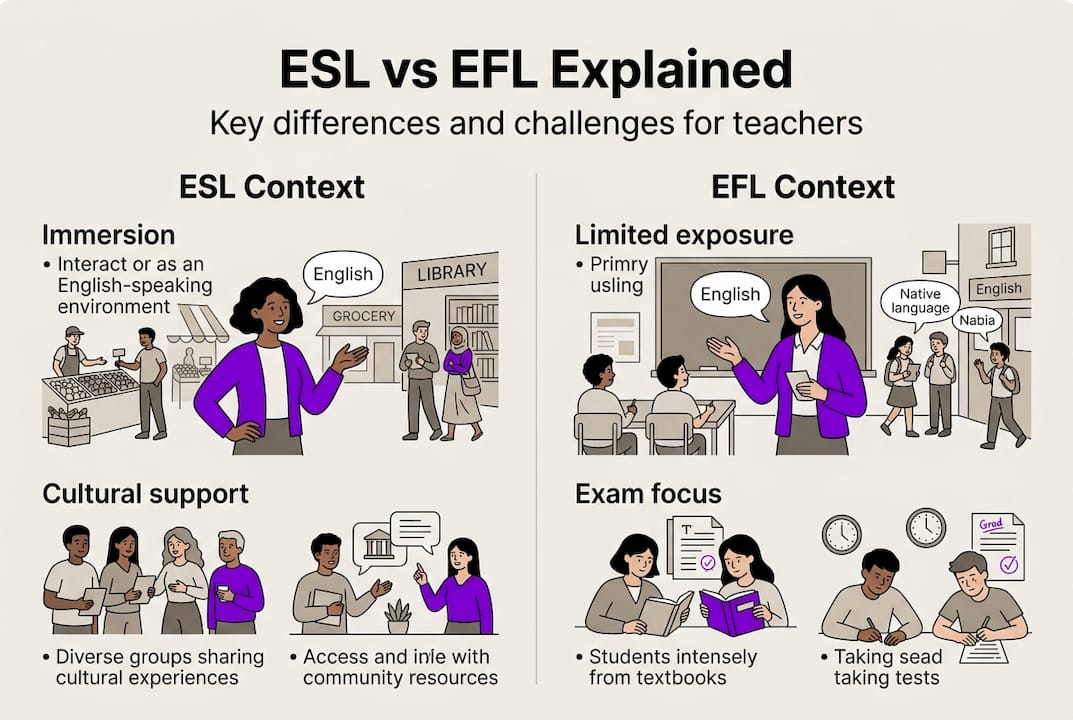
EFL students in non-English-speaking countries have limited exposure beyond your classroom. They might study English for years without speaking it to native speakers. This controlled environment allows more systematic grammar instruction but can produce students who excel at written tests yet struggle with spontaneous conversation. Understanding which context you’ll teach in helps you set realistic expectations and design appropriate curricula.
| Aspect | ESL context | EFL context |
|---|---|---|
| Student exposure | Constant immersion in English-speaking environment | Limited to classroom and intentional study |
| Primary motivation | Immediate survival and integration needs | Academic requirements or future career goals |
| Teaching focus | Functional communication and cultural navigation | Systematic grammar and examination preparation |
| Common challenges | Information overload and cultural adjustment stress | Limited authentic practice and motivation maintenance |
| Assessment emphasis | Real-world task completion and fluency | Accuracy and standardised test performance |
Common challenges cut across both contexts. First-language interference causes predictable errors. Spanish speakers might omit subject pronouns because their language allows it. Mandarin speakers struggle with articles because Chinese lacks them. Arabic speakers reverse adjective-noun order. Recognising these patterns helps you anticipate difficulties and address them proactively rather than correcting the same errors repeatedly.
Diverse proficiency levels within single classes demand differentiation. You might have a student who reads advanced texts but barely speaks alongside another who converses fluently but writes at elementary level. This mismatch requires flexible grouping strategies, tiered assignments, and activities that allow multiple entry points. Technology can help: adaptive learning platforms adjust difficulty automatically whilst you work with small groups.
Effective strategies include:
- Scaffolding complex tasks into manageable steps with clear models
- Building rapport through genuine interest in students’ backgrounds and goals
- Exercising patience when progress seems slow or students regress under stress
- Using visual aids and realia to support comprehension beyond verbal explanation
- Incorporating movement and interaction to maintain engagement and provide kinesthetic learning opportunities
Fluency development takes time. It may take up to 7 years for ESL learners to reach fluency due to language and cultural challenges. Basic interpersonal communication skills develop faster than cognitive academic language proficiency. A student might chat comfortably about weekend plans within months but need years to analyse literature or write research papers at grade level. Recognising this distinction prevents unrealistic expectations.
Cultural sensitivity underpins everything. You’ll encounter students from collectivist cultures uncomfortable with individual presentations, others whose educational backgrounds emphasised rote memorisation over critical thinking, and some who find your informal teaching style disrespectful. Adapting your approach whilst maintaining learning objectives requires flexibility and cross-cultural awareness.
The Trinity CertTESOL programme addresses these challenges directly through its practical training model. You’ll teach actual ESL learners during the course, experiencing firsthand how language interference manifests and practising differentiation strategies with expert guidance. This experiential learning proves far more valuable than reading about challenges in textbooks.
Pro Tip: Create error analysis journals where you track common mistakes by first language group. Over time, you’ll recognise patterns and develop targeted mini-lessons that address root causes rather than surface errors.
Becoming an accredited ESL teacher with Trinity CertTESOL
Trinity CertTESOL offers practical, accredited training accepted worldwide including by the British Council, with lifetime job support and a strong global community. The certification represents the gold standard for aspiring ESL teachers who want internationally recognised credentials that actually prepare them for classroom realities. Unlike generic TEFL certificates that vary wildly in quality and recognition, Trinity CertTESOL maintains rigorous standards validated by Trinity College London’s century of educational excellence.
The course structure emphasises hands-on teaching practice. You’ll spend significant time in front of actual learners, planning lessons, delivering instruction, and receiving detailed feedback from experienced tutors. This practical focus develops the essential skills ESL teachers need:
- Classroom management techniques that maintain productive learning environments
- Lesson planning frameworks that balance structure with flexibility
- Assessment methods that accurately measure progress across skills
- Error correction strategies that build confidence whilst improving accuracy
- Material adaptation skills for diverse proficiency levels and learning styles
Accreditation matters enormously in the competitive ESL job market. Schools and language centres worldwide recognise Trinity CertTESOL because they trust the training quality it represents. Many employers specifically request Trinity or Cambridge certifications in job postings. This recognition translates to better job prospects, higher salaries, and positions at reputable institutions rather than questionable operations.
Job support extends throughout your career. Upon certification, you gain access to a global network connecting you with teaching opportunities across continents. EBC TEFL provides lifetime job placement assistance, helping you find positions that match your goals whether you want to teach young learners in Spain, business English in France, or academic preparation in Italy. This ongoing support proves invaluable as your career evolves and you seek new challenges.
The global community aspect cannot be overstated. You’ll join thousands of Trinity-certified teachers worldwide who share resources, offer advice, and provide professional camaraderie. This network becomes particularly valuable when you’re teaching abroad and need guidance navigating unfamiliar systems or simply want to connect with people who understand the unique rewards and challenges of ESL teaching.
Global acceptance opens doors everywhere. The British Council recognises Trinity CertTESOL for teaching positions worldwide. European language schools prize it. Asian universities accept it. Middle Eastern institutions value it. This portability means your certification investment pays dividends regardless where your teaching journey leads. You’re not locked into one market or region.
Practical training versus theoretical approaches makes the difference between feeling prepared and feeling overwhelmed on day one. Trinity CertTESOL doesn’t just teach you about language acquisition theories. It puts you in classrooms where you apply those theories, make mistakes in a supported environment, receive expert feedback, and develop genuine competence before you’re solely responsible for student learning.
“The Trinity CertTESOL transformed my understanding of teaching. I entered thinking I’d just explain grammar rules. I left with a toolkit of strategies for engaging diverse learners, managing classroom dynamics, and assessing progress meaningfully. That practical foundation gave me confidence when I started my first teaching position abroad.”
The advantages of Trinity CertTESOL extend beyond initial certification. The skills you develop, the network you access, and the credential you earn create a foundation for long-term career growth. Many teachers start with Trinity CertTESOL and later pursue advanced qualifications like Trinity DipTESOL, building on the solid practical base their initial certification provided.
Explore Trinity CertTESOL courses and start teaching abroad
Ready to transform your aspiration into qualified expertise? EBC TEFL offers accredited TESOL certification with comprehensive job placement support that extends throughout your teaching career. Our Trinity CertTESOL programmes combine rigorous practical training with the global recognition employers demand. You’ll develop essential classroom skills through hands-on teaching practice, receive expert feedback from experienced tutors, and join a worldwide community of ESL professionals.
Beyond core certification, explore our specialised TEFL teaching skills courses covering Business English, CLIL, online teaching methodologies, and more. These targeted programmes deepen your expertise in high-demand areas, making you an even more competitive candidate. Whether you envision teaching young learners in Barcelona, coaching professionals in Paris, or delivering academic English in Rome, EBC TEFL provides the training and support to make it happen. Book a call with our team to discuss which programme aligns with your goals and timeline. Your teaching adventure starts here.
Frequently asked questions
What qualifications do I need to become an ESL teacher?
The main qualification is an accredited TESOL or TEFL certificate like Trinity CertTESOL. Whilst many employers prefer candidates with bachelor’s degrees, practical teaching certification often matters more than academic field. Some countries and institutions have specific requirements, so research your target market. Practical teaching experience gained during certification proves invaluable and distinguishes you from candidates with purely theoretical training.
How long does it take to become fluent teaching ESL learners?
Fluency development varies dramatically by learner age, first language, motivation, and immersion level. It may take up to 7 years for ESL learners to reach academic fluency due to language complexity and cultural adjustment challenges. Basic conversational skills develop faster, often within months of intensive study. As a teacher, you’ll use scaffolding techniques and patient support to guide students through this extended process, celebrating incremental progress whilst maintaining realistic expectations.
Can I teach ESL online or abroad with Trinity CertTESOL?
Absolutely. Trinity CertTESOL is globally recognised and supports both overseas and online teaching careers. The certification meets requirements for teaching positions worldwide, including British Council approved schools. Online platforms increasingly seek Trinity-certified teachers because the practical training translates directly to virtual classroom management. Whether you want to teach abroad with Trinity CertTESOL or build a location-independent online teaching business, the certification opens both pathways.
What makes Trinity CertTESOL better than other TEFL certificates?
Trinity CertTESOL maintains rigorous standards through Trinity College London accreditation, ensuring consistent quality worldwide. The course emphasises practical teaching with real learners rather than theoretical knowledge alone. You’ll receive detailed feedback on actual lesson delivery, not just written assignments. Global recognition by employers, particularly the British Council, means your certificate carries weight in competitive job markets. Lifetime job placement support and access to a worldwide teaching community provide ongoing career advantages long after certification.
Do I need to be a native English speaker to teach ESL?
No. Whilst some employers prefer native speakers, many value non-native English-speaking teachers who bring multilingual perspectives and personal language learning experience. Trinity CertTESOL focuses on teaching competencies rather than accent or origin. Your ability to plan effective lessons, manage classrooms, assess progress, and support learners matters far more than whether English is your first language. Demonstrating strong English proficiency and completing accredited training like Trinity CertTESOL establishes your credibility regardless of linguistic background.
