
More than 1.5 billion people worldwide are learning English as a second language, making qualified teachers more important than ever. Choosing the right international TEFL certification shapes not just your career options but your ability to connect across cultures. Understanding what TEFL is and how it works can open the door to rewarding global opportunities and ensure you stand out in a growing field.
Table of Contents
- Defining International TEFL and Its Purpose
- Global TEFL Certification Types Explained
- Essential Requirements for International TEFL
- Key Benefits and Real-World Applications
- Common Challenges and Mistakes to Avoid
Key Takeaways
| Point | Details |
|---|---|
| International TEFL Certification | This certification empowers educators to effectively teach English in global contexts, bridging cultural and linguistic gaps. |
| Key Global Certifications | Prominent certifications include CELTA, Trinity CertTESOL, and various specialized TEFL diplomas, each catering to different teaching needs. |
| Essential Requirements | Candidates typically need a bachelor’s degree, TEFL/TESOL certification, and strong English proficiency to teach internationally. |
| Benefits of TEFL | TEFL certification offers global career mobility, cultural exchange, and opportunities for personal and professional development. |
Defining International TEFL and Its Purpose
International TEFL represents a globally recognised pathway for teaching English to non-native speakers across diverse cultural and linguistic contexts. At its core, this certification empowers educators to bridge communication gaps and facilitate language learning in international environments.
The primary purpose of International TEFL is to equip teachers with specialised skills for effectively instructing English in non-English speaking regions. Unlike localised teaching programmes, International TEFL provides a comprehensive framework that prepares instructors to adapt their teaching strategies across various cultural settings. Teachers learn not just language instruction techniques, but also cross-cultural communication skills that are critical when working with students from different backgrounds.
Key aspects of International TEFL include:
- Developing advanced English language instruction methodologies
- Understanding global communication contexts
- Learning culturally sensitive teaching approaches
- Gaining practical classroom management skills
- Preparing for international teaching opportunities
Through comprehensive training, International TEFL transforms passionate individuals into globally competent English language educators. Whether you’re interested in teaching in Asia, Europe, or South America, this certification provides the foundational knowledge and practical skills needed to succeed. For those wanting to understand the nuanced differences between various English teaching certifications, see our guide on TEFL certification types.
Global TEFL Certification Types Explained
Global TEFL Certification encompasses a range of internationally recognised qualifications designed to prepare educators for teaching English in diverse international contexts. These certifications provide standardised training that equips teachers with essential skills for effective language instruction across different cultural and linguistic environments.
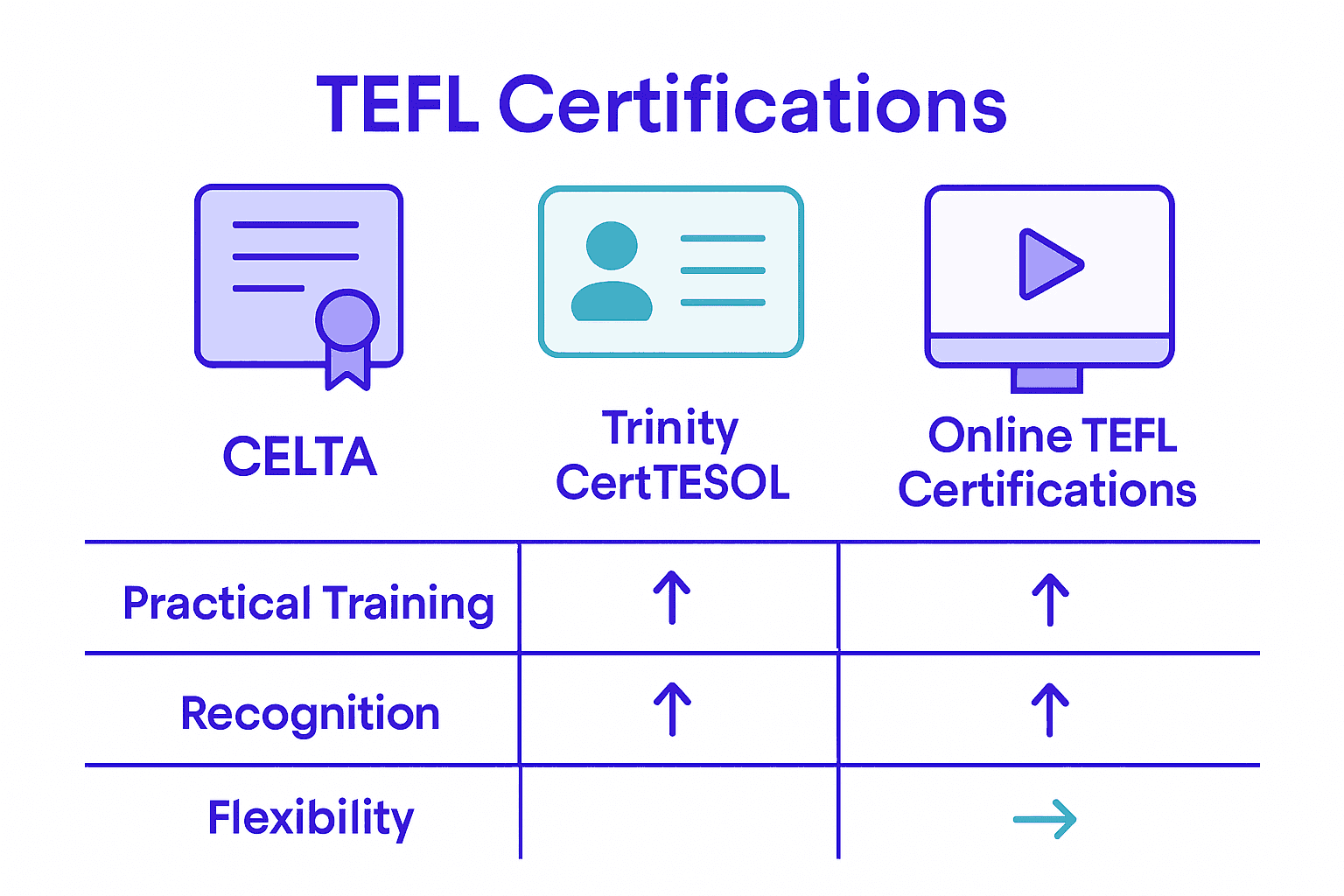
Among the most prominent global TEFL certification types are the Certificate in English Language Teaching to Adults (CELTA), the Trinity CertTESOL, and the Teaching English to Speakers of Other Languages (TESOL). Each certification offers unique strengths and focuses on different aspects of language teaching. The CELTA, for instance, is widely recognised for its practical classroom training, while the Trinity CertTESOL emphasises communicative language teaching approaches and provides comprehensive preparation for international teaching roles.
Key global TEFL certification types include:
- CELTA: Cambridge-validated certificate focusing on practical teaching skills
- Trinity CertTESOL: Internationally recognised qualification with strong communicative methodology
- Online TEFL Certifications: Flexible options for those unable to attend in-person training
- Specialised TEFL Diplomas: Advanced qualifications for experienced educators
- Country-Specific TEFL Certifications: Tailored programmes for specific regional teaching requirements
Understanding the nuances between different certification types is crucial for aspiring international English teachers. For a comprehensive breakdown of these certifications and their unique characteristics, check out our guide to understanding TEFL certification differences.
 Whether you’re planning to teach in Asia, Europe, or South America, selecting the right certification can significantly impact your teaching career and global opportunities.

Essential Requirements for International TEFL
International TEFL demands a comprehensive set of qualifications that go beyond simply speaking English. Aspiring educators must meet specific professional and academic standards to successfully teach English in diverse global environments. These requirements ensure that teachers are well-prepared to deliver high-quality language instruction across different cultural and educational contexts.
The core requirements for international TEFL typically include a combination of educational credentials, language proficiency, and specialised training. Most employers and educational institutions require candidates to have a bachelor’s degree in any field, a recognised TEFL/TESOL certification, and native or near-native English proficiency. Additionally, many positions prefer teachers with some prior teaching experience or demonstrated skills in classroom management and intercultural communication.
Key requirements for international TEFL include:
- TEFL/TESOL Certification: Accredited training programme
- Bachelor’s Degree: Minimum educational qualification
- English Language Proficiency: Native or near-native level
- Clean Background Check: Essential for international teaching roles
- Valid Passport: Ability to travel and work internationally
Navigating the complex landscape of international teaching requirements can be challenging for newcomers. Our comprehensive guide to teaching English abroad provides detailed insights into the specific qualifications and preparations needed to launch a successful international teaching career. Whether you’re a recent graduate or a career changer, understanding these essential requirements is your first step towards becoming a globally recognised English language educator.
Key Benefits and Real-World Applications
International TEFL offers a transformative career path that extends far beyond traditional language teaching, providing educators with unparalleled opportunities for personal and professional growth. The benefits of pursuing a TEFL certification go well beyond classroom instruction, opening doors to global experiences, cultural immersion, and meaningful cross-cultural communication.
In practical terms, TEFL certification enables professionals to work in diverse settings ranging from traditional schools and universities to online platforms, corporate training programmes, and international language institutes. Teachers can choose from multiple career trajectories, including classroom instruction, curriculum development, educational consulting, and digital language training. These varied applications mean that TEFL-certified educators are not confined to a single teaching model but can adapt their skills to multiple professional contexts.
Key benefits of International TEFL include:
- Global Career Mobility: Work opportunities across continents
- Cultural Exchange: Deep immersion in different international environments
- Personal Development: Enhanced communication and interpersonal skills
- Financial Opportunities: Competitive salaries in various teaching markets
- Lifelong Learning: Continuous professional and personal growth
Understanding the broader landscape of international teaching opportunities can be complex, which is why our comprehensive guide to teaching English abroad provides detailed insights into maximising your TEFL certification. Whether you’re seeking adventure, professional development, or a chance to make a global impact, TEFL certification represents a powerful pathway to transforming your career and expanding your worldview.
Common Challenges and Mistakes to Avoid
Navigating the international TEFL landscape comes with unique challenges that can catch even experienced educators off guard. Cultural adaptation and communication barriers represent the most significant hurdles for new TEFL teachers, requiring not just language skills but deep emotional intelligence and flexibility. Understanding these potential pitfalls is crucial for successfully transitioning into global teaching environments.
Professional TEFL teachers must be prepared to address complex challenges such as diverse learning styles, varying educational expectations, and significant cultural communication differences. Common mistakes often stem from a lack of cultural sensitivity, over-reliance on traditional teaching methods, and insufficient preparation for the nuanced interactions required in international classrooms. Successful TEFL practitioners learn to balance structured teaching approaches with adaptive, culturally responsive strategies.
Key challenges and mistakes to avoid include:
- Cultural Misunderstandings: Assuming universal teaching approaches
- Language Explanation Errors: Over-translating or using complex terminology
- Classroom Management Struggles: Failing to adapt to different student expectations
- Insufficient Preparation: Neglecting local educational context and norms
- Communication Breakdown: Not developing cross-cultural communication skills
Understanding these potential challenges requires ongoing learning and adaptation. Our comprehensive guide to teaching English abroad offers insights into navigating these complex professional landscapes, helping aspiring TEFL teachers develop the resilience and skills necessary for successful international teaching careers. Embrace these challenges as opportunities for personal and professional growth.
Take the First Step to Becoming a Confident International TEFL Teacher
If you have been inspired by the comprehensive guide on International TEFL, you likely recognise the challenges of meeting rigorous requirements and adapting to new cultural environments. Whether it is mastering effective teaching methodologies or navigating diverse classrooms with sensitivity and skill, the journey calls for trusted training and clear guidance. Our platform at EBC TEFL Course is designed to help you conquer these challenges with confidence.
Unlock the benefits of globally recognised certifications like Trinity CertTESOL and specialised courses while receiving lifelong job placement support. Gain practical experience, understand cultural nuance, and open doors to teaching opportunities worldwide. Ready to turn your passion into a rewarding global career? Book a free consultation today and discover how our tailored TEFL programmes can fast-track your teaching journey. Don’t wait to start your adventure in international education—your future students are waiting.
Frequently Asked Questions
What is International TEFL?
International TEFL (Teaching English as a Foreign Language) is a globally recognized certification that prepares individuals to teach English to non-native speakers in diverse cultural and linguistic contexts.
What are the main benefits of obtaining an International TEFL certification?
The main benefits include global career mobility, cultural exchange, personal development, financial opportunities, and lifelong learning through various professional contexts.
What are the essential requirements for pursuing an International TEFL certification?
Essential requirements typically include a bachelor’s degree, a recognized TEFL/TESOL certification, native or near-native English proficiency, and a clean background check.
How does International TEFL differ from other English teaching certifications?
International TEFL offers a comprehensive framework that focuses on cross-cultural communication and methodologies suitable for diverse environments, while other certifications may specialize in specific aspects of language teaching.
