
Choosing the right TEFL certification can feel like the most important step towards launching your global teaching career. With flexible online training options and opportunities to live and work in vibrant countries like Spain, France, and Italy, the decision shapes how confident and prepared you will feel stepping into your first classroom abroad. This guide highlights the strengths of accredited TEFL programmes and reveals what makes some courses more effective for developing real teaching skills and landing meaningful job opportunities.
Table of Contents
- Understanding Online TEFL Certification Programmes
- Trinity Accreditation and Practical Teacher Training
- Types of Online TEFL Courses Available
- Requirements for Enrolment and Accreditation
- Job Placement Support and Global Opportunities
- One-Year Study and Work Abroad Programmes
Key Takeaways
| Point | Details |
|---|---|
| Flexibility and Structure | Online TEFL certifications allow for flexible study while maintaining necessary deadlines and practical assessments, preparing teachers for actual classroom scenarios. |
| Trinity Accreditation | Obtaining a Trinity-accredited certification signals quality education and practical competence, increasing employability in competitive international markets. |
| Importance of Job Placement Support | Reputable TEFL programmes offer job placement assistance, expanding access to hiring opportunities and support throughout the job-search process. |
| One-Year Program Advantages | Study and work abroad programmes enhance practical teaching experience and cultural competence, significantly improving job prospects and career advancement. |
Understanding Online TEFL Certification Programmes
Online TEFL certification has fundamentally changed how aspiring English teachers gain their qualifications. Rather than committing to intensive in-person courses, you can now study flexibly whilst juggling work, family, or other commitments. An online TEFL certification typically combines self-paced learning modules with structured assignments, teaching practice observations, and tutor feedback delivered entirely through digital platforms. The most reputable programmes, such as Trinity CertTESOL offered online, maintain the same rigorous standards as their face-to-face counterparts, ensuring your qualification holds genuine weight with international employers.
What makes online TEFL certification particularly appealing to your demographic is the balance between flexibility and structure. You work through course materials at your own pace, but you’re still held to deadlines and assessment standards that reflect actual classroom demands. Research into online TEFL programmes reveals that whilst participants value this flexible access, many felt underprepared for classroom complexities, particularly around classroom management and adapting curriculum for different cultural contexts. This insight matters because it tells you something vital: the quality of your online programme determines whether you’ll actually be ready to teach when you land that first job abroad. Some programmes excel at providing personalised feedback and nuanced content on these critical areas, whilst others fall short. The difference can be the gap between stepping into a classroom with confidence versus feeling overwhelmed in your first week.
When evaluating online TEFL options, look beyond the certificate itself. Examine how programmes structure practical teaching components, whether they offer recorded feedback on your teaching demonstrations, and crucially, whether they provide post-certification support. Comparing online and face-to-face TEFL courses reveals that the best online programmes often blend the independence of remote learning with the rigour traditionally associated with classroom training. This hybrid approach, combined with Trinity College London accreditation, ensures employers across Spain, France, Italy, the Middle East, and Asia recognise your qualification as legitimate and valuable. You’re not just getting a certificate—you’re gaining genuine teaching competence backed by internationally recognised standards.
Pro tip: When selecting an online TEFL course, prioritise programmes that include recorded teaching practice feedback and ongoing mentorship beyond certification, as these elements directly impact your readiness for real classroom environments and your long-term career success.
Trinity Accreditation and Practical Teacher Training
Trinity College London accreditation represents one of the most respected credentials in English language teaching globally. When you earn a Trinity-accredited TEFL certification, you’re not simply receiving a document—you’re joining a network recognised by schools, universities, and language institutes from the Middle East to Southeast Asia, and across Europe. The Trinity CertTESOL certification stands out because Trinity maintains rigorous assessment standards that match the actual demands of modern classrooms. Unlike some online-only qualifications that lack practical components, Trinity-accredited programmes require demonstrated teaching competence through observed practice sessions, written reflections, and detailed assessments of your ability to plan lessons, manage student interactions, and respond to real teaching challenges.
What separates practical teacher training from theoretical qualification is the bridge between knowing about teaching and actually teaching. When you complete a Trinity-accredited course, your tutors observe you teaching live or recorded lessons, provide detailed feedback on specific classroom behaviours, and require you to evidence your understanding of learner needs, cultural adaptation, and differentiation strategies. This hands-on assessment means employers immediately recognise that you’ve been tested under conditions resembling actual classroom work. You won’t discover gaps in your classroom management skills or your ability to handle unexpected student questions after you’ve already arrived at your first teaching position abroad. Instead, you’ll have received mentoring that addressed these exact scenarios during your certification. The practical training components cover lesson planning frameworks, error correction techniques, elicitation strategies, and how to adapt materials for different proficiency levels and age groups—skills that textbooks alone cannot develop.
Beyond initial certification, the Trinity framework supports your ongoing development. The Trinity Certificate for Practising Teachers allows you to pursue further qualifications once you’re working abroad, ensuring your career progression doesn’t stall after your first certificate. This continuum of accreditation means Trinity qualifications grow with your experience rather than becoming static credentials gathering dust. Employers across Spain, France, Italy, and Asia specifically value Trinity accreditation because they know graduates have undergone genuine practical training that prepared them for actual classroom complexity. When you’re competing for teaching positions in competitive markets, this recognised standard gives you measurable advantage over candidates holding unaccredited online certificates from unknown providers.
Pro tip: Prioritise Trinity-accredited programmes with built-in practical teaching observations and detailed feedback cycles, as these components directly translate into your ability to secure better teaching positions and command higher salaries in international markets.
Types of Online TEFL Courses Available
Online TEFL courses come in different formats and specialisations, each designed to meet distinct teaching contexts and career goals. The foundational option is the standard TEFL certificate, which provides comprehensive training across all aspects of teaching English to non-native speakers. This covers classroom management, lesson planning, grammar instruction, and assessment strategies. Beyond the standard pathway, seven key types of accredited TEFL courses exist to help you target specific markets or student populations. The Trinity CertTESOL represents the gold-standard online option, maintaining rigorous accreditation standards whilst offering complete flexibility. You’ll complete assignments, teach practice lessons that are observed and assessed, and receive detailed feedback all through digital delivery. This matters because you’re not just ticking a box; you’re building genuine classroom competence that employers immediately recognise.

Specialised TEFL courses branch into specific teaching contexts where standard training alone isn’t sufficient. Business English certification teaches you how to train professionals in workplace communication, email writing, presentation skills, and industry-specific vocabulary. Teaching Young Learners focuses on child development, age-appropriate activities, motivation strategies for younger students, and classroom behaviour management suited to primary school age groups. Online TEFL prepares you to deliver lessons via video platforms rather than face-to-face, a skillset that became invaluable in recent years and remains highly marketable globally. CLIL (Content and Language Integrated Learning) combines subject teaching with language instruction, useful if you’re teaching maths or science through English. Specialised TEFL courses allow you to differentiate yourself in competitive job markets, particularly in corporate training sectors across Europe and Asia where Business English specialists command premium salaries.
Your choice depends on where you want to teach and what student populations appeal to you. If you’re targeting international schools across Spain, France, or Italy, a Young Learners specialisation opens doors to established institutions. Corporate language training positions in financial hubs pay significantly better and often provide more stable contracts. Private language academies typically want well-rounded TEFL graduates, whilst universities increasingly seek candidates with Business English or examination preparation expertise. The Trinity CertTESOL online course can serve as your foundation, after which you build specialisation based on your career trajectory. Many teachers start with the core certificate, teach for a year or two, then pursue specialised qualifications once they understand which student groups they genuinely enjoy working with. This staggered approach prevents investing in specialisation that doesn’t align with your actual teaching preferences.
Here is a summary of major TEFL course specialisations and target student groups:
| Course Type | Focus Area | Typical Employers |
|---|---|---|
| Standard TEFL | General EFL teaching | Private academies, schools |
| Business English | Corporate language skills | Multinational companies, language centres |
| Young Learners | Children, classroom management | Primary schools, international schools |
| Online Teaching | Digital lesson delivery | Remote teaching platforms |
| CLIL | Subject-English integration | Bilingual and international schools |
| Exam Preparation | IELTS, Cambridge exams | Universities, adult education centres |
Pro tip: Select your initial course based on immediate job prospects in your target country, then plan specialisation for year two or three once you’ve gained classroom experience and clarity about which teaching contexts suit your strengths.
Requirements for Enrolment and Accreditation
Enrolling in an online TEFL course is refreshingly straightforward compared to many professional qualifications. Most programmes require only that you’re at least 18 years old, fluent in English (either as a native speaker or at an advanced proficiency level), and possess basic computer literacy to navigate online learning platforms. You don’t need a teaching background, a university degree, or previous experience working with students. This accessibility explains why TEFL attracts people from diverse career backgrounds—journalists retrain as English teachers, engineers pivot to education, business professionals seek lifestyle changes abroad. The essential features of accredited TEFL courses include clear enrolment pathways that don’t gatekeep based on prior experience. Trinity College London accreditation specifically mandates that providers deliver consistent assessment standards, maintain detailed learner records, and ensure tutors meet professional teaching qualifications. What this means for you is straightforward: when you complete a Trinity-accredited course, you’re not getting a certificate printed by a marketing firm. You’re holding a credential verified by an independent, internationally recognised awarding body.
Accreditation standards vary significantly across TEFL providers, which directly impacts your employment prospects. Unaccredited courses might cost less upfront, but schools hiring internationally won’t recognise them. Trinity CertTESOL, by contrast, requires demonstrated teaching competence assessed through observed practice lessons, written assignments that demonstrate pedagogical knowledge, and portfolio work evidencing reflection on your teaching. The accreditation body conducts regular audits of training providers, checking that course content remains current, tutors are qualified, and assessments are rigorous. This oversight costs money, which reflects in course fees, but it guarantees employers that graduates have met consistent standards. When you’re competing for positions in Spain, France, Italy, or Asia against hundreds of other applicants, this accreditation difference becomes your competitive advantage. Schools know that Trinity-certified teachers have been tested on actual teaching competencies rather than simply completing online quizzes.
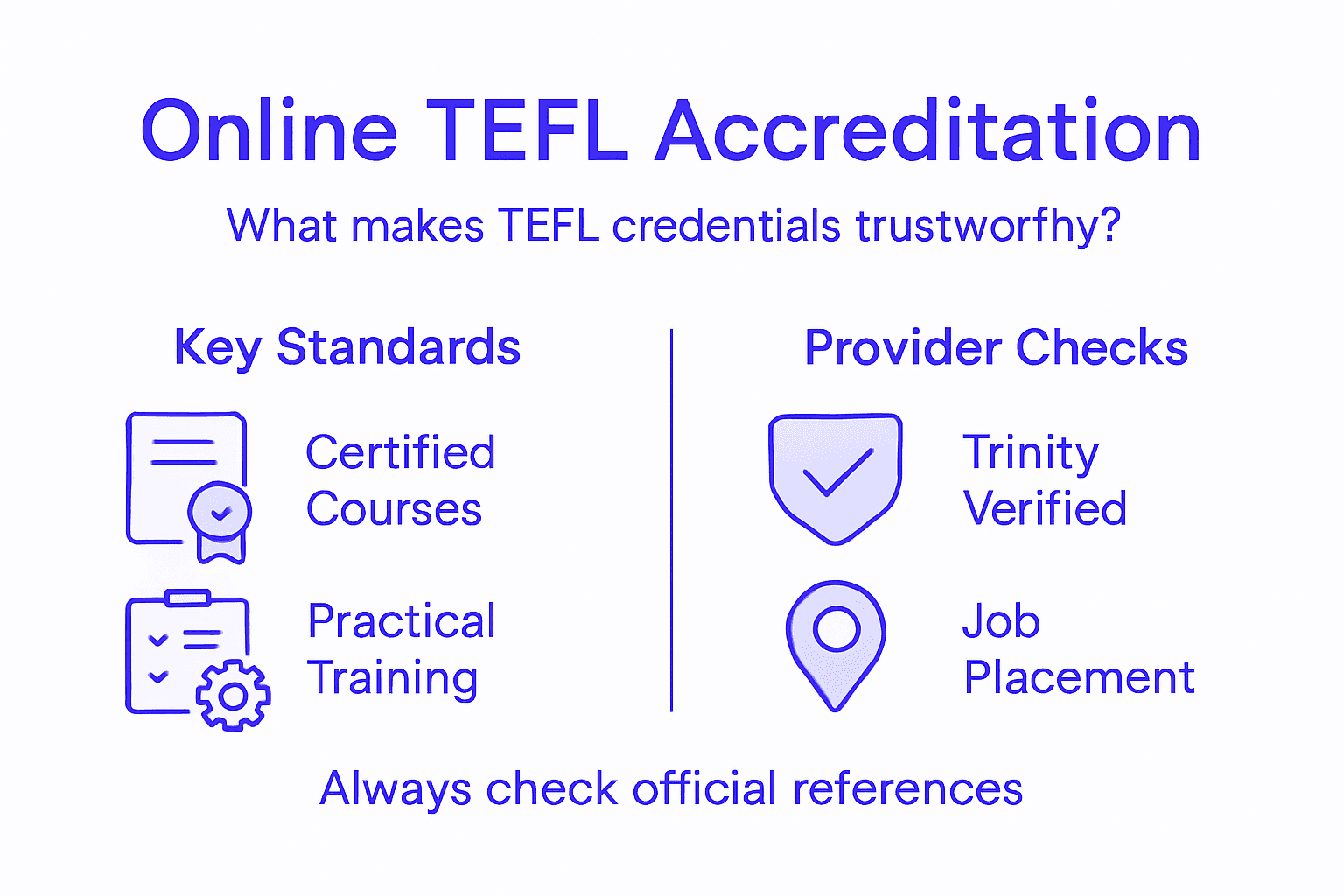
Before selecting a course, verify the accreditation credentials independently. Check Trinity College London’s official registry of accredited providers rather than trusting provider websites alone. Legitimate accreditation bodies publish lists of approved courses that anyone can access. Ask prospective course providers directly for their accreditation reference numbers and verification details. Read reviews from graduates, particularly from people teaching in your target countries, as they’ll honestly report whether the certification opened job doors or remained merely decorative. TEFL accreditation standards exist precisely because unaccredited training proliferated and left teachers disappointed. Your course investment should yield genuine career advancement, not regret. The time you spend verifying accreditation upfront saves months of frustration later when you’re searching for teaching positions and discovering your qualification carries no weight.
Pro tip: Before enrolling, request the course provider’s Trinity accreditation reference number and independently verify it on the Trinity College London website—this five-minute check confirms you’re investing in a credential employers actually recognise.
Job Placement Support and Global Opportunities
Job placement support transforms your TEFL certification from a credential sitting in a drawer into an active career catalyst. Reputable TEFL providers don’t simply hand you a certificate and wish you luck. They maintain ongoing relationships with schools, language academies, and international education institutions actively hiring English teachers. When you complete your course, you gain access to job boards listing verified positions across the globe, along with guidance on application strategies, interview preparation, and contract negotiation. >Lifetime job search assistance means you’re not abandoned after course completion. Support extends through your first job, second career pivot, and beyond, addressing the reality that teachers often explore multiple positions before finding the right fit. This matters profoundly because landing your first teaching position abroad determines whether your TEFL investment pays off. Without placement support, you’re competing against hundreds of other newly certified teachers for limited advertised positions. With institutional backing, you access opportunities that never appear on public job sites because schools contact providers directly with their hiring needs.
Global opportunities vary dramatically by region and season. The Middle East hires aggressively year-round, particularly for corporate training roles and international school positions, with some schools offering accommodation packages and premium salaries. Southeast Asian markets, particularly Vietnam, Thailand, and South Korea, operate on academic calendars with major hiring cycles in May and August. European markets in Spain, France, and Italy favour teachers with European Union work authorisation, though non-EU citizens find opportunities through international schools and private language academies. Mastering TEFL job placement processes equips you to navigate these regional differences strategically. Placement advisers understand which schools are genuinely reputable, which contracts contain hidden clauses that disadvantage teachers, and which positions offer professional development pathways versus dead-end employment. They guide you through visa paperwork, contract terms, and negotiation strategies that protect your interests. Without this expertise, you might accept positions with weak contracts, unethical schools, or locations that don’t suit your lifestyle preferences.
Your career trajectory post-certification depends heavily on strategic job selection. Accepting a well-chosen first position in a professional environment with supportive management accelerates your credentials and confidence. Poor first placements create frustration that sometimes drives teachers out of the profession entirely. Quality placement support filters opportunities, connecting you with schools aligned to your teaching philosophy and career ambitions. Ask prospective TEFL providers directly about their placement track record. How many graduates secure positions within three months of completion? Do they maintain alumni networks? Which geographic markets do they specialise in? Providers offering comprehensive guidance on paperwork, interviews, and orientation demonstrate commitment to graduate success beyond certificate issuance. This distinction separates training organisations genuinely invested in your career from those viewing graduates as completed transactions.
Pro tip: During course selection, request concrete placement statistics from providers, including graduate employment rates within three months and feedback from teachers currently working in your target countries, as this data reveals whether placement support is genuinely active or merely promotional.
One-Year Study and Work Abroad Programmes
One-year study and work abroad programmes represent the pinnacle of TEFL preparation, blending accredited teacher training with immersive language study and genuine teaching experience. Unlike standard online courses completed from your bedroom, these integrated programmes embed you in the actual teaching and cultural environment where you’ll build your career. You complete your Trinity-accredited TEFL certification whilst simultaneously studying the local language at university level, working part-time in schools or language academies, and building relationships with colleagues and students who become your professional network. This combination addresses a critical gap that online-only training leaves unfilled: cultural competence and practical classroom experience within real international school systems. Spain, France, and Italy host particularly strong programmes because these countries have established infrastructure for international teachers, recognised universities offering language study, and vibrant language academy sectors actively hiring teachers. The intensity of one-year programmes means you arrive at your next career position not as a newly certified teacher nervously navigating unfamiliar systems, but as someone with genuine in-country teaching experience and language proficiency that makes you immediately employable.
What distinguishes these programmes from simply moving abroad and finding work independently is structured support and accreditation. Visa sponsorship eliminates bureaucratic barriers that would otherwise consume months of your time. University-level language instruction ensures you develop professional-grade proficiency rather than tourist-level conversational ability. Your TEFL certification completed on location means you’re studying pedagogy whilst simultaneously observing and practising in actual classrooms, creating immediate relevance between theory and practice. Paid teaching assistant placements with structured mentorship provide income that substantially offsets programme costs whilst building your teaching portfolio. You’re not paying to learn in isolation; you’re gaining practical experience that employers value far more than theoretical knowledge. The stipend model means your investment in professional development translates into actual income during the programme year, making this far more accessible than traditional university postgraduate study.
Career outcomes after one-year programmes dramatically exceed those of online-only certification. Graduates secure senior teaching positions, curriculum development roles, and international school appointments because schools recognise their combined expertise. Your language proficiency opens doors to teaching roles requiring bilingual capacity, substantially expanding your job market. The networks you build with fellow teachers, school administrators, and educational professionals create ongoing career opportunities and mentorship relationships. Study abroad TEFL programmes transform your credentials from paper qualifications into demonstrated competence backed by local references and teaching experience. When you interview for positions after programme completion, you’re not explaining theoretical knowledge; you’re describing your recent classroom achievements, relationships with local educators, and cultural understanding that makes you immediately effective in diverse educational environments. This positioning changes how schools evaluate your candidacy, moving you from the pile of equally qualified new certificates into consideration for more selective, better-paying positions.
The decision to invest a full year abroad requires commitment, but the return on investment proves substantial. You’re not simply gaining certification; you’re launching a genuinely global career with foundational experience, language skills, and professional networks that sustain you throughout your teaching journey.
The following table compares online-only TEFL certification with one-year study and work abroad programmes for aspiring English teachers:
| Aspect | Online-Only TEFL Certification | One-Year Study & Work Abroad |
|---|---|---|
| Training Format | Digital modules, remote assignments | On-campus study and local teaching |
| Practical Experience | Limited, often virtual | In-person classroom practice |
| Cultural Competence | Minimal immersion | Extensive real-life exposure |
| Job Prospects | Broad but entry level | Senior positions, faster advancement |
| Language Learning | Usually optional, self-directed | Integrated, university-level language study |
| Typical Support | Occasional job boards, some guidance | Internship placement, mentorship, visa support |
| Immediate Employability | Certificate-focused | Teaching and language skills validated |
| Financial Support | Mostly self-funded | Stipends, paid assistant roles often included |
Pro tip: When evaluating one-year programmes, prioritise those offering university-level language qualification alongside TEFL certification and paid teaching placements, as this combination maximises your post-programme employment prospects and earning potential in competitive markets.
Advance Your Teaching Career with Trusted Trinity-Accredited TEFL Training and Global Support
If you are ready to move beyond basic online TEFL certificates and want genuine classroom readiness combined with globally recognised credentials, EBC TEFL offers exactly what you need. Our Trinity College London accredited programmes, including the renowned CertTESOL and CertPT courses, ensure you gain practical, hands-on teacher training that stands out to employers worldwide. We understand the challenges of feeling underprepared for real classroom demands and the uncertainty of finding reliable work abroad. That is why our training not only certifies you but also equips you with live teaching practice, detailed feedback, and personalised mentorship.
Explore our comprehensive one-year study and work abroad programmes in Spain, France, and Italy where you earn your TEFL certification alongside immersive language study, visa support, cultural integration, and part-time teaching experience. Benefit from our free lifetime job placement support that connects you to trusted employers across Europe and Asia. Dont settle for a certificate that leaves you uncertain and unsupported. Take the crucial step now to secure your internationally recognised qualification, gain meaningful experience, and launch your teaching career with confidence. Start your journey with a free consultation on EBC TEFL and transform your passion for teaching into a rewarding global career.
Frequently Asked Questions
What is an online TEFL certification?
Online TEFL certification is a professional qualification that allows individuals to teach English as a foreign language through online courses. These programmes typically combine self-paced learning with assessments and practical teaching components, enabling flexibility in study.
How does online TEFL certification enhance my teaching career?
Obtaining an online TEFL certification can significantly boost your teaching career by providing recognised qualifications that open job opportunities globally. Accredited certifications, like the Trinity CertTESOL, ensure that you are prepared for the complexities of teaching in various cultural and educational settings.
What types of online TEFL courses are available?
There are various types of online TEFL courses, including standard TEFL certificates, Business English, Young Learners, Online Teaching, and CLIL courses. Each specialises in particular teaching contexts or student demographics, allowing you to target your specific career goals.
What should I consider when choosing an online TEFL programme?
When selecting an online TEFL programme, consider factors such as accreditation, the inclusion of practical teaching components, the quality of tutor feedback, and post-certification job placement support. Choosing a well-structured programme significantly affects your readiness for teaching roles.
Recommended
- Get accredited online Trinity CertTESOL certification for more jobs – EBC Trinity CertTESOL and TEFL courses
- Why Take a virtual classroom TEFL Course: Unlocking Global Careers – EBC TEFL courses
- Teach online and face-to-face: Get certified to do both – EBC Trinity CertTESOL and TEFL courses
- Why Teach English Online: Complete Guide for 2026 – EBC Trinity CertTESOL and TEFL courses
- Maximus Monaheng Sefotho: Educational Psychologist And Inclusion Advocate / Naijatipsland
