
If you are training to teach English abroad, you have probably heard the term peer observation mentioned in course descriptions or training materials. Many aspiring teachers initially feel uncertain about what it involves or worry it might be intimidating. In reality, peer observation is one of the most valuable collaborative tools in teacher training, offering practical insights that strengthen your classroom skills and prepare you for Trinity College London accredited certification. This guide explains what peer observation is, why it matters, how it works in TEFL contexts, and how you can use it effectively to build confidence and teaching excellence throughout your career.
Table of Contents
- Key takeaways
- What is peer observation and why does it matter in TEFL training?
- Common methods and best practices for peer observation among English teachers
- Peer observation versus other forms of teacher evaluation and development
- Making the most of peer observation: tips for aspiring English teachers
- Explore accredited TEFL certification and training opportunities with EBC
- Frequently asked questions
Key Takeaways
| Point | Details |
|---|---|
| Collaborative feedback | Peer observation offers constructive feedback in a supportive, non judgemental way to improve teaching practice. |
| Reflective skills | It helps you develop reflective teaching abilities and practical classroom management relevant to TEFL certification. |
| Structured approach | Clear objectives and structured observation formats guide focused feedback and reduce anxiety. |
| Professional culture | Regular peer observation builds a culture of continuous improvement and strengthens professional networks within training cohorts. |
What is peer observation and why does it matter in TEFL training?
Peer observation is a collaborative, developmental approach where teachers observe each other’s classes with the aim of sharing constructive feedback and improving teaching practice. Rather than being a formal evaluation or assessment, it creates a supportive environment where trainee and experienced English teachers learn from one another’s strengths and challenges. During peer observation, one teacher watches another deliver a lesson, takes structured notes, and later discusses observations in a constructive, non-judgmental manner.
For aspiring English teachers pursuing Trinity College London accredited certifications, peer observation serves multiple critical functions. It helps you develop reflective teaching skills, which are essential for professional growth and meeting accreditation standards. You gain practical insights into classroom management, lesson pacing, student engagement techniques, and activity design by watching peers in action. This real-world learning complements theoretical training and accelerates your development as a confident, adaptable teacher.
Peer observation also builds a culture of continuous improvement within training cohorts. When you participate regularly, you become comfortable receiving feedback and recognise that constructive criticism strengthens rather than undermines your teaching. This mindset is invaluable when you begin teaching English abroad, where you will often work in diverse educational settings with varying support structures. The ability to seek and offer feedback becomes a professional asset throughout your career.
Several myths surround peer observation that can deter trainee teachers from embracing it fully. Some believe it is merely a box-ticking exercise for certification, but effective programmes integrate it as a core developmental tool. Others worry that peers lack the expertise to provide useful feedback, yet structured observation frameworks ensure feedback is focused and actionable. Finally, some fear peer observation feels judgmental, but when conducted with clear guidelines and mutual respect, it fosters collaboration rather than competition.
The benefits of peer observation extend beyond individual skill development:
- Enhanced awareness of different teaching styles and approaches
- Opportunities to trial new techniques observed in peer lessons
- Strengthened professional relationships and support networks
- Increased confidence through normalising challenges all teachers face
- Practical preparation for lesson observation by mentors or assessors
Common methods and best practices for peer observation among English teachers
Peer observation in TEFL settings can take several forms, each suited to different training contexts and objectives. Formal peer observation involves scheduled sessions with pre-agreed focus areas, structured observation forms, and dedicated feedback meetings. This method works well during intensive certification courses where specific teaching competencies are being developed. Informal peer observation is more spontaneous, allowing teachers to drop into each other’s classes and share quick reflections afterwards. Reciprocal peer observation involves two teachers observing each other’s lessons in turn, creating balanced learning opportunities and mutual accountability.
Effective peer observation includes structured observation forms, pre- and post-observation meetings, and honest, supportive feedback to improve teaching strategies. The process typically follows these key steps. Before the observation, the observing teacher and observed teacher meet briefly to discuss lesson objectives, target areas for feedback, and any specific concerns. This pre-observation meeting ensures the observer knows what to focus on and the observed teacher feels prepared and comfortable.
During the observation itself, the observer takes detailed notes using an observation framework or checklist. These tools help focus attention on specific aspects such as instructions clarity, student engagement levels, error correction techniques, or activity transitions. Observers should remain unobtrusive, sitting where they can see and hear clearly without disrupting the lesson flow. Taking notes on both strengths and areas for development ensures balanced, constructive feedback.

After the lesson, both teachers meet for a post-observation discussion, ideally within 24 hours while the lesson remains fresh. The observed teacher typically reflects first, sharing what went well and what they would change. The observer then offers specific, evidence-based feedback, highlighting effective techniques before suggesting improvements. This sequence encourages self-reflection and makes feedback easier to receive.
Best practices for conducting peer observation include:
- Establishing clear, agreed-upon objectives before each observation
- Using observation forms aligned with classroom management and teaching competencies
- Focusing feedback on observable behaviours rather than personal judgments
- Balancing positive observations with constructive suggestions
- Creating a confidential, supportive environment where honesty is valued
- Following up on feedback in subsequent observations to track progress
Pro Tip: When giving feedback, use the “specific-positive-constructive” formula. Start with a specific strength you observed, acknowledge its positive impact on learning, then offer one constructive suggestion framed as an opportunity rather than a criticism. This approach keeps feedback actionable and motivating.
Common pitfalls to avoid include providing vague feedback such as “good lesson” without specific examples, focusing only on negatives, allowing personal relationships to bias observations, or skipping the pre-observation meeting. These mistakes reduce the developmental value of peer observation and can create discomfort or defensiveness.
Peer observation versus other forms of teacher evaluation and development
Understanding how peer observation differs from related processes helps clarify its unique role in TEFL training. Mentor or manager evaluations are formal assessments conducted by experienced educators or supervisors, often for certification, employment decisions, or performance reviews. These evaluations carry higher stakes and focus on measuring competency against established standards. While valuable for accountability and accreditation, they can feel stressful and may not encourage the same openness as peer observation.
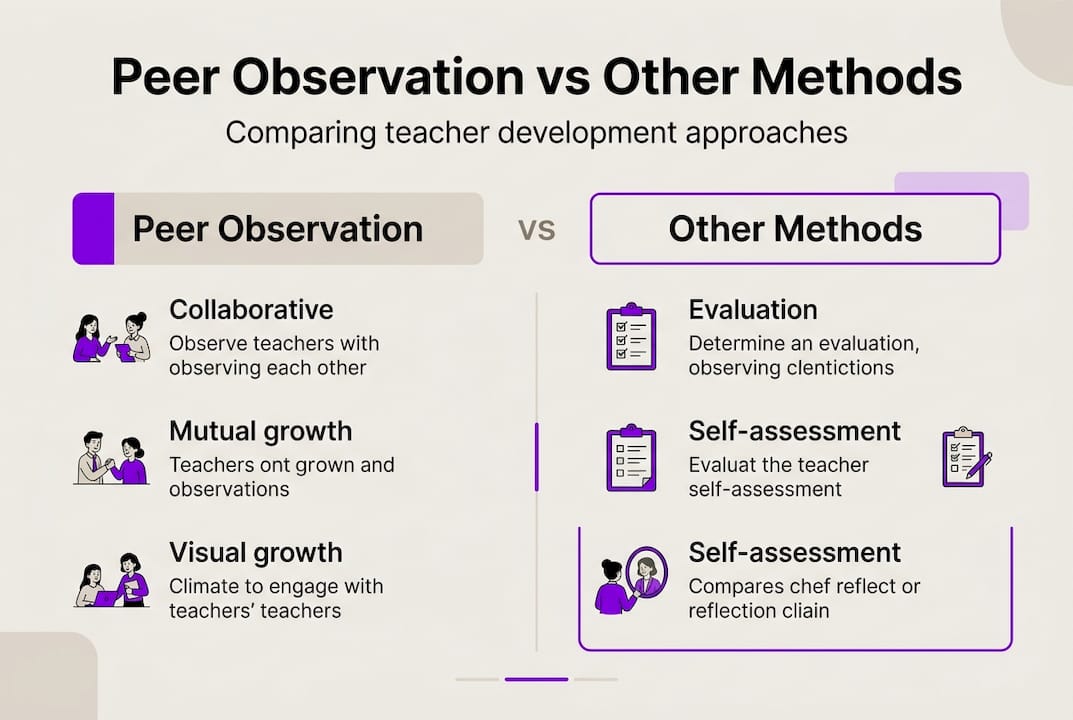
Peer observation fosters a collaborative learning environment distinct from top-down evaluations, promoting mutual growth and reflective practice. Because peers are equals in the learning process, the power dynamic shifts from evaluative to developmental. This equality encourages honest reflection, risk-taking with new techniques, and vulnerability about challenges without fear of negative consequences.
Self-assessment involves teachers reflecting independently on their own lessons, strengths, and areas for growth. While essential for developing reflective practice, self-assessment lacks the external perspective that peer observation provides. Teachers may not notice certain patterns in their teaching or may be overly critical or lenient with themselves. Combining self-assessment with peer observation creates a more balanced, comprehensive view of teaching effectiveness.
Peer teaching differs from peer observation in that it involves teachers collaboratively planning and sometimes co-teaching lessons, rather than simply observing. Peer teaching emphasises shared responsibility for lesson delivery and immediate collaborative problem-solving. Peer observation focuses on watching, reflecting, and discussing after the fact. Both approaches support professional development but serve different learning purposes.
| Evaluation type | Primary purpose | Who conducts it | Formality level | Developmental focus |
|---|---|---|---|---|
| Peer observation | Collaborative learning and feedback | Fellow teachers | Low to moderate | High |
| Mentor evaluation | Assess competency and progress | Experienced mentor or trainer | Moderate to high | Moderate |
| Manager evaluation | Performance review or accreditation | Supervisor or external assessor | High | Low to moderate |
| Self-assessment | Personal reflection and goal-setting | Individual teacher | Low | High |
| Peer teaching | Collaborative lesson design and delivery | Fellow teachers together | Low to moderate | High |
For aspiring English teachers, peer observation offers distinct advantages. It normalises the learning process by showing that all teachers face challenges and continuously improve. It provides a safe space to experiment with new techniques and receive immediate, supportive feedback. It builds professional networks and collaborative skills essential for working in international teaching environments. Finally, it develops the reflective habits and feedback literacy required for ongoing career development.
Choosing when to use each approach depends on your training stage and goals. Early in certification courses, frequent peer observation builds foundational skills and confidence. As you progress, mentor evaluations provide formal benchmarks of competency. Throughout your career, balancing peer observation with self-assessment sustains continuous improvement without relying solely on external validation.
Making the most of peer observation: tips for aspiring English teachers
To engage confidently and effectively in peer observation, preparation is essential. Before observing a peer, review the lesson plan if available and clarify the focus areas with the observed teacher. Bring an observation form or notebook to record specific examples rather than general impressions. Approach the observation with curiosity and openness, remembering your role is to support learning, not to judge.
When you are being observed, prepare mentally by viewing it as a learning opportunity rather than a test. Share your lesson plan and highlight any areas where you particularly want feedback. During the lesson, focus on your students and teaching rather than the observer’s presence. Afterwards, reflect honestly on what went well and what you would change before hearing your peer’s observations.
Giving constructive feedback requires care and specificity. Follow these steps to ensure your feedback is helpful:
- Begin by asking the observed teacher to share their own reflections and feelings about the lesson
- Acknowledge strengths with specific examples, such as “Your instructions for the role-play were clear and included a demonstration, which helped students start the activity confidently”
- Frame suggestions as questions or possibilities, such as “What might happen if you extended the peer feedback stage by two minutes?”
- Limit feedback to two or three key points to avoid overwhelming the teacher
- End by agreeing on one concrete action or technique to try in the next lesson
Receiving feedback gracefully is equally important. Listen without interrupting or defending your choices. Ask clarifying questions if feedback is unclear. Thank your peer for their time and insights, even if you disagree with some observations. Later, reflect on which suggestions resonate and how you might apply them.
Reflection following peer observation is key to consolidating learning and developing teaching confidence. After each observation cycle, spend time writing or thinking about what you learned, what surprised you, and how you will adjust your practice. This reflective habit transforms peer observation from a passive exercise into active professional development.
Maintaining a positive attitude towards peer learning involves remembering that all teachers, regardless of experience, benefit from fresh perspectives. Embrace discomfort as a sign of growth rather than inadequacy. Celebrate small improvements and recognise that teaching excellence develops gradually through repeated practice and reflection.
Pro Tip: Create a peer observation journal where you record key insights from each session, track techniques you want to try, and note progress over time. Reviewing this journal before formal evaluations or job interviews provides concrete examples of your commitment to professional development in TEFL.
Beyond initial training, continue seeking peer observation opportunities throughout your teaching career. Many international schools and language centres encourage collaborative observation as part of ongoing professional development. Online teaching communities also offer virtual peer observation partnerships. These sustained practices keep your teaching fresh, responsive, and continually improving.
Explore accredited TEFL certification and training opportunities with EBC
If you are ready to develop your teaching skills through practical, collaborative training that includes peer observation, EBC TEFL courses offer Trinity College London accredited programmes designed for aspiring English teachers worldwide. Our certification pathways combine rigorous academic content with hands-on classroom experience, ensuring you build the confidence and competence needed for successful international teaching careers.
EBC’s TEFL certification programmes incorporate structured peer observation as a core component of practical training. You will observe experienced teachers and fellow trainees, receive expert feedback, and develop reflective teaching practices aligned with global standards. Our courses prepare you not only to teach English abroad but to thrive in diverse educational settings through collaborative professional development.
Beyond certification, EBC offers comprehensive one-year study and teach abroad programmes in Spain, France, and Italy. These programmes combine accredited teacher training with language study, post-graduate opportunities, visa support, and part-time teaching or work placements. You gain cultural immersion and professional experience while building a global teaching career supported by EBC’s lifetime job placement assistance. Explore our course options today and book a free consultation to discuss which pathway best suits your goals.
Frequently asked questions
What is peer observation in teaching?
Peer observation is a collaborative professional development process where teachers observe each other’s lessons and exchange constructive feedback to improve teaching practice. Unlike formal evaluations by supervisors, it emphasises mutual learning and reflective growth in a supportive, non-judgmental environment. This approach helps teachers develop new techniques, gain fresh perspectives, and build confidence through shared experiences.
How can peer observation benefit new English teachers?
Peer observation provides new English teachers with practical insights into classroom management, lesson pacing, and student engagement by watching peers in action. It builds confidence through normalising challenges all teachers face and receiving supportive, specific feedback. The collaborative nature encourages reflection and strengthens professional relationships, creating a network of support essential for success in international teaching environments.
What are some common challenges with peer observation and how to overcome them?
Common challenges include discomfort or anxiety about being observed, fear of receiving unconstructive criticism, and uncertainty about how to give useful feedback. Overcome these by establishing clear observation guidelines and focus areas before sessions, building trust through regular participation, and using structured observation forms to keep feedback specific and actionable. Open communication about expectations and creating a confidential, respectful environment also reduce anxiety and increase the developmental value of peer observation.
How is peer observation used in Trinity College London accredited TEFL courses?
Peer observation is an integral component of Trinity College London accredited TEFL courses, supporting the development of reflective teaching skills required for certification. Trainees observe each other’s teaching practice sessions, provide structured feedback, and document observations as evidence of professional growth. This process helps meet accreditation standards while building the collaborative habits and lesson observation skills essential for ongoing career development in diverse teaching contexts worldwide.