
Many language schools have needs for teachers working with young children. Choosing to teach young learners means engaging with some of the most rapid and important stages in child development. Whether you are new to the classroom or looking to deepen your expertise, understanding the definition and age range of young learners will help you meet their specific needs, use effective teaching approaches, and build a rewarding educational experience for both teacher and student.
Table of Contents
- Definition And Age Range Of Young Learners
- Core Approaches To Young Learner Teaching
- Types Of Learning Activities And Methods
- Qualifications For Teaching Young Learners Abroad
- Common Challenges And Professional Solutions
Key Takeaways
| Point | Details |
| Understanding Age Groups | Young learners are defined as children aged 5 to 12 years, with early childhood (5-7) and pre-adolescent (8-12) sub-groups requiring tailored teaching approaches. |
| Developmentally Appropriate Practice | Effective teaching strategies must align with the cognitive, emotional, and social capabilities of children at different stages of development. |
| Engaging Learning Activities | Incorporating movement-based instruction and interactive methods increases engagement and enhances language acquisition. |
| Necessity of Professional Qualifications | Teachers should obtain recognised certifications, such as the Trinity CertTESOL, to equip themselves with the skills needed for teaching young learners effectively in various contexts. |
Definition And Age Range Of Young Learners
Teaching young learners represents a specialised and dynamic segment of English language education that requires unique pedagogical approaches and understanding. Young learners are typically defined as children between the ages of 5 and 12 years old, representing a critical developmental period for language acquisition and cognitive growth.
This age range encompasses two primary sub-groups with distinct learning characteristics: early childhood learners (5-7 years) and pre-adolescent learners (8-12 years). Early childhood learners are characterised by high levels of curiosity, limited attention spans, and strong emotional dependency on teachers. In contrast, pre-adolescent learners demonstrate more advanced cognitive abilities, greater independence, and enhanced capacity for structured learning activities.
Understanding the developmental stages within the young learners’ age range is crucial for designing effective language teaching strategies. Educators must adapt their instructional methods to match the cognitive, emotional, and social capabilities of children at different developmental phases. Key considerations include:
- Cognitive Development: Tailoring content complexity to match learners’ mental processing capabilities
- Attention Span: Creating engaging, short-duration learning activities
- Emotional Support: Providing nurturing and encouraging learning environments
- Interactive Learning: Incorporating games, movement, and multisensory experiences
Successful teaching of young learners requires specialised training and understanding of child psychology, language acquisition theory, and age-appropriate pedagogical techniques. Professional certifications like the Trinity CertTESOL provide comprehensive preparation for educators seeking to specialise in teaching English to children across these critical developmental stages.
Core Approaches To Young Learner Teaching
Teaching young learners requires sophisticated and nuanced pedagogical strategies that go far beyond traditional classroom instruction. Developmentally Appropriate Practice (DAP) emerges as a foundational approach, emphasising instructional methods that align precisely with children’s cognitive, emotional, and social developmental stages. This approach ensures that teaching techniques are not just theoretical but deeply rooted in understanding how children actually learn and process information.

Two primary instructional frameworks dominate contemporary young learner teaching: Cognitive Apprenticeship and Experiential Learning. Cognitive apprenticeship focuses on making thinking processes visible, where teachers model problem-solving strategies and gradually transfer cognitive skills through techniques like coaching, scaffolding, and reflective practice. Teaching young learners in language contexts requires educators to break down complex linguistic skills into manageable, observable steps that children can internalise.
Key pedagogical principles for young learner teaching include:
- Active Engagement: Creating learning experiences that invite participation
- Multimodal Learning: Incorporating visual, auditory, and kinaesthetic teaching methods
- Emotional Safety: Establishing supportive, low-stress learning environments
- Incremental Complexity: Gradually introducing linguistic challenges
Successful young learner teaching demands a holistic understanding of child development, language acquisition theories, and adaptive instructional strategies. Educators must remain flexible, responsive, and deeply attuned to individual learners’ unique developmental trajectories and learning preferences. Professional training programmes like the Trinity CertTESOL provide comprehensive preparation in these sophisticated teaching approaches, equipping teachers with the skills to create engaging, developmentally appropriate language learning experiences.
Types Of Learning Activities And Methods
Effective language teaching for young learners demands a diverse and dynamic approach to learning activities that engage multiple sensory and cognitive channels. Movement-based instruction has emerged as a powerful pedagogical strategy, integrating physical activity directly into language learning to enhance cognitive processing, maintain student engagement, and create memorable learning experiences. This approach recognises that children learn most effectively when instruction moves beyond traditional seated learning environments.
Key learning methods for young English language learners encompass several innovative and interactive approaches. Concept-Oriented Reading Instruction (CORI) provides a sophisticated framework that transforms language learning into an exploratory process. Teaching strategies for young learners require educators to design activities that simultaneously develop linguistic skills and cognitive abilities through structured yet dynamic instructional techniques.
Primary types of learning activities include:
- Kinesthetic Games: Language learning through physical movement and interactive play
- Storytelling Workshops: Narrative-based activities developing comprehension and communication skills
- Role-playing Scenarios: Contextual language practice mimicking real-world communication
- Sensory Learning Stations: Multimodal environments encouraging exploration and linguistic discovery
- Musical Language Exercises: Rhythm and melody-based learning techniques
Successful young learner language education demands a holistic, child-centered approach that recognises individual learning preferences. Educators must continuously adapt their methodologies, creating learning environments that are simultaneously structured and spontaneous, challenging and supportive. Professional training programmes like the Trinity CertTESOL equip teachers with the sophisticated pedagogical skills required to design engaging, developmentally appropriate language learning experiences that transform education into an exciting journey of discovery.
Qualifications For Teaching Young Learners Abroad
Teaching young learners internationally demands a sophisticated blend of specialised qualifications, cultural adaptability, and pedagogical expertise. Professional Certification stands as the cornerstone of successful international teaching credentials, with specific programmes designed to prepare educators for the unique challenges of teaching English to children in diverse global contexts. These qualifications go far beyond basic language proficiency, requiring comprehensive understanding of child development, instructional strategies, and cross-cultural communication.
The most recognised qualifications for teaching young learners abroad typically include internationally accredited certifications such as the Trinity CertTESOL and Cambridge CELTA, which provide specialised training in language teaching methodologies. Requirements for teaching English abroad encompass multiple dimensions, including pedagogical skills, language proficiency, and cultural adaptability. These certifications demonstrate a teacher’s ability to design age-appropriate, engaging language learning experiences that support children’s cognitive and linguistic development.
Key qualifications and requirements for teaching young learners internationally include:
- Advanced Language Teaching Certification: Specialised programmes focused on young learner instruction
- Native or Near-Native English Proficiency: Demonstrable high-level communication skills
- Child Protection Certifications: Understanding of international child safeguarding standards
- Cultural Competence Training: Ability to adapt teaching approaches to diverse cultural contexts
- Minimum Educational Background: Bachelor’s degree preferred in education or related fields
Successful international young learner teachers must combine formal qualifications with personal qualities like patience, creativity, and emotional intelligence. Professional development programmes like the Trinity CertTESOL provide comprehensive preparation, equipping educators with the nuanced skills required to create transformative language learning experiences across different cultural and educational environments.
Common Challenges And Professional Solutions
Teaching young learners presents a complex landscape of professional challenges that demand sophisticated, adaptive strategies. Developmental Diversity emerges as a primary obstacle, with children exhibiting widely varying cognitive, emotional, and linguistic capabilities within the same learning environment. Educators must develop nuanced approaches that simultaneously address individual learning needs while maintaining cohesive classroom dynamics and achieving overarching educational objectives.
The implementation of Developmentally Appropriate Practice requires educators to navigate intricate pedagogical challenges, balancing structured instruction with individual learner responsiveness. English teaching job challenges reveal the complexity of creating inclusive, engaging learning experiences that accommodate diverse developmental trajectories. Professional solutions emphasise flexible instructional techniques, continuous assessment, and personalised scaffolding to support each child’s unique learning journey.
Key strategies for addressing common teaching challenges include:
- Adaptive Lesson Planning: Designing flexible curricula that accommodate varied learning speeds
- Differentiated Instruction: Creating multiple entry points for learning complex linguistic concepts
- Emotional Intelligence: Developing sophisticated classroom management techniques
- Continuous Professional Development: Regularly updating pedagogical skills and cultural competencies
- Technology Integration: Leveraging digital tools to support personalised learning experiences
Successful young learner educators must cultivate a holistic approach that combines technical pedagogical skills with deep empathy and understanding. Professional training programmes like the Trinity CertTESOL provide comprehensive preparation, equipping teachers with the sophisticated toolkit required to transform potential classroom challenges into opportunities for meaningful, engaging language learning experiences.
Elevate Your Ability to Teach Young Learners with Trusted Certification and Global Opportunities
Teaching young learners demands specialised skills in developmental understanding, engaging lesson planning, and adaptive strategies to meet diverse cognitive and emotional needs. If you aim to transform your passion for teaching children into a fulfilling international career, EBC TEFL offers Trinity College London accredited courses that provide in-depth practical training tailored to these unique challenges. Our globally recognised certifications, including the Trinity CertTESOL, prepare you to create dynamic, developmentally appropriate learning experiences that truly make an impact.
Take your teaching career further through our comprehensive 1-year study and work abroad programmes in Spain, France, and Italy. These immersive programmes combine accredited teacher training with language study, cultural immersion, and part-time teaching opportunities. Supported by free lifetime job placement assistance and visa support, you gain the confidence and credentials to secure rewarding positions worldwide. Discover how you can start your journey to becoming an expert young learners teacher by booking a free consultation today at EBC TEFL. Step into your future with skills, support, and global connections designed to open doors immediately.
Frequently Asked Questions
What defines young learners in the context of English language teaching?
Young learners are typically defined as children aged between 5 and 12 years old, which includes early childhood learners (5-7 years) and pre-adolescent learners (8-12 years).
What are the essential skills for teaching young learners effectively?
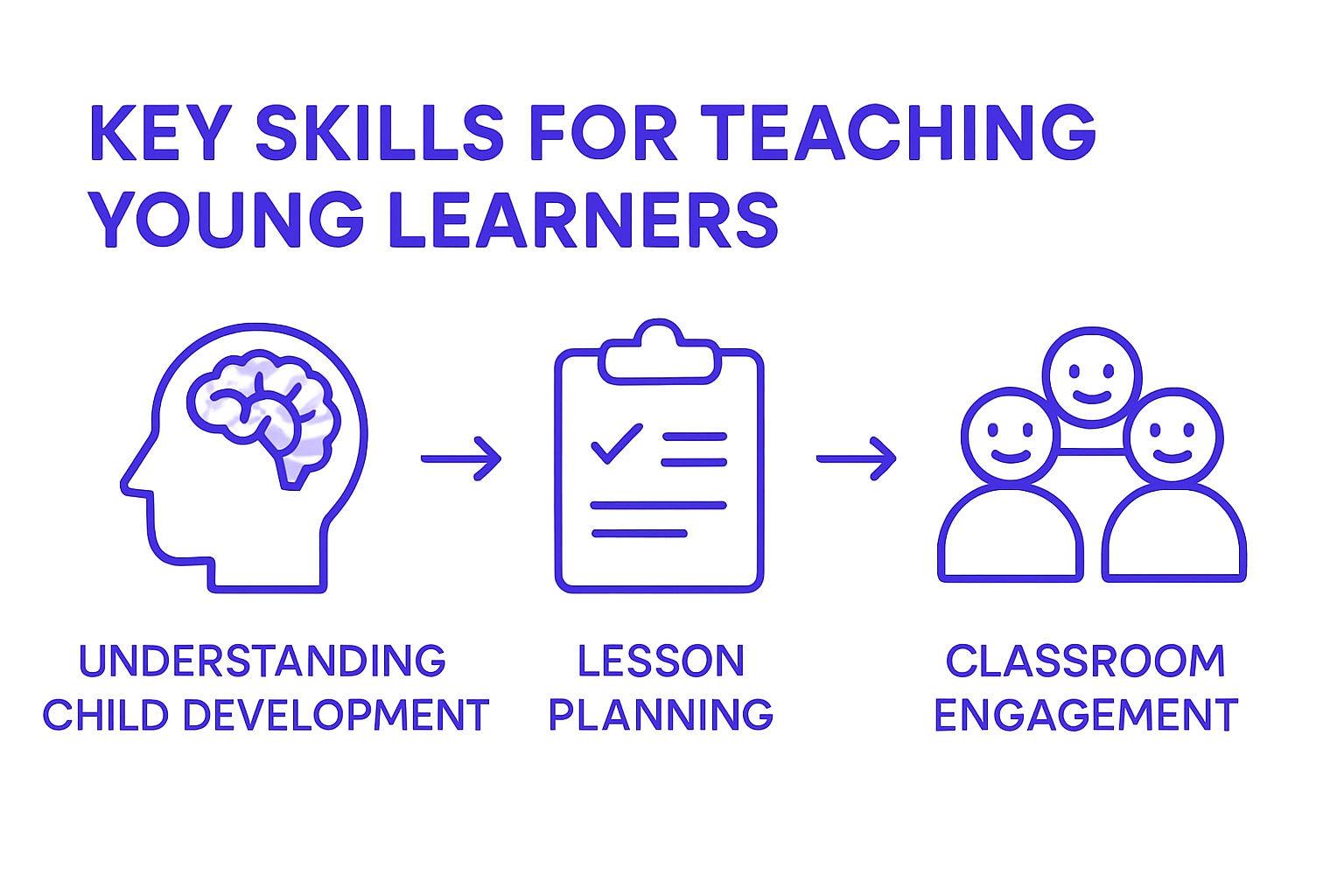
Essential skills include understanding child development, applying developmentally appropriate practices, creating engaging and interactive learning experiences, and employing various instructional techniques tailored to different learning styles.
How can educators support the emotional development of young learners in the classroom?
Educators can provide emotional support by creating a nurturing and encouraging learning environment, using positive reinforcement, and being attentive to individual emotional needs, thus fostering a sense of safety and belonging.
What types of learning activities are most effective for young English language learners?
Effective learning activities include kinesthetic games, storytelling workshops, role-playing scenarios, sensory learning stations, and musical language exercises, all designed to engage young learners through interactive and multimodal experiences.
Recommended
- English language teaching skills for successful TEFL teachers – EBC Trinity CertTESOL and TEFL courses
- 200-Hour Online TEFL Certification | EBC with Trainer Support
- Teaching English to children in Asia: All you need to know – EBC Trinity CertTESOL and TEFL courses
- Teaching Practice: Everything You Need to Know – EBC TEFL courses
- Making Learning Fun: Engaging Activities for Your Kids – The Zoofamily
- The Essential Guide to Teaching Critical Thinking Skills – Projector Display
