
Many recent graduates dream of transforming their degree into an international career, but myths about TEFL can make the process seem confusing or out of reach. In reality, qualifying as an English teacher is about more than quick online certificates – it centres around professional training designed for real classroom challenges. Understanding the true role of accredited TEFL certification will help you confidently plan your next steps towards gaining international experience and meaningful cultural immersion.
Table of Contents
- TEFL Explained: Core Concepts And Myths
- Types Of TEFL Courses And Accreditation
- Trinity College London’s Role In Quality Assurance
- Requirements For Teaching English Abroad
- EBC’s One-Year Study And Work Abroad Programmes
- Job Prospects And Lifetime Placement Support
Key Takeaways
| Point | Details |
|---|---|
| TEFL Certification Is Rigorous | Achieving TEFL certification requires substantial coursework and practical teaching experience, ensuring genuine teaching competency. |
| Accreditation Matters | Opt for internationally recognised certifications like Trinity CertTESOL to enhance employability and credibility in the job market. |
| Diverse Career Opportunities | TEFL qualification opens pathways in various sectors, including language schools, corporate training, and online teaching roles. |
| Lifetime Placement Support | Programs like EBC provide ongoing job placement assistance, facilitating career advancement across multiple teaching contexts. |
TEFL Explained: Core Concepts And Myths
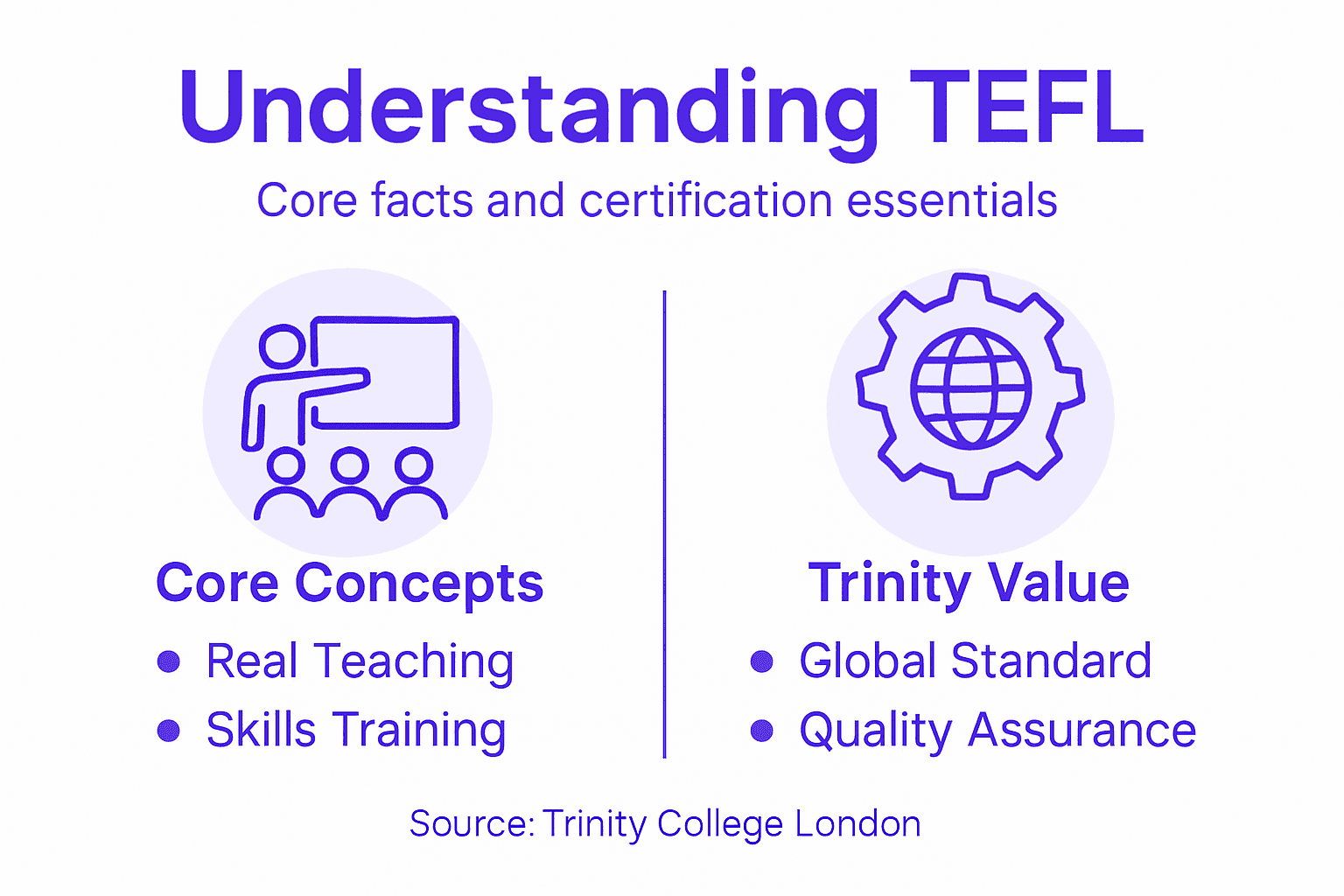
Teaching English as a Foreign Language (TEFL) often gets wrapped up in misconceptions that can actually deter capable people from pursuing the field. What TEFL actually represents is a professional qualification that trains teachers to deliver English instruction to non-native speakers in structured, effective ways. The core of TEFL certification involves learning classroom management, grammar instruction, lesson planning, and assessment techniques tailored specifically for learners whose first language is not English. This distinction matters because teaching English to foreign language learners requires different approaches than teaching native English speakers. You’re not simply explaining English; you’re building a framework that helps students grasp entirely new linguistic patterns, phonetics, and cultural communication styles. The training process itself is rigorous and methodical, designed to prepare you for real classroom challenges you’ll face whether you’re working in Madrid, Paris, Milan, or Bangkok.
One persistent myth suggests TEFL certification is just a quick weekend course that anyone can complete without real effort. In reality, accredited TEFL certifications like Trinity CertTESOL demand substantial coursework, practical teaching demonstrations, and observed lessons with actual students. You’ll study language systems, teaching methodologies, assessment approaches, and learner psychology. Another misconception is that TEFL teachers are either failed academics or gap-year backpackers killing time abroad. The truth is far different. Graduates with degrees in linguistics, business, social sciences, and other fields successfully transition into TEFL roles and build lasting careers. Career changers find that TEFL provides genuine professional structure, clear advancement pathways, and opportunities to develop specialised expertise in areas like Business English, teaching young learners, or online instruction. The global demand for qualified English teachers means your qualification opens doors across multiple continents, not just one region.
Another important distinction many people overlook involves the different certifications available. While TEFL is the broader term for teaching English to foreign language speakers, the distinctions between TEFL, TESOL, and other certifications matter significantly for your career trajectory. Trinity CertTESOL (Certificate in Teaching English to Speakers of Other Languages) holds international recognition and weight in employment markets worldwide. Unlike generic online certificates, Trinity accreditation ensures your qualification meets rigorous international standards and represents genuine teaching competency. This matters when you’re applying for positions at language schools, private institutions, or establishing yourself as an independent tutor. Schools hiring international staff prioritise candidates with recognised certifications because it guarantees baseline teaching quality and professional accountability.
The practical reality of TEFL work also differs from what many people imagine. You won’t spend your days in abstract discussions about linguistics. Instead, you’ll manage diverse classrooms where students have varying proficiency levels, motivation patterns, and learning styles. You’ll adapt lesson materials on the fly, provide written feedback on student work, plan progression pathways, and often work across multiple proficiency levels within the same institution. The role demands creativity, patience, cultural awareness, and genuine commitment to student progress. What makes this rewarding is seeing students’ confidence grow as they gain communication ability. A student who couldn’t order coffee in English at the start of your course later leads business presentations or holds conversations with confidence. That transformation represents the real value of quality TEFL instruction.
Pro tip: When evaluating your TEFL options, prioritise internationally accredited programmes over unrecognised certificates; Trinity College London accreditation carries genuine weight with employers worldwide and directly affects your earning potential and job flexibility across different countries.
Types Of TEFL Courses And Accreditation
TEFL courses come in several distinct formats, each designed for different timelines, learning styles, and career goals. Understanding your options matters because the course you choose directly affects both your preparation quality and how employers perceive your qualification. Full-time intensive programmes typically run between 4 and 12 weeks and immerse you completely in teaching methodology, practice lessons, and classroom observation. These courses pack significant learning into a compressed timeframe and suit people who want to launch their teaching careers quickly. Part-time courses spread the same content across several months, allowing you to work or study alongside your TEFL training. Online TEFL courses offer maximum flexibility, letting you learn from anywhere whilst completing assignments and teaching practice on your own schedule. Specialist TEFL pathways focus on particular contexts: Business English for corporate environments, Young Learner instruction for children, or online teaching for remote instruction. The seven key types of accredited TEFL courses each address specific teaching scenarios and professional specialisations that enhance your employment prospects.
Accreditation represents the crucial differentiator between legitimate teacher training and unregulated online certificates. When a TEFL course carries international accreditation from bodies like Trinity College London, it signals that the programme meets rigorous standards for content quality, trainer qualifications, and assessment methods. Trinity CertTESOL accreditation is particularly significant because employers worldwide recognise it as a genuine marker of teaching competency. Accredited courses require you to complete observed teaching practice with real students, submit written assignments demonstrating pedagogical knowledge, and receive feedback from qualified assessors. Non-accredited certificates, often completed entirely online in days, lack this accountability and carry minimal weight in competitive job markets. When applying for teaching positions in language schools, universities, or international curricula programmes, accreditation status frequently determines whether your application gets serious consideration. Unaccredited qualifications might allow you to find informal tutoring work, but they won’t open doors to established institutions or higher-paying positions. The distinction becomes especially important if you plan to teach across multiple countries, as many nations specifically require internationally recognised TEFL qualifications for work visa eligibility.
Choosing the right course type depends on your circumstances and career timeline. If you’re a recent graduate with flexible scheduling and want comprehensive training before moving abroad, an intensive four-week full-time course provides focused, immersive preparation. Career changers with existing jobs often benefit from part-time or blended learning options that let them maintain income whilst studying. Location matters too. Courses delivered in your target teaching country (Spain, France, Italy, or Asia) offer the practical advantage of local job networking, cultural familiarisation, and immediate teaching practice in your future work environment. Understanding TEFL accreditation standards helps you evaluate whether a programme’s content aligns with how you want to teach. Some teachers thrive with specialised certification in Young Learner instruction or Business English from the start, whilst others prefer core TEFL qualifications that provide broad teaching flexibility. The investment in proper accreditation upfront translates into genuine career advantages throughout your teaching life. Employers consistently prefer candidates with Trinity or equivalent internationally recognised qualifications, which typically translates to better salaries, more stable positions, and greater opportunities for professional advancement across different countries and teaching contexts.
Here’s a concise comparison of common TEFL course types and their typical benefits:
| Course Type | Duration & Format | Target Audience | Main Benefit |
|---|---|---|---|
| Full-time Intensive | 4–12 weeks, classroom | Graduates, fast starters | Quick qualification, immersive experience |
| Part-time | Several months, flexible | Career changers, busy adults | Study alongside work or study |
| Online | Self-paced, remote | Geographically restricted | Location flexibility, self-pacing |
| Specialist | Variable, focused | Niche educators, upskillers | Business English or young learners focus |
Pro tip: Prioritise Trinity accredited courses delivered in person in your intended destination country, as this combination provides legitimate qualification recognition, local professional networks, and authentic teaching practice with students from your future workplace.
Trinity College London’s Role In Quality Assurance
Trinity College London operates one of the world’s most respected systems for ensuring consistent quality across TEFL teacher training. When you complete a Trinity accredited course, you’re not just earning a certificate; you’re obtaining a qualification that has been validated against rigorous international standards. Trinity’s quality assurance framework begins before a course ever starts teaching students. The organisation carefully evaluates training providers’ curriculum design, trainer qualifications, teaching facilities, and assessment procedures to ensure they meet exacting criteria. This vetting process means that a Trinity accredited course in Madrid operates at essentially the same professional standard as one in Bangkok or Milan. Trinity doesn’t simply issue certificates and disappear; the organisation maintains ongoing monitoring of certified providers to ensure they continue meeting benchmarks. This continuous oversight protects your investment in training and guarantees that your qualification reflects genuine teaching competency rather than simply having completed paperwork.

The CertTESOL qualification represents a Level 5 Ofqual-regulated certification that carries specific legal recognition across the United Kingdom and substantial international credibility. This regulatory status matters because it means your qualification meets standardised government benchmarks for educational qualifications. Trinity’s assessment model requires you to complete observed teaching practice with actual students, not simulated lessons on video. Assessors watch you teach live classes and evaluate your classroom management, learner engagement, and instructional effectiveness. You’ll also submit written assignments demonstrating your understanding of language systems, teaching methodology, and learner psychology. This comprehensive assessment approach ensures that teachers holding Trinity certification have proven their ability to actually teach, not merely passed a multiple-choice exam. Employers understand this distinction immediately. When you present a Trinity credential, schools know you’ve been evaluated by qualified assessors against consistent standards, which removes uncertainty from the hiring process.
Trinity’s role extends beyond initial certification into supporting your ongoing professional development. The organisation maintains registers of qualified teachers and trainers, providing employers with a searchable database for verification. This transparency protects both language schools seeking quality staff and teachers protecting their professional reputation. For prospective teachers weighing different qualification options, Trinity’s involvement offers concrete assurance. You’re not betting on an unknown organisation’s credibility; you’re obtaining a qualification from an institution with centuries of educational expertise and international recognition. The advantages of Trinity CertTESOL certification extend throughout your career, as the qualification remains valuable for employment applications, salary negotiations, and professional advancement across multiple countries. Institutions that invest in Trinity training do so specifically because they trust the quality assurance process to produce competent teachers. This trust translates directly into better job opportunities for certificate holders and higher starting salaries compared to unaccredited alternatives.
Pro tip: When evaluating TEFL courses, verify Trinity accreditation status directly through Trinity College London’s official provider register rather than relying on course marketing materials, as this confirms the programme genuinely meets their quality standards.
Requirements For Teaching English Abroad
Teaching English abroad isn’t a completely open door, but the requirements are actually quite manageable for most people with determination. The baseline expectations are consistent across most countries where you might teach: a bachelor’s degree from an accredited university, a recognised TEFL or TESOL certification like Trinity CertTESOL, native or near-native English proficiency, and a clean criminal record. Some countries remain more flexible about specific credentials, particularly in parts of Asia where established language schools sometimes hire based on personality and teaching aptitude rather than rigid qualification checklists. However, the seven key requirements for teaching English abroad typically include both formal qualifications and legal documentation that protects both you and your employer. The critical point here is that nearly all countries require work authorisation, which means obtaining the proper visa classification. You cannot simply arrive in Spain, France, or Italy with a TEFL certificate and start teaching; you need legal permission to work in those countries. This is where having an accredited qualification becomes strategically important, as schools supporting international teachers understand visa requirements and can sponsor appropriate work permits if you hold genuine credentials.
Your educational background matters more than many prospective teachers initially realise. Most established language schools, universities, and international curricula programmes require you to hold a bachelor’s degree in any discipline, not necessarily English or education. This is both a practical requirement and a legal one in many countries. Holding a degree signals that you’ve completed tertiary education and meets baseline standards that immigration authorities recognise when processing work visas. If you’re a recent graduate, you’re actually in an ideal position because your degree is fresh and easily verified through official channels. Career changers without university degrees face a steeper path but not an impossible one. Some countries and certain teaching contexts accept candidates with extensive professional experience, vocational qualifications, or demonstrated teaching ability alongside TEFL certification. The reality is that degree requirements exist partly to protect the profession’s credibility and partly because immigration law in many countries specifically mandates tertiary education for skilled work visas.
Criminal background checks form a non-negotiable requirement everywhere. Schools and educational institutions must protect children and young people, so thorough background verification happens during hiring. You’ll need to obtain an official criminal record check from your home country and potentially an international police certificate for countries outside your usual residence. This process can take several weeks, so starting early matters. Beyond criminal checks, you’ll need to demonstrate English language proficiency, though native speakers of English automatically satisfy this requirement. Most countries also require health screenings including vaccination records and sometimes medical clearance. Visa requirements vary significantly depending on your nationality and target destination. European Union nationals teaching within the EU historically faced minimal bureaucratic barriers, though Brexit changed pathways for British citizens. Non-European teachers typically need employer sponsorship for work visas, which is why teaching at established schools with international recruitment experience streamlines the process considerably. Having Trinity accreditation strengthens your visa applications because employers can argue convincingly that you meet professional standards and deserve legal work authorisation.
The table below outlines major requirements for teaching English abroad and their importance:
| Requirement | Purpose | Why It Matters for Applicants |
|---|---|---|
| Bachelor’s Degree | Meets school & visa regulations | Increases employability in most countries |
| TEFL/TESOL Certification | Verifies teaching competency | Essential for reputable institutions |
| Native/Near-native English | Confirms language proficiency | Satisfies employer expectations |
| Criminal Record Check | Ensures child safety | Mandatory for work permits and hiring |
| Medical Clearance | Meets health and legal standards | Required for some visas and schools |
Pro tip: Begin gathering your criminal record check and degree verification documents before enrolling in TEFL training, as these items take longest to obtain and having them ready dramatically accelerates your job application process once you’re certified.
EBC’s One-Year Study And Work Abroad Programmes
EBC’s one-year study and work abroad programmes represent a comprehensive pathway for recent graduates and career changers seeking to combine professional teacher training with language acquisition and cultural immersion. Rather than simply completing a TEFL course and figuring out the rest, these integrated programmes handle the complexity for you. You complete your Trinity CertTESOL certification whilst simultaneously studying the local language (Spanish, French, or Italian), securing employment in a teaching role, and building genuine professional experience. The programmes operate in Spain, France, and Italy, allowing you to choose your preferred destination based on career aspirations, personal interests, or existing language connections. This structured approach addresses a genuine challenge many prospective teachers face: completing TEFL training in isolation, then scrambling to find work, secure visas, and arrange language study independently. EBC’s model eliminates that uncertainty by bundling everything together with institutional support and professional guidance throughout the entire year.
The practical architecture of these programmes balances multiple objectives simultaneously. You’ll spend your initial weeks completing intensive Trinity CertTESOL training, receiving hands-on instruction in teaching methodology, classroom management, and assessment techniques. This foundation happens in your destination country, which means you’re learning to teach in the actual environment where you’ll work. Parallel language study begins immediately, allowing you to develop genuine communicative ability in Spanish, French, or Italian rather than merely achieving tourist-level survival phrases. Once your TEFL certification is completed, you transition into teaching roles, typically with partner language schools or educational institutions that EBC has vetted and established relationships with. Teaching English abroad whilst learning the local language transforms your experience from a temporary gap-year adventure into a purposeful professional development initiative. You’re not simply marking time; you’re building teaching credentials, developing linguistic fluency, and creating a professional network in your destination country.
Visa support and employment arrangements distinguish these programmes from independent approaches. EBC handles the bureaucratic complexities that would otherwise consume weeks of research and application effort. The organisation assists with work visa sponsorship, ensuring your legal status is properly established so you can teach without anxiety about employment legality. Partner institutions understand they’re receiving teachers trained through accredited programmes, which simplifies hiring and integration processes. Teaching positions typically offer reasonable remuneration covering living expenses and allowing modest savings. Beyond salary, you gain genuine teaching experience that strengthens future job applications and builds your professional portfolio. Graduates move forward with Trinity certification, demonstrated teaching practice, local language ability, and established professional connections within their chosen country. This combination opens doors to more senior teaching roles, curriculum development positions, or transitions into related educational work. The cultural immersion aspect shouldn’t be underestimated either. Living as a working professional in Spain, France, or Italy rather than as a tourist creates fundamentally different relationships with local communities and accelerates both language acquisition and cultural understanding.
Pro tip: Apply for one-year study and work programmes six to nine months before your intended start date, as visa processing and employment coordination require substantial advance planning, and early applications improve destination availability and optimal placement matching.
Job Prospects And Lifetime Placement Support
The global demand for qualified English teachers has never been stronger, and holding Trinity CertTESOL certification positions you directly into this expanding job market. Teaching English is one of the few professions where a recent graduate without extensive experience can secure international employment earning reasonable salaries whilst building professional credentials. The job landscape extends far beyond language schools. International schools following British or American curricula need English teachers. Corporate training departments hire TEFL qualified professionals to deliver business English programmes. University preparation centres employ teachers preparing students for academic study. Private tutoring offers flexibility and often superior hourly rates. Online teaching platforms connect qualified teachers with students across time zones, eliminating geographic constraints entirely. This diversity means your Trinity qualification opens multiple career pathways rather than locking you into a single role type. Whether you prefer stable institutional employment, flexible freelance work, or a combination of teaching positions, the market accommodates different preferences. Starting salaries in Spain, France, and Italy typically range from 1200 to 1800 euros monthly in established schools, with experienced teachers and those in senior positions earning considerably more. Private tutoring can exceed these figures significantly depending on your client base and specialisation.
What distinguishes EBC’s approach is the commitment to lifetime placement support rather than abandoning you after certification completion. This matters profoundly because job searching across international markets involves real challenges: understanding local employment regulations, navigating different hiring timelines, identifying legitimate opportunities amongst unreliable schemes, and building professional networks in unfamiliar countries. Free lifetime job placement assistance means you have ongoing access to opportunities as your career evolves. Maybe you complete a year teaching in Spain, then want to relocate to Italy or transition into curriculum development. Rather than starting your job search from scratch, you maintain access to professional placement guidance and institutional networks developed over years. Teaching English abroad opens doors to varied career opportunities that extend well beyond your first position. Many EBC graduates progress into teacher training roles, directing language programmes, or establishing independent tutoring businesses. The initial Trinity certification provides the credential that makes all these progression pathways possible.
Career advancement with Trinity certification follows predictable trajectories. Early career positions typically involve classroom teaching at language schools or educational institutions, where you develop practical experience and refine your pedagogical skills. After two to three years, experienced teachers transition into more senior roles: coordinator positions overseeing curriculum or staff, specialist roles teaching Business English or examination preparation, or trainer positions delivering professional development to other teachers. Higher salaries accompany these transitions, often jumping 30 to 50 percent above baseline teaching rates. Some teachers combine traditional employment with income diversification through private tutoring, online instruction, or content creation for educational platforms. The credential itself never expires or requires renewal, so your Trinity CertTESOL remains professionally valid throughout your entire career. This stability contrasts with fields where certifications demand periodic renewal or updating. Your investment in quality training pays dividends across decades of professional work.
Beyond individual career progression, the TEFL profession offers genuine community and professional development networks. Organisations like IATEFL and TESOL connect teachers globally, offering conferences, professional publications, and networking opportunities that enhance teaching practice and career visibility. Many teachers find that TEFL work attracts people with genuine intellectual engagement in language and pedagogy rather than those merely chasing international lifestyle experiences. This creates collaborative professional environments where teachers learn from one another and develop specialist expertise. Lifetime placement support combined with professional community access means your TEFL journey extends far beyond your initial certification course. You’re joining a global profession with established standards, recognised credentials, and genuine career pathways for those committed to developing their teaching practice.
Pro tip: Begin building your professional network and documenting your teaching achievements from your first day working, as detailed experience descriptions and positive student feedback significantly strengthen future job applications and enable progression into senior roles.
Unlock Your TEFL Career with Trinity Accreditation and EBC’s Comprehensive Programmes
Understanding what TEFL really means and recognising the importance of Trinity College London certification are crucial first steps for anyone serious about teaching English abroad. If you want to overcome the common challenges of finding accredited training, gaining real teaching experience, and securing legal work opportunities internationally, EBC TEFL offers the ideal solutions. Our accredited Trinity CertTESOL courses deliver rigorous, practical teacher training recognised worldwide. We also support you every step of the way with free lifetime job placement assistance, opening doors to teaching jobs across Spain, France, Italy, Asia, and beyond.
For those seeking a fully immersive experience, explore our unique one-year study and work abroad programmes in Spain, France, and Italy. These combine Trinity certified training with language study, visa support, part-time teaching opportunities, and deep cultural immersion. This holistic approach equips you with the confidence and qualifications employers prioritize, while helping you build a fulfilling international career.
Let us help you transform your passion for teaching into a sustainable profession backed by global accreditation and ongoing support. Discover how Trinity College London certification and EBC’s programmes can elevate your teaching journey today.
Ready to start your internationally recognised TEFL journey and access worldwide job support? Book your free consultation now at EBC TEFL and take the first step towards an exciting global teaching career. Learn more about our Trinity CertTESOL courses or find out about our comprehensive study and work abroad programmes to secure your future in English language teaching.
Frequently Asked Questions
What is TEFL and what does it involve?
TEFL stands for Teaching English as a Foreign Language. It involves training teachers to deliver English instruction to non-native speakers, focusing on classroom management, grammar instruction, lesson planning, and assessment techniques tailored for learners.
Why is obtaining Trinity CertTESOL certification important?
Trinity CertTESOL certification is internationally recognised and reflects rigorous training and teaching competency. It provides a qualification that meets global standards, enhancing employment prospects and assuring potential employers of your teaching abilities.
How does Trinity College London ensure the quality of its TEFL courses?
Trinity College London evaluates course providers for curriculum design, trainer qualifications, and assessment methods to ensure they meet high standards. Continuous monitoring of accredited providers maintains the quality of the training programmes.
What are the typical requirements for teaching English abroad?
Generally, the requirements include holding a bachelor’s degree, a recognised TEFL certification like Trinity CertTESOL, native or near-native proficiency in English, and a clean criminal record. Some countries may have more flexible standards depending on the teaching context.
Recommended
- Complete Guide to Trinity CertTESOL Certification – EBC Trinity CertTESOL and TEFL courses
- What is the Trinity CertTESOL? How do I pass the course?
- 7 Key Advantages of the Trinity CertTESOL for Aspiring Teachers – EBC TEFL courses
- TESOL, TEFL, CELTA, DELTA, TESL – How Are They Different? – EBC Trinity CertTESOL and TEFL courses
