
What are the CELTA and Trinity CertTESOL?
The Cambridge CELTA and Trinity CertTESOL are the most prestigious and internationally respected Level 5 TEFL/TESOL qualifications. Awarded by leading examination and assessment bodies, they represent a rigorous standard of initial teacher training, combining academic understanding, assessed teaching practice and professional evaluation.
Together, they set the benchmark for professional preparation in English language teaching, with international recognition and rigorous assessment standards that set them apart from other Level 5 qualifications and more generic TEFL certificates.
Choosing between the Cambridge CELTA and the Trinity CertTESOL is an important decision if you want to start a career teaching English as a foreign language. Both qualifications are internationally recognised, include assessed teaching practice and provide a foundation for teaching English to speakers of other languages.
However, they have different syllabuses, unit structures and approaches to teacher development. Understanding those differences can help you choose the course that best matches your professional goals and the way you want to develop as a teacher.
This guide compares CELTA and Trinity CertTESOL, covering course content, teaching practice, assessment, recognition and career opportunities. It also explains some distinctive features of Trinity CertTESOL that prospective trainees should consider before enrolling.
Table of contents
- CELTA vs Trinity CertTESOL: at a glance
- What do CELTA and Trinity CertTESOL have in common?
- Course content: CELTA vs Trinity CertTESOL
- Teaching approach and methodology
- Teaching practice and assessment
- Recognition and employment opportunities
- Which qualification should you choose?
- Study Trinity CertTESOL with EBC
- Frequently asked questions
- Final thoughts
CELTA vs Trinity CertTESOL: at a glance
CELTA and Trinity CertTESOL are both Level 5 initial qualifications for teaching English to speakers of other languages. Each requires trainees to develop their language awareness, plan lessons, teach real learners and reflect on their performance.
The table below summarises some of their main similarities and differences. The two awarding bodies organise their courses differently, so figures such as guided learning hours and tutor contact hours should not be treated as directly interchangeable.
| Feature | Cambridge CELTA | Trinity CertTESOL |
|---|---|---|
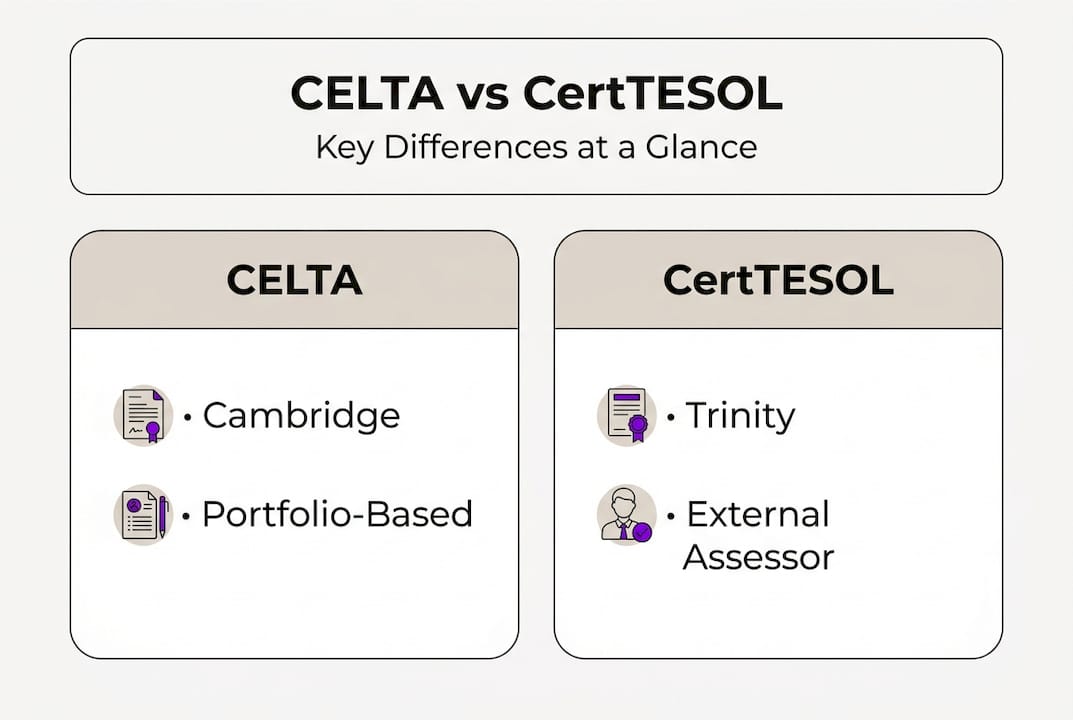
| Awarding body | Cambridge English | Trinity College London |
| Qualification level | Level 5 | Level 5 |
| Total qualification time | 200 hours | 200 hours |
| Guided or tutor-led learning | At least 120 hours of contact with tutors | At least 130 guided learning hours |
| Independent study | 80 additional learning hours | 70 independent study hours |
| Assessed teaching practice | At least 6 hours | At least 6 hours |
| Teaching practice learners | Adult learners at a minimum of two levels | Real English adult at a minimum of two levels – EBC also includes young learner teaching practice classes |
| Course structure | Five main syllabus topic areas | Five assessed units |
| Written work | Four written assignments | Five Units with assignments, portfolios and reflective work |
| Assessment | Continuous assessment, including teaching practice and written assignments | Assessment across all five units, teaching practice, with external moderation |
Both qualifications require commitment, independent study and practical teaching experience. Neither is simply a short introductory TEFL course. They are assessed professional qualifications designed to prepare trainees for the demands of English language teaching.
What do CELTA and Trinity CertTESOL have in common?
Although the qualifications have different course structures, they share several important features. Both aim to develop the knowledge, practical skills and professional awareness that new English language teachers need.
Recognised initial teaching qualifications
CELTA and Trinity CertTESOL are established qualifications for people entering the English language teaching profession. Both are Level 5 qualifications on the UK’s Regulated Qualifications Framework.
Employers around the world recognise these qualifications, although individual schools and organisations may set additional recruitment requirements.
Practical teaching experience
Both courses include at least six hours of assessed teaching practice with real learners. Trainees plan lessons, teach classes, receive feedback and work on improving their classroom performance.
This practical element matters. It gives trainees the opportunity to apply what they learn about language, lesson planning and teaching techniques in an actual learning environment.
Language awareness and lesson planning
Both qualifications develop trainees’ understanding of English grammar, vocabulary, pronunciation and language skills. They also cover lesson planning, classroom management, teaching resources and learner needs.
Feedback and professional development
Tutors observe trainees and provide feedback during the course. Trainees must respond to that feedback and demonstrate progress. Reflection and professional development therefore form part of both qualifications.
Course content: CELTA vs Trinity CertTESOL
Both qualifications cover the foundations of teaching English, but they organise their content in different ways. Cambridge CELTA uses five main syllabus topic areas, while Trinity CertTESOL has five assessed units.
CELTA course content
The CELTA syllabus covers five main topic areas:
- Learners and teachers, and the teaching and learning context: understanding learners, teachers and the environments in which language teaching takes place.
- Language analysis and awareness: understanding English language systems and how to explain language to learners.
- Language skills: developing techniques for teaching reading, listening, speaking and writing.
- Planning and resources: preparing lessons and selecting appropriate teaching materials.
- Developing teaching skills and professionalism: building practical classroom skills and professional awareness.
These topics connect with the course’s teaching practice and written assignments. Trainees develop their ability to plan and deliver lessons, analyse language and evaluate their own teaching.
You can read the full Cambridge CELTA syllabus for the detailed learning outcomes and assessment requirements.
Trinity CertTESOL course content
Trinity CertTESOL has five assessed units. Together, they develop practical teaching skills, language awareness and an understanding of the learner’s experience.
- Unit 1: Teaching Skills. Trainees develop their classroom skills through lesson planning, teaching practice, observation, feedback and reflection.
- Unit 2: Language Awareness and Skills. Trainees develop their understanding of English grammar, vocabulary, pronunciation and language use, as well as the skills needed to teach language effectively.
- Unit 3: Learner Profile. Trainees analyse an individual learner’s needs and prepare and teach a suitable one-to-one lesson.
- Unit 4: Materials Assignment. Trainees select, adapt, create and evaluate materials for language teaching.
- Unit 5: Unknown Language. Trainees experience learning an unfamiliar language and reflect on the challenges and strategies involved in learning a new language.
The Learner Profile, Materials Assignment and Unknown Language unit are distinctive features of the CertTESOL syllabus. They give trainees specific opportunities to explore individual learner needs, resource development and the experience of language learning.
Trinity’s CertTESOL syllabus provides further information about the qualification’s units and requirements. You can also consult Trinity’s current CertTESOL qualification overview.
Trinity CertTESOL includes a minimum of 130 guided learning hours and 70 hours of independent study, giving a total qualification time of 200 hours. Trainees complete at least six hours of assessed teaching practice with real learners and at least four hours of guided observation of experienced teachers.
Trinity sets a common syllabus and assessment framework for validated providers. Its CertTESOL Validation Requirements explain the requirements for course delivery, assessment, moderation and quality assurance. Providers must meet these requirements, while Trinity allows them to adapt aspects of delivery to the local context.
Teaching approach and methodology
Both CELTA and Trinity CertTESOL follow defined syllabuses and established teaching principles. Both include practical teaching, lesson planning, language analysis, observation, feedback and reflection. Neither qualification is an unstructured route into teaching.
The distinction is better understood as one of emphasis and course design, rather than a simple contrast between a rigid course and a flexible one.
CELTA: a clearly defined framework for developing teaching skills
CELTA provides a structured framework for developing the practical skills required to teach English to adults. Trainees work with lesson planning, classroom management, language analysis and teaching techniques. Tutors observe their lessons and provide feedback throughout the course.
The course also includes written assignments on learner needs, language analysis, language skills and reflection on classroom teaching. Cambridge’s syllabus sets out the required learning areas and assessment expectations.
Trinity CertTESOL: structured training with an emphasis on individual development
Trinity CertTESOL also has a defined methodology, syllabus and assessment structure. Its five units provide a clear route through teaching practice, language awareness, learner analysis, materials development and the experience of learning an unfamiliar language.
Some elements give trainees particular opportunities to develop their own teaching judgement. The Learner Profile requires trainees to investigate an individual learner’s needs and plan a one-to-one lesson. The Materials Assignment develops the ability to select, adapt and create resources. The Unknown Language unit encourages trainees to consider what it feels like to learn a language they do not know.
Reflective journals and feedback also help trainees evaluate their progress and identify areas for development. At EBC, we see this as an opportunity to recognise and develop each trainee’s natural teaching strengths, while grounding those strengths in sound methodology and professional practice.
This does not mean that CELTA excludes reflection or individual development. Both qualifications expect trainees to respond to feedback and improve their teaching. The difference lies in the way each syllabus organises and emphasises the learning experience.
Teaching practice and assessment
Practical teaching is central to both qualifications. Trainees plan and teach lessons with real English language learners, receive feedback from tutors and complete written work. Both qualifications assess performance throughout the course rather than relying on a single final examination.
CELTA focuses its assessed teaching practice on adult learners, as reflected in its full name: Certificate in English Language Teaching to Adults.
Trinity CertTESOL also focuses primarily on teaching adults aged 16 and over. Trinity also allows course providers to include additional training in teaching young learners.
At EBC, we go beyond this core adult-teaching focus by arranging practical teaching experience with both adults and young learners. Through our partnerships with local schools, trainees have the opportunity to teach younger learners and experience the different planning, classroom management and teaching approaches that this age group requires.
This element of our course is particularly valued by Trinity’s external moderators. It enriches our trainees’ experience and gives them a broader practical foundation for their future teaching careers.
CELTA teaching practice and assessment
CELTA includes:
- At least 120 hours of contact with course tutors.
- At least six hours of assessed teaching practice with adult learners at a minimum of two levels.
- Six hours of directed observation of experienced teachers. Up to three hours may involve filmed lessons.
- Four written assignments, each normally between 750 and 1,000 words.
- Ongoing tutor feedback and individual tutorials.
Cambridge recommends a further 80 hours for independent learning, including preparation, reading, research, lesson planning and assignment writing. The possible CELTA grades are Pass A, Pass B, Pass and Fail. Assessment takes place throughout the course, with no separate final examination.
Trinity CertTESOL teaching practice and assessment
Trinity CertTESOL includes:
- A minimum of 130 guided learning hours.
- 70 hours of independent study, giving a total qualification time of 200 hours.
- At least six hours of observed and assessed teaching practice with real learners.
- At least four hours of guided observation of experienced teachers.
- Assessment across all five units, including teaching practice, assignments and reflective work.
Assessment includes teaching portfolios and reflective journals, language awareness assessments, the Learner Profile, the Materials Assignment and the Unknown Language learning journal. Trainees must pass all five units to achieve the qualification. Trinity also uses external moderation to maintain assessment standards.
External moderation: an important difference between CELTA and Trinity CertTESOL
Both CELTA and Trinity CertTESOL use external moderation to maintain assessment standards. However, the moderators have different responsibilities within each qualification.
CELTA Moderation
The CELTA external moderator:
- reviews trainees’ written work
- interviews individual trainees
- examines their teaching practice
- can recommend that a trainee fails the course if the required standard has not been met
Trinity CertTESOL Moderation
The Trinity external moderator:
- reviews written work
- interviews trainees individually and as a group
- examines their teaching practice
- can recommend that a trainee fails the course if the required standard has not been met
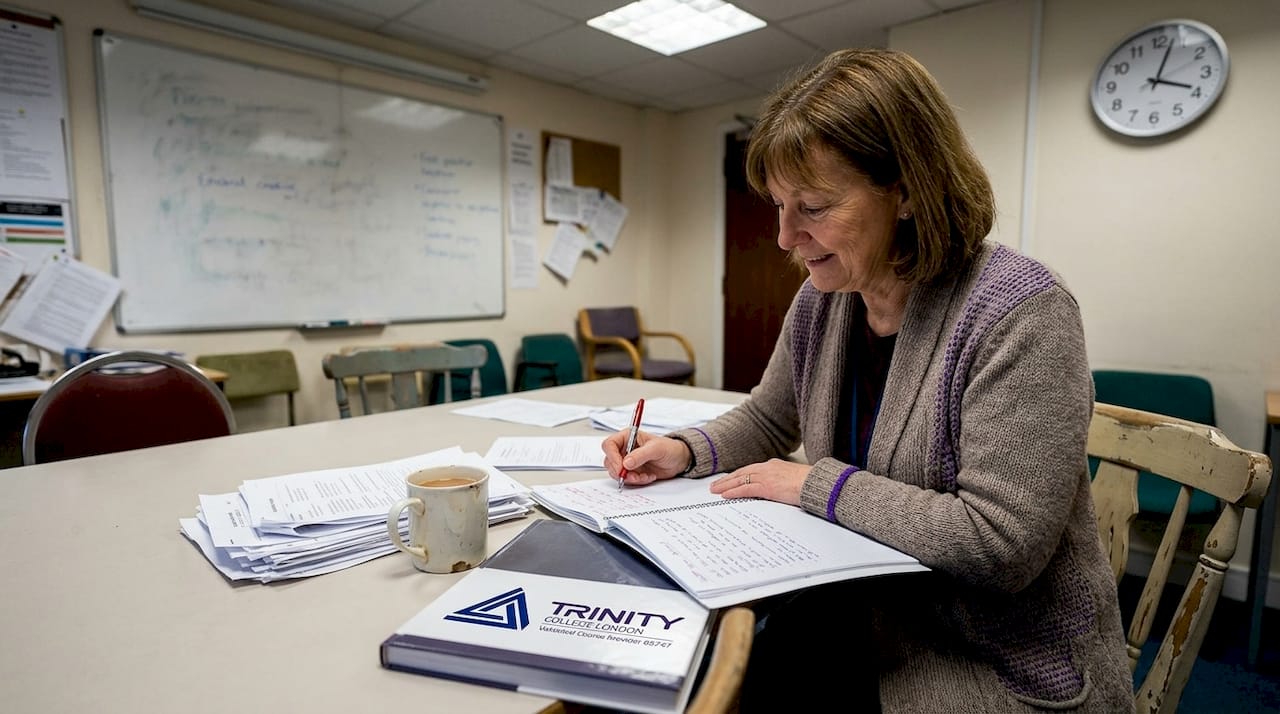
However, Trinity’s moderator has an additional assessment responsibility: marking Unit 4, the Materials Assignment.
This creates an important distinction in the final assessment process. Both awarding bodies’ external assessors can contribute to a decision that a trainee has not met the qualification requirements. However, Trinity’s moderator also directly awards a mark for Unit 4, which contributes to the trainee’s final course result. CELTA’s external assessor does not perform an equivalent additional unit-marking role.
The hours listed for the two qualifications are not directly interchangeable. Cambridge describes 120 hours of tutor contact and 80 additional learning hours, while Trinity specifies 130 guided learning hours and 70 independent study hours. Both have a total qualification time of 200 hours.
Recognition and employment opportunities
CELTA and Trinity CertTESOL are internationally recognised initial qualifications for people starting a career in English language teaching. Both are Level 5 qualifications on the UK’s Regulated Qualifications Framework.
Employers may accept either qualification, but hiring requirements vary. Some roles also require a university degree, previous teaching experience, a particular level of English proficiency or the legal right to work in the country.
Trinity confirms that the CertTESOL is accepted by the British Council as an initial teaching qualification for relevant roles in its accredited teaching organisations and overseas teaching operations. However, individual vacancies may have additional requirements.
Neither qualification guarantees a job, a visa or employment in a particular country. Before enrolling, check the requirements of the countries and employers where you hope to work.
For more information about the benefits of the Trinity qualification, read our guide to the advantages of Trinity CertTESOL. You can also explore our overview of qualifications for teaching English abroad.
Which qualification should you choose?
Both CELTA and Trinity CertTESOL are highly regarded, internationally recognised qualifications that offer an equally valid route into English language teaching. Neither is inherently superior to the other; they are peer-level qualifications with different course structures and areas of emphasis. Your choice should therefore depend on which approach to teacher development best suits your goals, as well as the quality of the training centre, its tutors and the practical experience it provides.
Choose CELTA if you:
- Specifically want to obtain the CELTA qualification as your initial teaching credential.
- Want an initial teaching qualification with a strong emphasis on practical classroom skills, lesson planning and language analysis.
- Prefer the CELTA syllabus and assessment framework.
- Have found an authorised centre that offers the right timetable, training environment and tutor support.
Choose Trinity CertTESOL if you:
- Want a comprehensive initial teaching qualification that combines practical classroom training with a deeper exploration of language, learners and the learning process.
- Value the opportunity to work closely with an individual learner through the Learner Profile, analysing their needs and planning a tailored one-to-one lesson.
- Want to develop your ability to select, adapt and create effective teaching materials, rather than relying solely on existing resources.
- Appreciate the Unknown Language unit, which gives you first-hand experience of being a language learner and encourages you to reflect on how learners experience challenges in the classroom.
- Want to develop your own teaching judgement, confidence and individual teaching style through practical experience, tutor feedback and reflective work.
- Value a qualification with a defined syllabus and rigorous external moderation, while allowing validated providers to contextualise aspects of course delivery.
- Would benefit from additional practical experience with different age groups. At EBC, our partnerships with local schools give trainees the opportunity to teach both adult and young learners.
Before making your decision, compare the course fees, timetable, teaching practice arrangements, tutor experience, class size, support and available study formats. Ask each provider how it organises teaching practice and feedback, and what support it offers when trainees find an aspect of the course challenging.
If you are considering a career change, our article on why Trinity CertTESOL can be a good career-change option explores the qualification in more detail.
Study Trinity CertTESOL with EBC
At EBC, we specialise in preparing trainees for the Trinity CertTESOL. Our course combines practical teaching experience with the theoretical knowledge and reflective work required by the qualification.
We help trainees develop the skills they need to plan lessons, understand language, respond to learner needs and build confidence in the classroom. We also provide guidance as trainees consider their next steps in English language teaching.
Whether you are changing careers, starting your first teaching role or looking for a recognised qualification to support your plans to work abroad, we can help you understand the training process and what to expect.
Find out more about what Trinity CertTESOL involves, explore our guide to Trinity CertTESOL certification, or learn more about TEFL and teaching English as a foreign language.
If you would like to discuss the course and whether it matches your plans, book a call with our team.
Frequently asked questions
Is Trinity CertTESOL equivalent to CELTA?
Both are Level 5 initial qualifications for teaching English to speakers of other languages. They have comparable overall qualification times and include assessed teaching practice with real learners. However, they are separate qualifications with different syllabuses, unit structures and assessment arrangements. One is not simply another version of the other.
Is CELTA better than Trinity CertTESOL?
Neither qualification is automatically better. Both are recognised routes into English language teaching. Your decision should depend on the course structure, training provider, tutors, teaching practice, assessment and the aspects of teacher development that matter most to you.
Is Trinity CertTESOL accepted by the British Council?
Yes. Trinity states that CertTESOL is accepted by the British Council as an initial TESOL or TEFL qualification for relevant teaching roles in its accredited teaching organisations and overseas operations. Individual vacancies may also require a degree, experience or other qualifications, so check the criteria for the role you want.
Do CELTA and Trinity CertTESOL both include teaching practice?
Yes. Both include at least six hours of assessed teaching practice with real English language learners. Trainees plan and teach lessons, receive feedback and demonstrate their developing teaching skills.
Can I teach abroad with CELTA or Trinity CertTESOL?
Both qualifications can support applications for English teaching jobs abroad. However, requirements differ between countries, employers and types of school. Some positions require a degree, relevant experience or specific work authorisation. Always check the requirements before accepting a role or making travel plans.
How long do CELTA and Trinity CertTESOL take?
Both qualifications have a total qualification time of 200 hours. CELTA includes at least 120 hours of contact with tutors and 80 additional learning hours. Trinity CertTESOL includes 130 guided learning hours and 70 hours of independent study. The calendar time depends on whether you choose a full-time or part-time course and the timetable offered by the provider.
Can I teach English online with either qualification?
Both qualifications can provide a foundation for online English teaching. However, online employers set their own requirements, and some ask for additional experience or training. Read our guide to the requirements for teaching English online before deciding which roles to pursue.
Final thoughts: CELTA or Trinity CertTESOL?
CELTA and Trinity CertTESOL are both substantial, assessed qualifications that prepare you for the realities of teaching English. Each combines theoretical learning, practical classroom experience, feedback and professional development.
CELTA offers a well-established Cambridge syllabus and a structured route through the core skills of teaching English.
Trinity CertTESOL is equally well-established and follows its own rigorous framework, with distinctive units that place particular emphasis on individual learner needs, materials development and the experience of learning an unfamiliar language.
So which one is best for you?
The best choice is the qualification and training style that match your professional goals and preferred learning experience.
Take time to compare the actual course delivery and career support available before you enrol.
Recommended
- 7 Key Advantages of the Trinity CertTESOL for Aspiring Teachers – EBC TEFL courses
- Your complete guide to the Trinity CertTESOL course
- Trinity CertTESOL Step by Step Guide for Global Educators
- Trinity CertTESOL Certification: Boosting Global Teaching Careers
- CELTA and Trinity CertTESOL: Course Requirements