
Key Points
- Recognised TEFL qualifications like CELTA and CertTESOL give access to better roles and higher salaries.
- Europe’s rich culture and structured programmes foster personal growth, professional skills, and language proficiency.
- Certification enhances visa prospects and employability in competitive European teaching markets.
You can step into a classroom in Spain, France, or Italy without any TEFL certification. Some government assistant programmes will let you do exactly that. But here is the reality: teachers who arrive with a recognised qualification access better schools, higher salaries, and a genuinely richer experience. The gap between a basic assistant role and a full teaching position is not just about pay. It is about confidence, classroom ability, and how schools perceive you from the first interview. This article covers what makes Europe exceptional for TEFL teachers, which qualifications carry real weight, how visas work in practice, and how to turn a year abroad into lasting personal and professional growth.
Table of Contents
- What makes Europe a unique TEFL destination?
- TEFL requirements and recognition: What you need to know
- TEFL and visas: How certification impacts your options
- Maximising your cultural and professional experience
- Our take: What most TEFL applicants overlook
- Start your TEFL journey in Europe
- Frequently asked questions
Key Takeaways
| Point | Details |
|---|---|
| Europe rewards TEFL credentials | Certified teachers enjoy superior job access, higher pay, and richer experiences compared to uncertified assistants. |
| Prestige matters for recognition | Choosing a recognised course like Trinity CertTESOL or CELTA boosts employability throughout Europe. |
| Immersion is a game-changer | Combining TEFL, language study, and everyday life in Spain, France, or Italy maximises professional and personal growth. |
| Visas and programmes vary | Non-EU citizens face visa hurdles, but TEFL helps unlock work, especially through government or private schemes. |
What makes Europe a unique TEFL destination?
Let’s start by understanding why Europe, and especially these Mediterranean countries, stand out among global TEFL destinations.
Teaching English in Europe is not simply a job. It is a structured opportunity to live inside a culture, develop professional skills, and build an international career foundation. Spain, France, and Italy offer something genuinely distinct compared to destinations in Asia or Latin America. The combination of rich history, diverse urban and rural settings, and established language learning traditions makes these three countries particularly compelling.
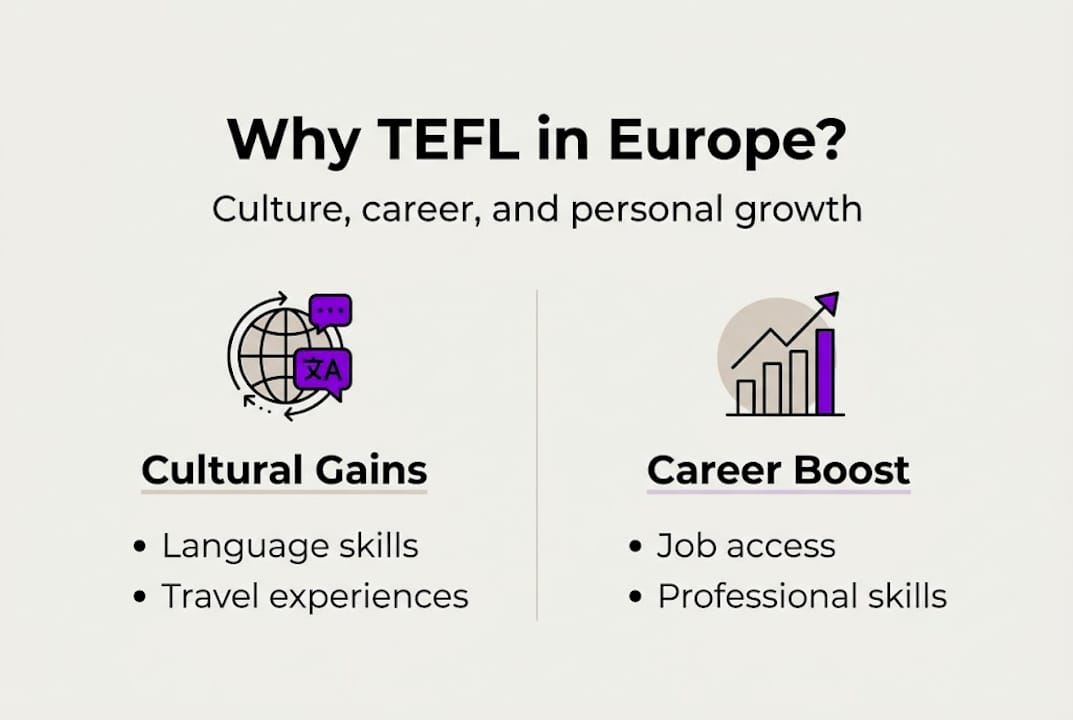
Spain draws teachers with its lively cities, warm climate, and strong demand for English across state schools and private academies. France offers a more formal educational culture, excellent infrastructure, and the appeal of one of the world’s most celebrated languages. Italy brings centuries of art, food, and regional diversity, along with a growing appetite for English in business and education.
What truly sets these destinations apart, though, is what happens when you commit to a longer stay. Short-term TEFL placements give you a taste. A full year changes you. Consider what a structured, immersive year actually includes:
- Accredited teacher training that gives you transferable qualifications recognised worldwide
- Language study so you make genuine progress in Spanish, French, or Italian
- Part-time work or teaching that helps fund your stay and builds your CV
- Cultural integration through local communities, events, and everyday life
- Postgraduate study options that add academic weight to your year abroad
“One-year programmes combining TEFL, language study, and part-time work in Spain, France, and Italy maximise your experience far beyond what certification alone can deliver.”
Exploring the best study abroad destinations in Europe will show you just how varied the options are. The benefits of teaching abroad extend well beyond language skills. Employers notice candidates who have navigated unfamiliar systems, built cross-cultural relationships, and demonstrated independence. That is exactly what a well-structured year in Europe delivers.
TEFL requirements and recognition: What you need to know
Now that you know why Europe appeals, let’s look at the qualifications you’ll need and how to stand out from the crowd.
Not all TEFL certificates carry the same weight, and this matters enormously when you are applying for competitive roles in European schools. Understanding the landscape helps you invest wisely.
The most basic entry point is a 120-hour TEFL certificate. This satisfies minimum requirements for many private language schools and some assistant programmes. However, in markets with strong competition, particularly Spain and France, basic certificates often leave candidates at the back of the queue.
The qualifications that genuinely set you apart are CELTA and Trinity CertTESOL These are internationally recognised, require assessed teaching practice, and are mapped to the European Qualifications Framework (EQF) at Level 5. EQF Level 5 recognition matters because it signals to European employers and institutions that your training meets a verified standard. In saturated job markets, EQF-recognised qualifications for teaching give you a measurable advantage.
| Qualification | Hours | Teaching practice | EQF level | Best suited for |
|---|---|---|---|---|
| Basic TEFL certificate | 120 hrs | Varies | Not mapped | Entry-level roles |
| Trinity CertTESOL | 130+ hrs | Required | Level 5 | Competitive markets |
| CELTA | 120+ hrs | Required | Level 5 | International schools |
When weighing other TEFL certificates, ask whether the course includes observed and assessed teaching practice. This is the single biggest differentiator. Theory alone does not prepare you for a real classroom.
Pro Tip: Ask any TEFL provider whether their course is mapped to EQF Level 5 before you enrol. If they cannot answer clearly, that tells you something important about the qualification’s standing.
Look carefully at the qualifications needed for teaching in Europe before committing to a course. Making the right choice at this stage saves you considerable time and money later.
TEFL and visas: How certification impacts your options
Understanding qualifications is just the start. Your citizenship also affects opportunities, and TEFL plays a strategic role in navigating visa and job programmes.
For EU citizens, the picture is relatively straightforward. Freedom of movement means you can work in any EU member state without a separate work visa, and a strong TEFL qualification simply makes you more competitive.

For non-EU citizens, the situation is more complex. Administrative requirements vary by country and change regularly. However, TEFL certification consistently improves your position in several practical ways.
Spain’s Auxiliares de Conversación programme is a well-known route for non-EU speakers. Spain’s government-backed language assistant roles allow entry without a TEFL mandate, but the roles are limited in scope and the pay reflects that. Certified teachers who pursue positions in private academies or international schools access better salaries and more professional working conditions. Read our Auxiliares de Conversación Spain: What Nobody Tells You Before You Sign Up article for more about the Auxiliares programme.
Here is a clear breakdown of how certification affects your options:
| Route | TEFL required? | Open to non-EU? | Typical monthly salary |
|---|---|---|---|
| Spain Auxiliares programme | No | Yes (with visa) | €700 to €1,000 (a stipend – not a salary) |
| Private language academy | Yes | Yes (with visa) | €1,500 to €2,500 |
| International or bilingual school | Yes | Yes (with visa) | €1,500+ |
Key considerations when planning your move:
- Visa timelines can be lengthy for non-EU citizens. Start your application process early.
- Work permit conditions vary. Some visas allow part-time work only, which suits one-year study programmes well.
- Certified teachers are prioritised by reputable schools, which often provide administrative support for work authorisation.
Researching the top TEFL countries gives you a broader sense of where certification delivers the strongest return. If your goal is financial stability alongside cultural experience, pairing a recognised qualification with visa and employment guidance is the most practical approach.
Maximising your cultural and professional experience
With the practicalities covered, let’s get specific about how you can turn your TEFL adventure into personal and professional transformation.
The teachers who gain the most from a year in Europe are not necessarily the most experienced. They are the most intentional. They treat every element of the experience, teaching, language study, community involvement, as interconnected parts of a larger plan.
Here is a practical framework for making the most of your time:
- Commit to language learning from day one. Even basic conversational skills in Spanish, French, or Italian signal respect to local colleagues and communities. Schools notice the effort.
- Seek out teaching contexts beyond your comfort zone. Younger learners, business professionals, and exam preparation groups all build different skills. Variety strengthens your CV.
- Document your experience professionally. A reflective teaching journal, lesson plans, and student feedback become portfolio evidence for future employers.
- Build relationships with local educators. These connections become your professional network. Many teaching jobs are filled through personal referrals, not online listings.
- Use part-time work strategically. Tutoring, language coaching, or content work in English supplement your income and extend your professional range.
One-year immersive programmes that combine TEFL training, language study, and part-time employment offer something structured language courses alone cannot replicate: genuine lived experience in a professional context.
Pro Tip: When choosing where to study abroad, consider city size carefully. Larger cities offer more job opportunities, but smaller cities and towns often provide deeper cultural immersion and stronger connections with local communities.
Graduates who complete a full year in Europe consistently report stronger interview performance, clearer career direction, and a confidence in cross-cultural communication that stays with them throughout their careers. That is not an accident. It is the result of sustained, structured immersion combined with professional training.
Our take: What most TEFL applicants overlook
You have seen the facts. Here is our honest perspective based on years working with TEFL candidates across Europe.
Most applicants focus almost entirely on minimum requirements. They ask, “What is the least I need to get started?” That is the wrong question. Schools in Spain, France, and Italy are not looking for the minimum. They are looking for adaptability, intercultural awareness, and a genuine commitment to the profession.
We have seen highly qualified candidates lose roles to teachers with fewer formal credentials but stronger interpersonal skills and cultural sensitivity. Certification matters enormously, but it is the foundation, not the whole structure.
Choosing an immersive, higher-level programme like Trinity CertTESOL in Europe does not just improve your job prospects. It changes how you approach teaching, how you connect with students, and how confidently you navigate unfamiliar environments. The difference between a basic online certificate and an assessed, classroom-based qualification is not just on paper. It shows up in your first lesson and every lesson after that. Invest in the experience, not just the credential.
Start your TEFL journey in Europe
Ready to take the leap? Here is how you can begin your accredited TEFL career in Europe today.
EBC TEFL operates globally, supporting teachers at every stage of their journey, from first-time applicants to experienced educators pursuing advanced qualifications. Our Trinity College London accredited courses combine rigorous training with practical classroom experience, and our one-year programmes in Spain, France, and Italy offer structured pathways that include language study, visa support, and part-time work opportunities.
If you are serious about building an international TEFL career, the right time to act is now. Whether you are exploring your options or ready to enrol, our advisors are here to help. Start with our introduction to TEFL or speak to our TEFL advisors directly and get personalised guidance at no cost.
Frequently asked questions
Do I need a TEFL certificate to teach English in Spain, France, or Italy?
While some assistant programmes allow entry without a TEFL, certification opens access to better pay, more professional roles, and respected schools across all three countries.
What is the difference between a basic TEFL certificate and Trinity CertTESOL or CELTA?
Trinity CertTESOL and CELTA are mapped to EQF Level 5 and include assessed teaching practice, making them significantly more recognised and respected by European employers than a basic 120-hour online certificate.
How does TEFL help with getting a work visa in Europe?
A recognised TEFL qualification strengthens your application for both teaching positions and associated work authorisation, particularly when targeting quality schools that offer employer sponsorship or administrative support for non-EU candidates.
Can TEFL in Europe help me learn a new language?
Absolutely. One-year programmes in Spain, France, and Italy deliberately combine TEFL training with structured language study and cultural immersion, making language acquisition a core part of the experience rather than an afterthought.
Recommended
- Best TEFL study abroad destinations in Europe 2026 – EBC TEFL courses
- Best TEFL countries in Europe for Trinity certification 2026 – EBC TEFL courses
- Best TEFL countries in Europe for Trinity certification 2026 – EBC TEFL courses
- Teaching English in Europe: Pathways and Opportunities – EBC TEFL courses