
Key Points
- Teaching English in Asia offers a rewarding, globally portable career with high demand and competitive salaries.
- Having a TEFL certification and a university degree qualifies you for legal employment and helps you succeed culturally.
- Long-term opportunities include advancement into management, curriculum development, and cross-cultural professional roles.
Teaching English in Asia is far more than a gap year adventure. For the growing number of people who pursue it with genuine ambition and the right qualifications, it represents a meaningful, financially rewarding, and globally portable career. Asia’s education sector is expanding rapidly, and demand for qualified English teachers has never been stronger. Whether you are a recent graduate, a career changer, or someone seeking international professional experience, this guide will walk you through the real opportunities, the practical requirements, and the long-term career potential that await you across the continent.
Table of Contents
- Why Asia is a top destination for English teachers
- Who can teach English in Asia? Requirements and preparation
- What is it really like? Teaching experiences and life in Asia
- Career development and long-term benefits
- The truth about TEFL in Asia: What most guides miss
- Explore TEFL certification and job placement opportunities
- Frequently asked questions
Key Takeaways
| Point | Details |
|---|---|
| Asia’s high demand | Asia offers the most opportunities and benefits for new and experienced English teachers. |
| TEFL certification advantages | Accredited TEFL credentials are essential for job access, higher pay, and legal employment in Asia. |
| Broader career pathways | Teaching in Asia opens doors to diverse international careers and develops valuable life skills. |
| Real experiences matter | Life in Asian classrooms offers unique challenges and rewards not found elsewhere. |
Why Asia is a top destination for English teachers
Asia consistently attracts more TEFL-certified teachers than any other region in the world. The reasons are practical as well as cultural. Countries like China, South Korea, and Japan have invested heavily in English language education at every level, from kindergarten through to university, creating sustained and reliable demand for qualified foreign teachers. As Asia offers some of the highest demand and diverse opportunities for TEFL-certified teachers, the region stands apart from destinations in Latin America or Eastern Europe where job markets can be smaller or more competitive.
Salaries in parts of Asia are genuinely competitive. South Korea, for example, offers monthly salaries that can range from 2,000 to 3,000 USD, often accompanied by free housing, flight reimbursement, and health insurance. Teaching in Japan through programmes such as the JET Programme provides similar benefits, including a guaranteed contract, paid holidays, and a structured support network for new teachers. Teaching in South Korea through EPIK (English Programme in Korea) follows a similar model, making the financial entry point much lower than in comparable international teaching markets.
Beyond the financial appeal, Asia offers an extraordinary richness of cultural experience. Living in a country where the language, cuisine, traditions, and social norms are entirely different from your own is genuinely transformative. It builds resilience, adaptability, and a global perspective that employers across many sectors value highly.
“TEFL credentials unlock opportunities across rapidly developing Asian economies, giving certified teachers access to positions that are stable, well-supported, and increasingly prestigious.”
Here is a brief comparison of what different regions typically offer English teachers:
| Region | Job demand | Average salary | Typical benefits | Cultural immersion |
|---|---|---|---|---|
| East Asia (China, Korea, Japan) | Very high | High | Housing, flights, insurance | Exceptional |
| Southeast Asia (Thailand, Vietnam) | High | Moderate | Variable | Very high |
| Latin America | Moderate | Low to moderate | Limited | High |
| Eastern Europe | Moderate | Low | Limited | Moderate |
| Middle East | High | Very high | Housing, flights | Moderate |
Asia, particularly East Asia, offers a combination of high demand, strong salaries, and generous benefits that is difficult to match elsewhere.
Who can teach English in Asia? Requirements and preparation
Having considered why Asia stands out, let’s identify who is qualified and how you can start teaching there. The requirements vary slightly from country to country, but the core expectations are fairly consistent across the major markets.

Most Asian countries require a bachelor’s degree and a recognised TEFL qualification for legal employment. This is not simply an administrative formality. Governments such as South Korea, China, and Japan have built these requirements into their visa and work permit regulations, meaning that without them, you will not be able to legally work as a teacher regardless of how strong your English is.
Here is a straightforward preparation checklist for aspiring English teachers in Asia:
- Complete a recognised TEFL or TESOL qualification. Trinity College London accredited courses such as the Trinity CertTESOL are widely accepted by employers and governments across Asia. Online-only courses are increasingly scrutinised, so a course with a practical teaching component carries far more weight.
- Confirm your degree status. Most countries require a bachelor’s degree in any subject. If you are still studying, plan your TEFL certification around your graduation timeline.
- Research your target country’s specific requirements. Teaching in China, for instance, requires a Z visa, which demands specific documentation including a health certificate, a notarised degree certificate, and a criminal background check.
- Prepare your application documents. A strong CV tailored to teaching roles, a cover letter, reference letters, and a professional photograph are typically required.
- Apply to schools or recruiting agencies. Many teachers find their first position through reputable recruitment agencies that specialise in placing foreign teachers across Asia.
- Sort your visa and pre-departure logistics. This includes organising accommodation (if not provided), arranging travel insurance, and learning basic phrases in your host country’s language.
Pro Tip: When selecting a TEFL course, prioritise those accredited by an internationally recognised body such as Trinity College London. Many schools in Asia, particularly those in China and South Korea, actively request Trinity-accredited certification as part of their hiring criteria. A certificate that carries genuine credibility will make teaching English abroad considerably easier from the very first application.
A common concern among aspiring teachers is whether a lack of classroom experience will hold them back. In practice, a well-structured TEFL course includes observed teaching practice, which provides you with evidence of classroom competence even before your first professional contract. Age limits are another frequent worry. While some government-sponsored programmes in South Korea do have upper age limits (typically 62), the majority of private schools, language centres, and international schools in Asia have no such restrictions.
What is it really like? Teaching experiences and life in Asia
Understanding the requirements, let’s now explore what daily life and teaching in Asia actually involve. The reality is richer and more varied than most introductory guides suggest.
Your daily routine will depend enormously on the type of school you work in. Public school teachers in South Korea typically work from around 8:30 am to 4:30 pm, co-teaching with a Korean colleague and following a structured national curriculum. Private language centre (hagwon) teachers often work afternoon and evening shifts, catering to students who attend after their regular school day. In China, international school teachers enjoy longer holidays, greater autonomy in lesson planning, and stronger ties to a globally mobile professional community.
Teaching children in Asia brings its own particular rewards and challenges. Young learners are enthusiastic and responsive, and progress can be visible within weeks. However, managing large class sizes (sometimes 30 to 40 students in state schools) requires strong classroom management skills and well-prepared materials.
Here is a data snapshot comparing teaching conditions across three major destinations:
| Country | Average monthly salary (USD) | Class size (typical) | Contract length | Key benefits |
|---|---|---|---|---|
| South Korea | 2,000 to 2,800 | 20 to 35 | 12 months | Housing, flights, health insurance |
| Japan | 2,200 to 3,500 | 25 to 40 | 12 months | Housing allowance, paid holidays |
| China | 1,800 to 3,500 | 20 to 45 | 12 months | Housing, flights, end-of-contract bonus |
As the data suggests, TEFL salaries in Asia are strong relative to cost of living, and teaching contracts in Asia generally include accommodation, airfare, and competitive benefits packages, significantly reducing your day-to-day living costs.
Key perks of teaching in Asia:
- Free or subsidised accommodation in most government programmes
- End-of-contract bonuses (standard in South Korea and common in China)
- Paid annual leave and national holidays
- Access to a large community of fellow expat teachers
- Opportunity to save a meaningful portion of your salary each month
Real challenges to be aware of:
- Cultural and communication differences in the workplace can be significant at first
- Homesickness and social isolation affect many first-time teachers, particularly in rural placements
- Bureaucratic visa processes can be time-consuming and stressful
- Teaching styles that work in Western classrooms may need significant adaptation
- Some private schools have demanding schedules with limited preparation time
Social life is generally very active for foreign teachers in Asia, particularly in cities. Expat communities are well-established in Seoul, Tokyo, Shanghai, and Beijing, and it is relatively straightforward to build friendships both with fellow teachers and with local colleagues and students.
Career development and long-term benefits
Once you have seen what daily life can be like, it is important to consider what teaching in Asia could mean for your future career. Many people enter TEFL expecting a one-year experience and leave having built a foundation for a decades-long professional journey.
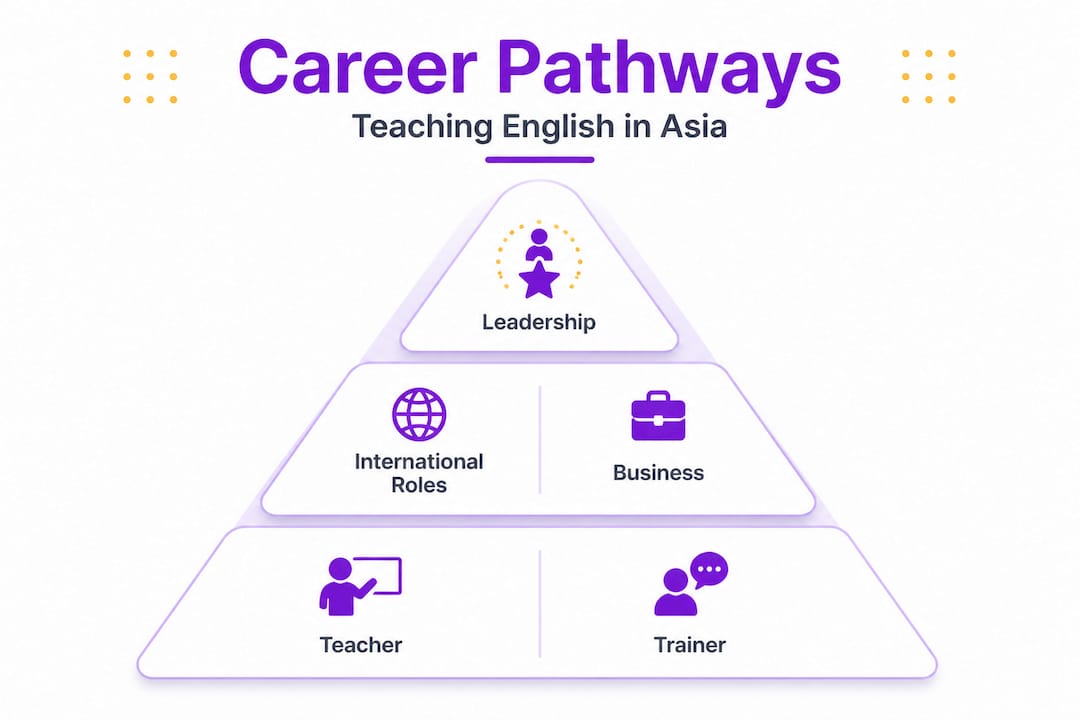
As noted in research on TEFL career pathways, TEFL teaching opens doors to advanced education roles, management, and cross-cultural careers. The skills you develop in an Asian classroom translate powerfully into other professional contexts.
Transferable skills you will build:
- Leadership and classroom management. Managing a room of 30 students from a different cultural background builds genuine authority and organisational capability.
- Cross-cultural communication. Working across language barriers sharpens listening, empathy, and non-verbal communication skills.
- Adaptability and problem-solving. Teaching in unfamiliar environments constantly demands creative, rapid thinking.
- Curriculum design and lesson planning. These skills are directly applicable to corporate training, instructional design, and educational technology roles.
- Patience and resilience. Employers across all sectors recognise these as defining professional qualities.
After your initial contract in Asia, career progression can take several directions. Many teachers move into senior roles at international schools, which typically require additional qualifications but offer significantly higher salaries and greater professional prestige. Others move into academic management, teacher training, or curriculum development. A growing number transition into online English teaching, which allows full geographic flexibility while drawing on the credibility of their classroom experience.
Gaining teaching experience in Asia also strengthens your profile for roles in international business, diplomacy, and NGO work, where cross-cultural competency and language awareness are highly valued.
Pro Tip: When updating your CV after your Asia experience, go beyond listing job titles. Quantify your achievements. How many students did you teach each week? What percentage of your students passed key assessments? Did you develop any new course materials or lead any extracurricular programmes? Specific, measurable outcomes make your teaching experience far more compelling to future employers in any field.
The truth about TEFL in Asia: What most guides miss
Most guides about teaching English in Asia focus on practical logistics: how to get certified, which countries pay the most, and what to pack. These are useful, but they miss something more fundamental. The teachers who genuinely thrive in Asia are not simply those with the most qualifications or the best contracts. They are the ones who arrive with a genuine commitment to the role, a willingness to be changed by the experience, and an openness to the communities they become part of.
Teaching in Asia is not a passive experience. It asks something of you. You will face moments in the classroom where your prepared lesson falls flat, where cultural differences create genuine misunderstanding, and where the gap between expectation and reality feels very wide. These moments are not failures. They are the most instructive parts of the experience.
A common pitfall among first-time teachers is under-preparing for the cultural dimension of the work. It is not enough to know your grammar rules or your lesson structure. You need to understand how students in your host country are conditioned to relate to authority, to learning, and to participation in class. In Japan, for example, students are often hesitant to speak up or make mistakes publicly. In China, large-group learning and rote practice are deeply embedded in classroom culture. Adapting your teaching approach to these norms, rather than imposing a Western model, is what separates effective teachers from frustrated ones.
Successful TEFL teachers in Asia are those who embrace local culture, invest in ongoing development, and prioritise student outcomes over travel. That insight from experienced practitioners should shape how you approach the entire journey. Your TEFL certification benefits are real and valuable, but certification alone does not make you a great teacher. What makes you great is combining strong training with genuine curiosity and respect for your students.
The people who treat Asia as a backdrop to their own adventure tend to leave after one contract feeling vaguely unfulfilled. The people who invest in the work and the community often stay for years, take on greater responsibilities, and look back on the experience as genuinely defining.
Explore TEFL certification and job placement opportunities
Now that you know what is possible, here is how you can get started with the right TEFL course and support. At EBC TEFL, we work with aspiring teachers around the world to help them earn internationally recognised TEFL certification accredited by Trinity College London, one of the most respected awarding bodies in the field.
Whether you are still weighing up your TEFL or TESOL options, or you are ready to apply, our team provides free lifetime job placement support to every graduate. We operate globally, with programmes and placement networks spanning Asia, Europe, and beyond. Our one-year study and work abroad programmes in Spain, France, and Italy offer a unique combination of teacher training, language study, visa support, and cultural immersion for those seeking an even deeper international experience. To find out which course is right for you, book a call with one of our advisors today.
Frequently asked questions
Do I need a degree to teach English in Asia?
Most Asian countries require a bachelor’s degree and a recognised TEFL qualification, though some private schools in Southeast Asia may consider diploma holders with strong accredited certification.
Which countries in Asia pay English teachers the most?
South Korea, Japan, and China typically offer the highest salaries and best benefits packages, and Asia offers some of the highest demand and most diverse opportunities globally for TEFL-certified teachers.
Is TEFL certification necessary for teaching in Asia?
A TEFL or TESOL certificate is increasingly required rather than simply preferred, as it directly affects work permit eligibility and employer confidence. Most Asian countries require a recognised qualification for legal employment.
What kinds of schools hire foreign English teachers in Asia?
Public schools, private language centres, international schools, kindergartens, and universities all hire foreign English teachers, with contracts and conditions varying significantly between each type.
Can I build a long-term career by teaching English in Asia?
Absolutely. TEFL teaching opens doors to advanced education roles, management positions, and cross-cultural careers that extend well beyond the classroom and across multiple industries.
Recommended
- Teach English in Japan | TEFL Certification & Jobs Guide
- 4 Ways to Teach English in Japan Without a Degree in 2026
- Teaching English to children in Asia: All you need to know
- Teaching English in Europe: Pathways and Opportunities – EBC TEFL courses
- Top Reasons Why One Must Learn Chinese in Singapore – Linda Mandarin