
Key Points
- Teaching young learners requires understanding their unique developmental, motivational, and cognitive traits.
- Active, multisensory methods like TPR and songs are highly effective for engaging children in language learning.
- Qualified TEFL certification with a young learner focus opens global teaching opportunities and career growth.
Young learners can acquire native-like pronunciation far more readily than adults, yet many aspiring TEFL teachers assume that what works in an adult classroom will transfer seamlessly to a room full of six-year-olds. It will not. Children aged 5 to 12 process language differently, stay focused for shorter periods, and are motivated by entirely different forces. Understanding these distinctions is not optional; it is the foundation of effective teaching. This article explains what makes young learners unique, which methods genuinely work, the rewards this specialism offers, and how to get qualified to teach them, particularly across Europe.
Table of Contents
- What makes young learners unique in language classrooms
- How interactive and multisensory methods boost young learners’ success
- Unique benefits: Why teaching young learners is rewarding and impactful
- Getting qualified: Specialised TEFL certifications and opportunities in Europe
- What most aspiring TEFL teachers get wrong about young learners
- Ready to start your young learners TEFL journey?
- Frequently asked questions
Key Takeaways
| Point | Details |
|---|---|
| Child-centred methods work best | Interactive activities, play, and routines make language stick for young learners more than traditional adult methods. |
| TEFL certification opens doors | Specialising in teaching young learners gives you a global edge and is valued by top schools, especially in Europe. |
| Early input delivers lasting results | Teaching children English early on boosts their pronunciation, academic success, and cognitive growth long-term. |
| Expert teachers stay flexible | Adapting your teaching style to developmental needs leads to better outcomes and a more fulfilling classroom experience. |
What makes young learners unique in language classrooms
Teaching young learners is a professional specialism, and it begins with understanding who they are developmentally. Children aged 5 to 12 are not simply smaller adults. Their brains are wired differently, their attention spans are shorter, and their relationship with language is far more instinctive than analytical.
Understanding the children vs adults differences in language learning is essential before you step into a classroom. Young learners absorb language through experience rather than explanation. They do not benefit from long grammatical breakdowns. Instead, they thrive on repetition, rhythm, visual cues, and physical movement. A child who hears a song ten times will internalise its vocabulary far more effectively than one who copies a word list from the board.
Research confirms that young learners require structure and sensory stimulation in ways that adults, who rely more on abstract thinking and self-direction, simply do not. This has direct implications for how you plan lessons, manage behaviour, and assess progress.
Here are the key characteristics that shape young learner classrooms:
- Short attention spans: Most children aged 5 to 8 can focus on a single activity for 10 to 15 minutes at most. Lesson plans must include frequent transitions.
- Extrinsic motivation: Young learners respond to praise, stickers, games, and visible rewards. Internal motivation develops gradually with age.
- Strong phonological sensitivity: Children pick up sounds and rhythm naturally, making early language exposure especially powerful for pronunciation.
- Need for routine: Predictable lesson structures reduce anxiety and help children feel safe enough to take linguistic risks.
- Concrete thinking: Abstract concepts must always be grounded in physical objects, pictures, or actions.
“The most common mistake new teachers make is treating young learners like quiet adults. They are not. They are active, curious, and learn best when their whole body is involved.”
For a practical breakdown of how to structure lessons around these traits, the teaching young learners guide on our site offers step-by-step advice grounded in real classroom experience.
How interactive and multisensory methods boost young learners’ success
Building on the developmental context, let us explore which teaching methods actually work best for young learners. The short answer is: active, varied, and sensory-rich approaches win every time.
Interactive and multisensory approaches including games, movement, music, and visual aids are central to effective young learner teaching. This is not about making lessons entertaining for entertainment’s sake. It is about matching the delivery of language to the way children’s brains actually process and retain new information.
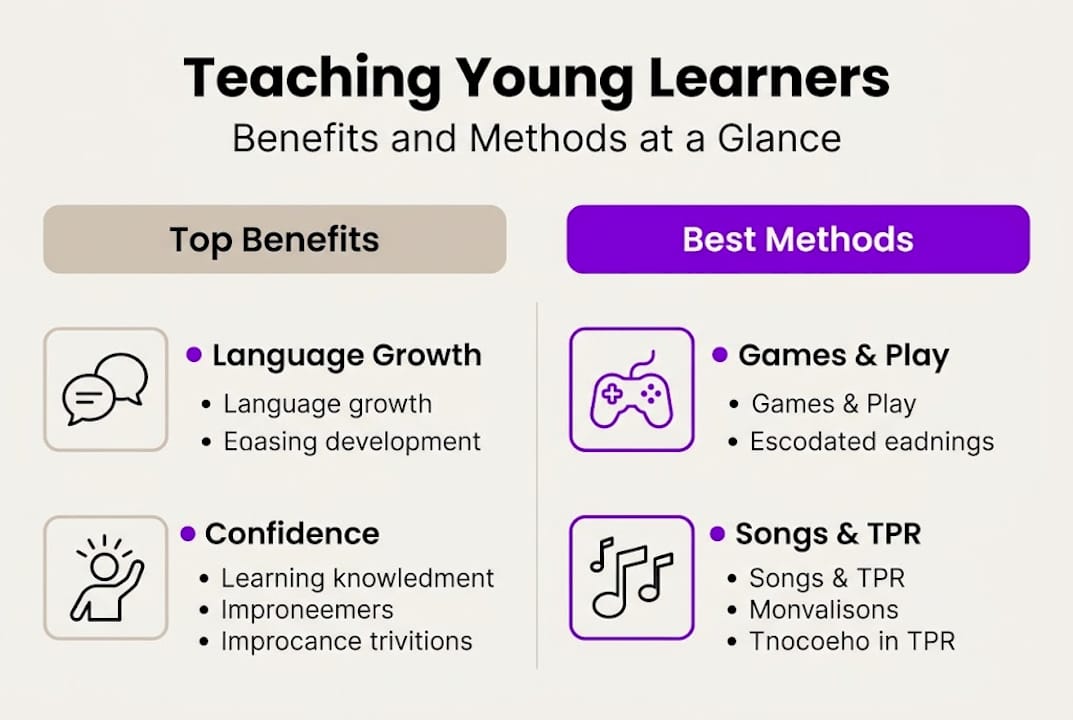
Total Physical Response (TPR) is one of the most well-evidenced methods for this age group. Children respond to commands with physical actions, connecting language directly to movement. “Jump,” “clap,” “point to the window” are not just instructions; they are vocabulary lessons in action. Songs and chants work similarly, using melody and repetition to lock new words into memory.
Here is a comparison of approaches and their suitability for young versus adult learners:
| Method | Young learners | Adult learners |
|---|---|---|
| Grammar-focused lectures | Ineffective | Moderately effective |
| TPR and movement activities | Highly effective | Limited use |
| Songs and chants | Highly effective | Occasionally useful |
| Peer discussion tasks | Developing skill | Highly effective |
| Visual storytelling | Highly effective | Useful |
| Self-directed reading | Not yet appropriate | Highly effective |
For a broader look at top teaching methods across all age groups, it is worth comparing approaches before settling on your preferred style.
A structured approach to young learner lessons typically follows these steps:
- Warm-up routine: A familiar song or greeting ritual settles the class and signals that English time has begun.
- Introduce new language: Use flashcards, puppets, or realia (real objects) to present vocabulary in context.
- Controlled practice: Guided games or activities where children use the new language with support.
- Free practice: Creative tasks such as drawing and labelling, role play, or storytelling.
- Wrap-up and review: A quick game or song to consolidate the lesson’s language before dismissal.
Pro Tip: Keep each activity segment to no longer than 10 to 12 minutes for children under 8. Switching activities frequently maintains energy and focus far better than extending a single task.
Teachers working in Asia, for example, find that these structured, high-energy approaches translate well across cultures. Our resource on teaching children in Asia explores how these methods adapt to different educational contexts globally.
Unique benefits: Why teaching young learners is rewarding and impactful
Having looked at methods, let us consider what makes teaching young learners so rewarding for both sides of the classroom.
The impact you have as a young learner teacher is not just academic. You are shaping a child’s relationship with language, with learning, and with other cultures. That is a significant responsibility, and for many teachers, it is also a profound source of professional satisfaction.
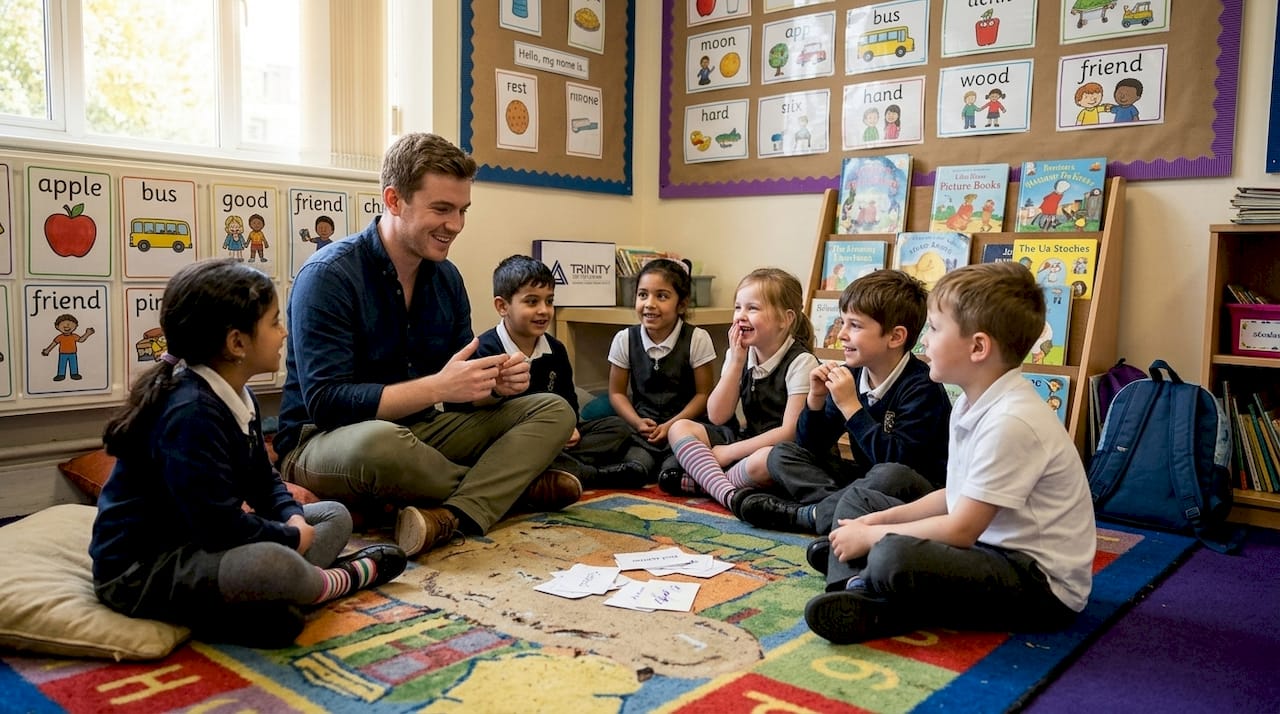
From a language development perspective, the evidence is clear. Children who receive quality early language input achieve native-like pronunciation and demonstrate stronger long-term retention compared to those who begin learning as adults. Starting early matters, and the teacher who facilitates that start plays a central role.
For bilingual children, the picture is equally encouraging. Research shows that immersion benefits bilingual children, with any initial vocabulary gaps in either language resolving naturally by middle childhood and leading to measurable cognitive gains. This is reassuring for teachers working in multilingual classrooms.
Benefits for teachers who specialise in young learners include:
- Career growth: Demand for qualified young learner specialists is rising globally, particularly in Asia, the Middle East, and across Europe.
- Creativity in the classroom: Lesson planning for children encourages genuine creativity and keeps teaching fresh and engaging.
- Personal development: Working with children builds patience, adaptability, and communication skills that transfer to every area of life.
- Global mobility: Schools worldwide actively recruit certified young learner teachers, giving you flexibility to work in multiple countries.
- Lifelong impact: The children you teach may carry their English skills, and their memory of your classroom, for decades.
For those considering the professional pathway, our guide to a young learners TEFL career maps out the routes available globally. If you work with mixed-language groups, our resource on teaching multilingual students offers targeted classroom strategies.
Getting qualified: Specialised TEFL certifications and opportunities in Europe
To turn these insights into action, here is how you can get the right TEFL qualification for teaching young learners.
Most reputable schools around the world, whether in Spain, South Korea, or the UAE, prefer to hire teachers who hold a recognised certification with a young learner component. A general TEFL certificate is a starting point, but a specialised qualification sets you apart and opens doors to better-paid, more stable roles.
The main certification options for aspiring young learner teachers include:
- CELTA with Young Learners extension: Offered by Cambridge, this combines core TEFL training with a focused module on teaching children.
- IH Young Learners and Teenagers (IH VYL/YL): A respected qualification offered through International House centres worldwide.
- Trinity CertTESOL: Accredited by Trinity College London, this is one of the most globally recognised TEFL qualifications available. It provides rigorous practical training and is widely accepted by employers across Europe and beyond.
In Europe, specialised programmes in Barcelona and Dublin offer hands-on training with real young learner classes, giving you genuine classroom experience before you graduate.
Pro Tip: When choosing a programme, ask whether observed teaching practice with children is included. Classroom hours with real young learners are far more valuable than theory-only modules when you are applying for jobs.
Here is what the qualification journey typically looks like:
- Choose your programme: Consider location, duration, cost, and whether a young learner component is included.
- Complete practical training: Most reputable courses include observed teaching practice, written assignments, and feedback sessions.
- Apply for roles with job support: Providers like EBC offer lifetime job placement assistance, meaning you are never navigating the job market alone.
Understanding the certification requirements for different teaching contexts helps you plan your pathway effectively. For a deeper look at why Trinity College London accreditation matters to employers, the Trinity CertTESOL insight page is an excellent starting point. You can also explore TEFL pathways for young learners to see the full range of global opportunities available after qualifying.
What most aspiring TEFL teachers get wrong about young learners
Most guides focus on methods and qualifications. What they rarely address is the mindset shift required to teach young learners well.
Many new teachers assume that teaching children is the easier option. Simpler vocabulary, shorter lessons, less pressure. In reality, it is one of the most demanding specialisms in TEFL. Children are perceptive. They know immediately when a teacher is unprepared or uncomfortable, and they will let you know.
The concept of Developmentally Appropriate Practice (DAP) is key here. It means aligning your methods with children’s cognitive and emotional stages, not simply reducing the difficulty of adult tasks. A grammar worksheet with smaller words is not a young learner activity. A vocabulary game that involves running to the correct flashcard is.
Effective young learner teaching demands creativity, structure, and genuine respect for where children are developmentally. Our practical guide for young learners offers concrete tools to help you build that foundation before you enter the classroom.
Ready to start your young learners TEFL journey?
If you are motivated to inspire young learners and build a global TEFL career, here is where to go next.
The right training makes all the difference. With a recognised qualification, hands-on classroom experience, and lifetime job placement support, you will be prepared to step into rewarding teaching roles across Europe and beyond.
Explore your options with our teach English abroad certification page, or start with our TEFL introduction if you are new to the field. When you are ready to talk through your options with an expert, book a call with EBC for a free, no-obligation consultation. We are here to help you take the next step with confidence.
Frequently asked questions
Why do young learners need different teaching strategies to adults?
Young learners process language through play, movement, and sensory experiences, making interactive methods essential. Multisensory engagement supports pronunciation and retention in ways that adult-focused methods simply cannot replicate.
What qualifications are best for teaching English to young learners?
Certificates such as CELTA with Young Learners, IH VYL, and Trinity CertTESOL provide targeted training and strong job support. Programmes in Barcelona and Dublin offer these specialisations with practical classroom hours included.
Are there long-term benefits for children taught by TEFL specialists?
Yes. Early language input from qualified teachers leads to better pronunciation, stronger retention, and measurable cognitive advantages. Research confirms that early learners outperform adult starters in several key language areas.
Can bilingual children face challenges when learning English young?
Some bilingual children experience temporary vocabulary gaps, but these resolve naturally by middle childhood without harming overall language development. Vocabulary gaps in bilinguals are well documented as a normal and temporary phase, not a cause for concern.
Recommended
- What Is Teaching Young Learners: Impact and Key Skills – EBC TEFL courses
- How to Teach Young Learners: A Practical Step-by-Step Guide – EBC TEFL courses
- Young Learners TEFL: Pathways to Global Teaching Success – EBC TEFL courses
- Microteaching: definition, benefits and insights for TEFL – EBC TEFL courses