
Choosing the right pathway as an English teacher often starts with understanding who young learners really are and separating fact from fiction. With global TEFL programmes placing strong emphasis on age-specific teaching, aspiring educators must cut through common myths about childhood language learning. This guide clarifies both the definition and challenges of teaching young students, offering clear insights for those pursuing international certification and hands-on experience abroad.
Table of Contents
- Defining Young Learners TEFL and Common Myths
- Distinct Learner Age Groups and Needs
- Core Teaching Methods and Strategies
- International Accreditation and Trinity Courses
- Essential Qualifications and Career Pathways
- Study and Work Abroad Programmes in Europe
Key Takeaways
| Point | Details |
|---|---|
| Understanding Young Learners | Young learners are aged 5 to 12, necessitating tailored approaches due to their diverse cognitive and emotional characteristics. |
| Challenging Myths | Common misconceptions about language acquisition impede effective teaching, highlighting the need for research-based strategies. |
| Diverse Teaching Methods | Successful TEFL programmes for young learners require diverse methodologies that align with developmental stages and learning preferences. |
| Professional Growth through Accreditation | Internationally recognised qualifications like Trinity CertTESOL enhance employability and credibility in global teaching contexts. |
Defining Young Learners TEFL and Common Myths
Defining young learners in the context of Teaching English as a Foreign Language (TEFL) goes far beyond simple age categorisation. Educators and language professionals recognise that young learners represent a dynamic and diverse group with unique cognitive, emotional, and linguistic developmental characteristics.
In academic research, the term “young learners” typically encompasses children aged between 5 and 12 years, though this definition can vary across different educational contexts. Understanding language acquisition complexities requires nuanced interpretation of developmental stages and learning capabilities.
Common myths about teaching English to young learners persist, creating misconceptions that can hinder effective language instruction. These widespread beliefs often emerge from oversimplified understanding of language learning processes:
- Myth 1: Young children automatically absorb languages effortlessly
- Myth 2: Only native speakers can effectively teach English to children
- Myth 3: Immersion guarantees complete language acquisition
- Myth 4: Children learn languages identically across different cultural contexts
Research challenges these misconceptions by highlighting the intricate nature of second language acquisition. Early childhood language development involves complex neurological, psychological, and social factors that extend beyond simplistic assumptions.
Successful young learner TEFL programmes recognise that effective language teaching requires specialised pedagogical approaches, including:
- Age-appropriate teaching methodologies
- Interactive and engaging learning environments
- Culturally sensitive instructional strategies
- Developmentally aligned curriculum design
- Holistic approach to language skill development
Professional TEFL educators understand that teaching young learners demands more than linguistic knowledge—it requires psychological insight, creativity, and adaptable instructional techniques.
Pro tip: When approaching young learner TEFL, focus on creating fun, interactive learning experiences that make language acquisition feel like a natural, enjoyable journey rather than a structured academic exercise.
Distinct Learner Age Groups and Needs
Understanding the nuanced developmental stages of young language learners is crucial for designing effective English language teaching strategies. Language acquisition research reveals that children’s linguistic learning capabilities differ dramatically across various age ranges.
Typically, young learners can be categorised into three primary developmental groups, each with distinct cognitive, emotional, and linguistic characteristics:
- Early Childhood Learners (Ages 3-6)
- Limited attention spans
- Highly imaginative
- Learn through play and sensory experiences
- Rely heavily on visual and kinesthetic learning
- Primary School Learners (Ages 6-9)
- Developing logical thinking skills
- Increased capacity for structured learning
- Growing metalinguistic awareness
- Enthusiastic about discovery and exploration
- Pre-Adolescent Learners (Ages 9-12)
- More sophisticated cognitive processing
- Emerging abstract thinking capabilities
- Greater self-awareness in learning
- Capacity for more complex language structures
Developmental language learning strategies emphasise that each age group requires tailored instructional approaches that align with their neurological and psychological development stages.
Successful TEFL programmes recognise that language acquisition is not a uniform process but a dynamic journey influenced by individual developmental trajectories. This understanding demands educators develop flexible, adaptive teaching methodologies that respect each learner’s unique cognitive landscape.
Effective language teaching transcends one-size-fits-all approaches, requiring nuanced, age-specific instructional strategies.
Cognitive development directly impacts language learning potential, with each age group presenting unique challenges and opportunities for English language acquisition. Young learners progress through intricate developmental phases that demand sophisticated, responsive pedagogical interventions.

Pro tip: Design your teaching strategies with age-specific cognitive development in mind, allowing flexibility and personalisation to maximise each learner’s linguistic potential.
Core Teaching Methods and Strategies
Teaching English to young learners demands sophisticated, adaptable approaches that transcend traditional instructional paradigms. Effective language teaching principles emphasise the critical importance of understanding learner diversity and developing responsive pedagogical strategies.
Successful young learner TEFL methodologies incorporate several core strategic approaches:
- Communicative Language Teaching (CLT)
- Prioritises real-world communication skills
- Encourages interactive classroom environments
- Focuses on meaningful language usage
- Reduces emphasis on grammatical perfection
- Total Physical Response (TPR)
- Integrates physical movement with language learning
- Particularly effective for younger learners
- Reduces learner anxiety
- Enhances kinesthetic memory retention
- Task-Based Learning (TBL)
- Structures lessons around completed tasks
- Promotes problem-solving skills
- Increases student engagement
- Develops practical language application
Language acquisition is most effective when learning feels natural, contextual, and enjoyable for young learners.
Professional TEFL educators understand that no single methodology suits all learners. Successful teaching requires dynamic, flexible approaches that adapt to individual learning styles, developmental stages, and classroom dynamics.
Here is a comparative overview of major TEFL teaching methods for young learners:
| Method | Key Strength | Best Age Group | Sample Classroom Activity |
|---|---|---|---|
| Communicative (CLT) | Develops real-life communication | Ages 6–12 | Role-playing short dialogues |
| Total Physical Response (TPR) | Builds language through movement | Ages 3–7 | Acting out action verbs |
| Task-Based Learning (TBL) | Encourages problem-solving | Ages 8–12 | Completing group projects |
Crucial to effective young learner instruction is creating a supportive, low-anxiety environment where students feel empowered to experiment with language without fear of judgement. This approach transforms language learning from a potentially intimidating process into an exciting journey of discovery.
Pro tip: Design lessons that seamlessly blend multiple teaching strategies, allowing for constant engagement and maintaining young learners’ natural curiosity and enthusiasm.
International Accreditation and Trinity Courses
In the competitive landscape of global English language teaching, international accreditation represents a critical differentiator for aspiring educators. Teaching qualification standards underscore the importance of recognised, rigorous certification that validates a teacher’s professional capabilities.
Trinity College London’s CertTESOL stands at the forefront of internationally recognised teacher training qualifications, offering comprehensive preparation for global teaching careers:
- Global Recognition
- Accredited by UK government agencies
- Recognised in over 100 countries worldwide
- Meets stringent international educational standards
- Provides credibility across diverse educational contexts
- Course Components
- Comprehensive theoretical training
- Practical classroom teaching practice
- Learner profile and language awareness modules
- Assessment and lesson planning skills
- Professional Development
- Develops advanced pedagogical techniques
- Enhances classroom management skills
- Provides insights into multicultural teaching environments
- Prepares educators for diverse learning contexts
International accreditation transforms a basic qualification into a globally respected professional credential.
The Trinity CertTESOL goes beyond traditional teaching certificates by emphasising practical skills, cultural competence, and adaptive teaching methodologies. It equips educators with the nuanced understanding required to navigate complex, multicultural classroom environments.
Successful international teaching demands more than linguistic knowledge—it requires a sophisticated understanding of pedagogical approaches, learner psychology, and cross-cultural communication. Trinity’s accreditation provides precisely this comprehensive professional development framework.
The following table summarises the benefits of internationally accredited TEFL qualifications:
</trCareer Relevance>
| Benefit | Accreditation Impact | |
|---|---|---|
| Global job opportunities | Recognised standards increase mobility | Easier recruitment abroad |
| Enhanced teaching credibility | Validates pedagogical skills | Trusted by premier schools |
| Professional growth | Supports further study | Enables higher positions |
Pro tip: Invest in internationally recognised qualifications that demonstrate your commitment to professional excellence and global teaching standards.
Essential Qualifications and Career Pathways
Navigating the competitive landscape of English language teaching requires strategic professional development and targeted qualification pathways. Teaching qualification frameworks provide comprehensive roadmaps for aspiring educators seeking global career opportunities.
Essential qualifications for young learner TEFL professionals typically include:
- Entry-Level Certifications
- Trinity CertTESOL
- Cambridge CELTA
- Online TEFL/TESOL certificates
- Minimum 120-hour accredited training
- Advanced Specialisations
- Young Learners Extension Certificate
- Business English Teaching Diploma
- Teaching English Online Certification
- Academic Teaching Credentials
- Professional Development Routes
- Postgraduate TEFL Diplomas
- Masters in Educational Linguistics
- International School Teaching Qualifications
- Continuous Professional Development (CPD) programmes
Professional qualifications transform language skills into sustainable global teaching careers.
Successful TEFL career progression demands more than initial certification. Educators must continually adapt, develop specialised skills, and remain responsive to evolving global educational landscapes.
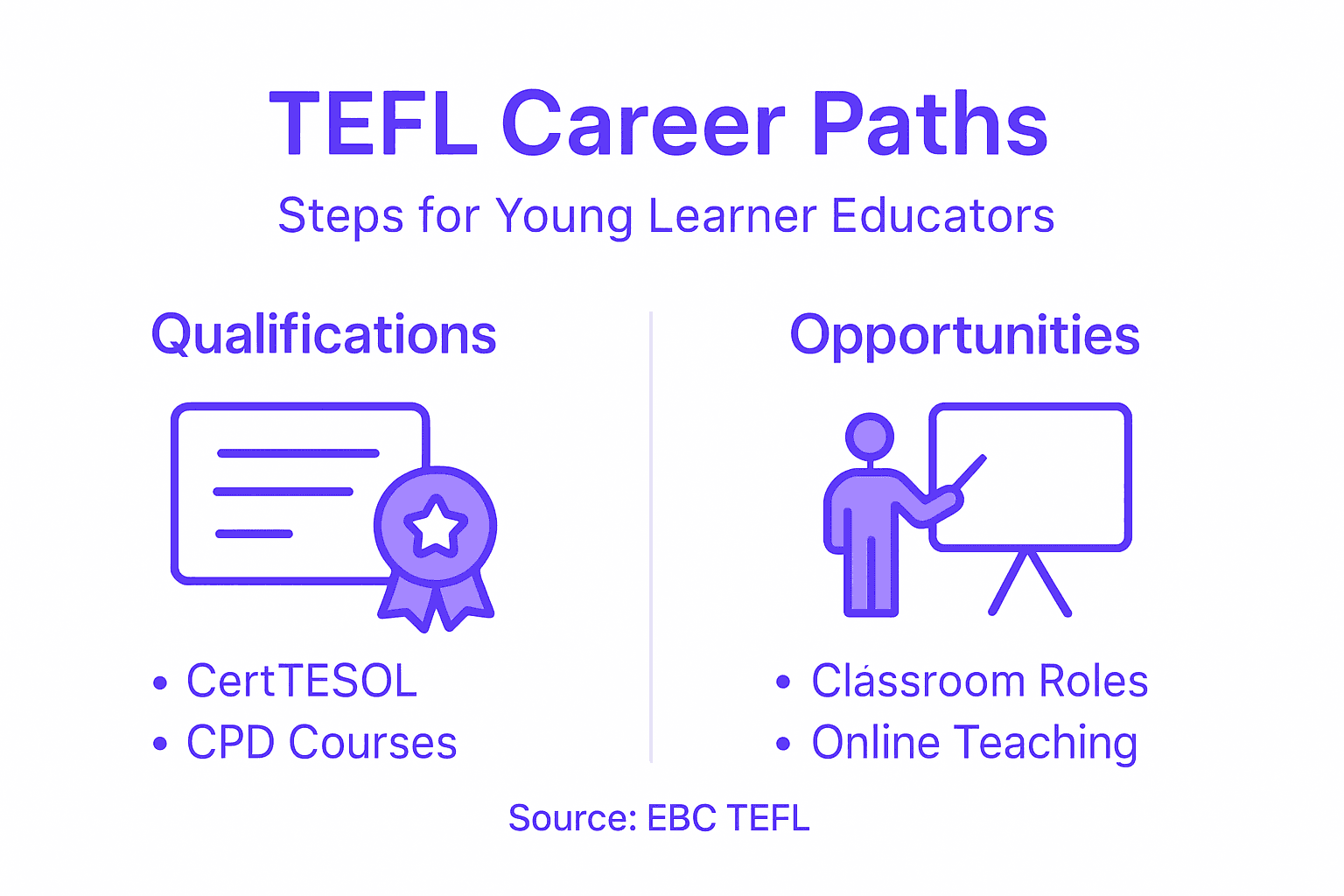
Modern TEFL career pathways are increasingly diverse, offering opportunities beyond traditional classroom settings. Online teaching platforms, corporate language training, educational technology roles, and curriculum development represent expanding professional horizons for qualified language educators.
Pro tip: Invest in versatile qualifications that offer multiple career entry points and demonstrate your commitment to continuous professional learning.
Study and Work Abroad Programmes in Europe
European study and work abroad programmes offer transformative opportunities for aspiring young learner TEFL educators seeking international professional development. Teaching opportunities in Europe provide comprehensive pathways for personal and professional growth beyond traditional career trajectories.
Key features of European study and work programmes typically encompass:
- Programme Structures
- Integrated language study
- Professional teaching certification
- Part-time work opportunities
- Cultural immersion experiences
- Visa and residency support
- Destination Highlights
- Spain: Vibrant language assistant roles
- France: Government-sponsored teaching positions
- Italy: University and private language school placements
- Portugal: Growing international education market
- Professional Benefits
- International teaching credentials
- Language skill development
- Cross-cultural communication expertise
- Networking with global educators
- Enhanced employability
European programmes transform language teaching from a job into a globally recognised professional journey.
Successful participants in these programmes develop more than just teaching skills. They gain profound intercultural competence, personal resilience, and a nuanced understanding of global educational landscapes that distinguishes them in competitive job markets.
Modern study and work abroad programmes are meticulously designed to provide holistic professional development. They blend rigorous academic training, practical teaching experience, and cultural immersion to create well-rounded, adaptable international educators.
Pro tip: Research programme details comprehensively, understanding visa requirements, financial considerations, and specific regional teaching contexts before committing to your international teaching adventure.
Unlock Your Global Teaching Potential with EBC TEFL
Teaching young learners presents unique challenges that require specialised training, international accreditation, and practical experience. If you want to overcome common misconceptions and master age-specific teaching methods, EBC TEFL offers Trinity College London accredited courses designed to build your confidence and expertise. Our programmes combine rigorous, hands-on teacher training with global job placement support, ensuring you receive a credible qualification recognised worldwide.
Our comprehensive 1-year study and work abroad programmes in Spain, France, and Italy are perfectly aligned with the developmental needs of young learners discussed in the article. These programmes include accredited teacher training, language study, cultural immersion, visa support, and paid teaching or part-time work opportunities—all crafted to develop you as a versatile, internationally competitive TEFL professional.
Take your first step towards a rewarding career by exploring Trinity College London CertTESOL courses and discover how our specialised pathways can match your aspirations. Join a supportive community committed to your lifetime job placement success and global mobility.
Ready to transform your passion for teaching into a globally respected career? Secure your place with EBC TEFL today and access personalised guidance through every stage of your journey at https://ebcteflcourse.com/#book-a-call.
Frequently Asked Questions
What defines young learners in TEFL?
Young learners in TEFL typically include children aged between 5 and 12 years, although this definition can vary depending on educational contexts and specific research.
What are some common misconceptions about teaching English to young learners?
Common misconceptions include the beliefs that young children automatically absorb languages effortlessly, only native speakers can effectively teach children, immersion guarantees complete language acquisition, and that children learn languages in identical ways across different cultural contexts.
What are the core teaching methods effective for young learners?
Core teaching methods for young learners include Communicative Language Teaching (CLT), Total Physical Response (TPR), and Task-Based Learning (TBL). Each method has its own strengths and is suited to different developmental stages and learning styles.
How can I enhance my qualifications for teaching young learners?
To enhance your qualifications, consider obtaining entry-level certifications like Trinity CertTESOL or Cambridge CELTA, pursuing advanced specialisations such as Young Learners Extension Certificates, and engaging in continuous professional development to stay updated on teaching methodologies.