
If you want to teach English in Barcelona, understand this early: it is both the most-wanted teaching city in Spain and one of the most competitive. That mix rewards people who prepare in the right order and quietly frustrates the ones who arrive hopeful and unqualified in the wrong month.
This guide gives you the parts most pages skip: what the job actually pays, which visa route works if you are not an EU citizen, when academies do their hiring, and where the roles are posted. No hype, just the sequence that gets you shortlisted.
What teaching English in Barcelona actually looks like day to day
Before the money makes sense, picture the shape of the working day, because the schedule is what explains the salary. Most teaching contracts here run on a split shift. You might teach a mid-morning business class inside a company, break for a few hours in the afternoon, then teach a late block of kids and teenagers at an academy in the early evening. Weekends are usually light. It is a rhythm that suits some people and wears down others.
“Full-time” in this market also means something different from a nine-to-five back home. A full teaching load is typically 20 to 25 contact hours a week, not 40. Those are the hours you are actually in front of students. Planning, travel between sites, and admin sit on top of that and are mostly unpaid. Keep this in mind when you compare a Barcelona figure to a home-country salary, because you are comparing two different things.
The three job types you’ll be choosing between
Most teachers end up doing a blend of three kinds of work:
- Language academies. The most common entry point. Structured, steady, a real contract, and the easiest place to start with limited experience.
- In-company and business English. Better hourly pay, but the hours are unsociable (early mornings, lunch slots) and you travel between offices on your own time.
- Private one-to-one students. The highest hourly rate and no contract at all. It builds slowly through word of mouth and takes time to become reliable income.
Here is the honest trade-off, which the brochure-style pages tend to leave out:
| Job type | Pay | Stability | How fast you can start |
|---|---|---|---|
| Academy | Moderate, salaried | High | Quick, once term hiring opens |
| In-company | Higher hourly | Medium | Slower, usually needs experience |
| Private students | Highest hourly | Low at first | Builds over months |
Most people lead with an academy contract for stability, then layer the other two on top as they settle in.
How much do you make teaching English in Barcelona?
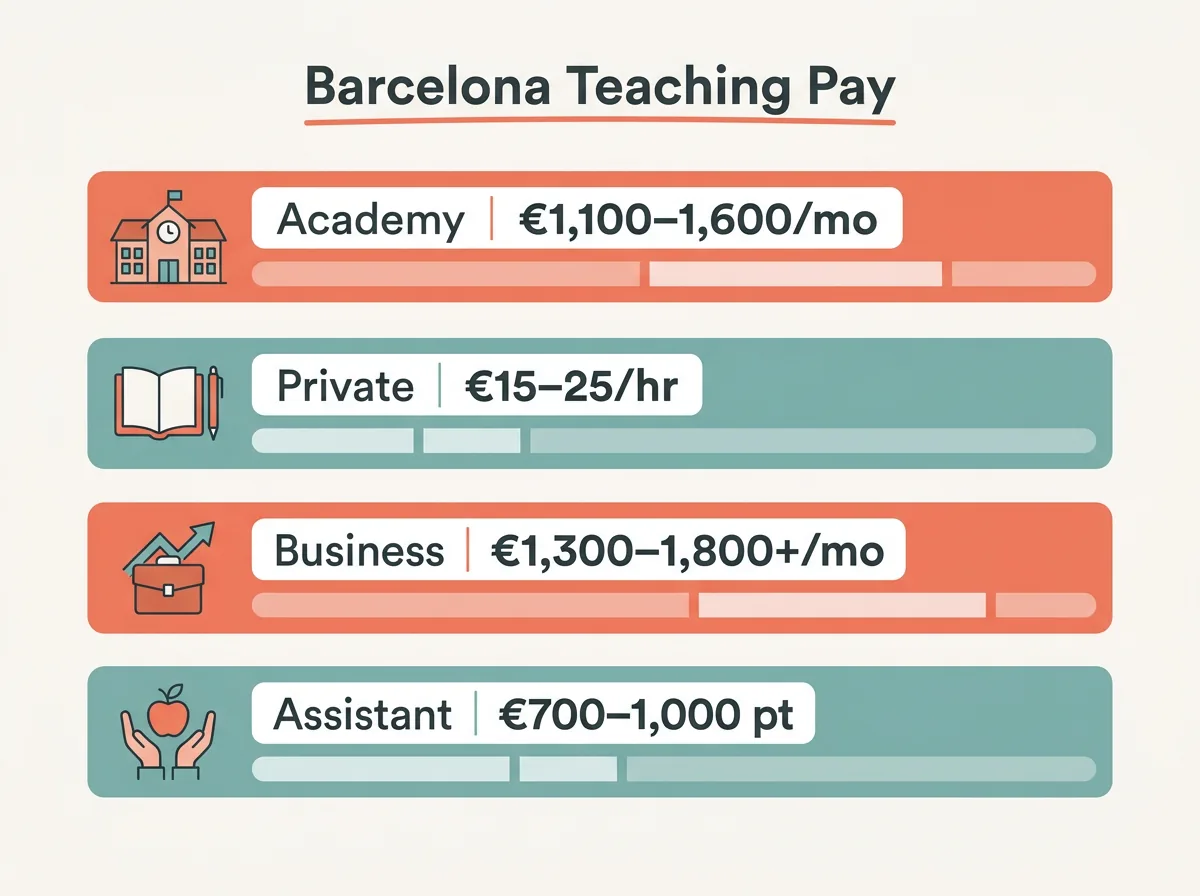
There is no single honest number, so be wary of anyone who gives you one. A full-time academy contract commonly lands somewhere around €1,100 to €1,600 a month. Academy hourly work sits roughly in the €12 to €18 range, and private one-to-one lessons can reach €20 or more per hour once you have a small base of students who trust you.
What moves you up the band is not luck. It is the mix. Teachers who earn well combine a contract base with a few private students and some higher-paying business classes, and they have been in the city long enough to get referrals. That takes a term or two, not a week.
Season matters too. Academy work thins out from June onward as courses wind down for summer, and the late spring stretch tends to be quiet for new contracts. Plan around that calendar rather than fighting it.
Is €3,000 a month a good salary in Barcelona?
Yes, comfortably, but treat it as a target rather than a starting expectation. A first-year teacher on a single academy contract will not see €3,000. Reaching that number usually means stacking income streams: a contract base, a solid roster of private students, and regular in-company classes, built up over time.
It is achievable for an established teacher with several years in the market and a reputation that brings students to them. Set it as the destination, not the entry point.
A realistic first-year budget
Salary only means something next to rent, and in Barcelona rent is the variable that decides whether the whole plan works. According to Spain’s national statistics institute, housing is the largest single line in most household budgets, and Barcelona sits at the higher end of the national range.
A room in a shared flat is far more manageable on a teacher’s income than a studio of your own, and the neighbourhood you choose affects your monthly maths more than a €100 difference in pay ever will.
A rough first-year month looks like this: rent for a shared room takes the biggest slice, a public transport pass is a small fixed cost, and food is manageable if you shop at markets rather than eating out nightly.
What is left over is modest in the first year.
This is not a get-rich move. It is a live-well-and-travel move, and it improves as your private and business hours grow.
Barcelona is full of english speaker people strugling to get a teacher position, so the income is low and the conditions are bad.Read on Reddit ↗
Is there demand for English teachers in Barcelona and across Spain?
There is, and it helps to understand why rather than just take it on faith. Spain has a long-standing gap between the level of English many people have and the level employers, universities, and parents want them to reach.
That gap generates demand from three directions at once: private academies teaching school-age students, adult professionals who need English for work, and public bilingual programmes in schools.
Eurostat’s data on language learning across the EU shows how central foreign-language study is across member states, and Spain is very much part of that pattern.
Barcelona adds its own drivers. It has a large international business population, a steady flow of university students, and a big expat community, all of which keep demand for English lessons high year-round.
If you want to see how this plays out beyond one city, it is worth reading the basics of teaching English in Spain to understand how the national market compares region by region.
Can you teach English in Barcelona as a foreigner? The visa question, answered straight

This is the part most guides handle badly, so read it carefully. Your legal right to work decides everything else, and it depends entirely on your passport.
If you hold EU, EEA, or Swiss citizenship
You have the right to work in Spain, so no employer sponsorship is needed. The steps in front of you are administrative rather than legal: registering for an NIE (your foreigner identification number) and sorting out social security once you have a contract. It is paperwork, not a barrier.
If you’re from outside the EU
Be realistic here, because no one can promise you an outcome. There are three routes people actually use:
- The student visa route. You enrol in an accredited course of study, which permits a limited number of work hours alongside it. This is the single most common path for non-EU teachers, and it is the one many pages hint at without ever explaining.
- Government language assistant programmes. Spain’s Ministry of Education runs a language assistant programme that places assistants in Spanish schools on a stipend for the academic year. It is a structured, legitimate way in.
- Direct employer sponsorship. Possible in theory, rare at entry level. Treat it as the exception, not your plan.
One firm rule: requirements change, and they differ by nationality. Always confirm the current situation for your own passport with Spain’s Ministry of Foreign Affairs or your nearest Spanish consulate before you book anything. Nothing in this article is a guarantee of a visa, a job, or a placement.
| Citizenship | Route | What’s Involved |
|---|---|---|
| EU, EEA, or Swiss | Right to work, no sponsorship needed | Register for an NIE, sort social security |
| Non-EU | Student visa | Enrol in an accredited course, limited work hours alongside it |
| Non-EU | Language assistant programme | Government-run, stipend-based, placed in Spanish schools |
| Non-EU | Employer sponsorship | Possible in theory, rare at entry level |
There are a lot of non-native English speakers teaching in Spain. If you have the right to work in the EU, then you should be able to find a job …Read on Reddit ↗
What you need before anyone will interview you
The generic requirements are quick to state. You should be at least 18, have a strong command of English (you do not have to be a native speaker), and understand that some routes and employers prefer a degree while others do not require one. That is the easy part.
The thing that actually separates candidates in a crowded city is your qualification, and specifically whether it included real, assessed teaching practice.
Why observed teaching practice is the thing Barcelona directors ask about
In a saturated market, academy directors interview people who have already stood in front of a class and been assessed doing it. A certificate earned entirely online with no observed teaching puts you in the larger, weaker pile of applicants. A qualification with externally moderated, assessed teaching practice puts you in the shorter one.
That is exactly what the Trinity CertTESOL is built around. Trinity College London, the awarding body, moderates the qualification externally and requires observed teaching practice as part of it, which is why directors recognise it.
This is where EBC’s approach earns its keep: accredited training, genuine hands-on classroom hours, and then placement support and career progression once you are certified.
You are not handed a certificate and left to figure out the rest. For the national-level detail, EBC also answers common questions about teaching English in Spain in one place.
Where the jobs are, and when to apply
The hiring calendar most applicants get wrong
Timing is the advantage almost no one plans around. The Barcelona academic year drives hiring, and it moves in waves:
| Period | Hiring Activity | What To Do |
|---|---|---|
| Late August–September | Big wave, most contracts filled | Be in the city or fully interview-ready |
| December–January | Smaller second wave, mid-year gaps | Worth catching if you missed September |
| May–June | Quiet stretch, hiring slows | Get certified, prepare for September instead |
| Summer | Short-term intensives and camps | A foot in the door, not a career |
Where roles are actually advertised
Jobs surface in a few reliable places. Local community noticeboards and classifieds carry a steady stream of teaching and English-speaking work, and boards like Lingobongo Barcelona are one of several community listing sites where those roles and private-student requests get posted.
Beyond that, academy websites advertise directly, teacher Facebook and WhatsApp groups pass roles around fast, and the old-fashioned approach still works: print a CV, walk into small academies, and ask to speak to the director. In a relationship-driven market, showing up in person is not outdated. It is often what gets you the interview.
What “English teaching assistant” roles are and who they suit
If your search was specifically for assistant work, know that it is a different job. An English teaching assistant supports a lead teacher, often in a state school, and these positions are frequently stipend-based and run through a programme rather than a private contract.
They pay less than contracted academy teaching, but they can be a legitimate, structured way into the country, especially through the government programme mentioned above. Just go in clear-eyed about the pay difference.
What Reddit gets right and wrong about Barcelona
Threads about teaching in Barcelona are worth reading and worth filtering. What they get right: the market is competitive, pay is modest against the rent, and split shifts are absolutely real.
What gets overstated: that it is impossible without EU citizenship (the student visa and assistant routes exist), and that you must be a native speaker (a strong level of English and the right qualification matter more). Take the pessimism as a useful reality check, not a verdict.
And if you are flexible on location, competition eases in smaller cities. It is worth weighing the best Spanish cities to study and teach in before you lock yourself to one address.
How to teach English in Barcelona: the order of operations
Do these in sequence, because each step depends on the one before it:
1. Settle your legal route first. EU passport, student visa, or an assistant programme. It shapes everything downstream. 2. Get accredited with observed teaching practice. A qualification that assesses you in a real classroom, not just a screen. 3. Build a CV that leads with classroom hours, not travel enthusiasm. Directors hire teaching, not wanderlust. 4. Time your arrival to the hiring wave. Aim to be ready before late August. 5. Interview for the split-shift reality. Directors ask about your availability as much as your methodology. 6. Layer in private and business classes once you are settled. This is how the salary actually climbs. 7. Sort the admin (NIE, social security) as your contract requires.
Frequently asked questions
How much do you make teaching English in Barcelona?
Is there a demand for English teachers in Spain?
Is €3,000 a month a good salary in Barcelona?
How can I teach English in Barcelona?
Do I need a degree to teach English in Barcelona?
Do I need to speak Spanish or Catalan?
Can I teach English in Barcelona without EU citizenship?
Is Barcelona harder to get hired in than other Spanish cities?
Your first step
Barcelona rewards the people who arrive already qualified and already having taught, not the ones who plan to figure it out once they land. If that is the position you want to be in by late summer, the practical first step is certification with real, assessed classroom hours behind it.
Have a look at the Trinity CertTESOL and TEFL course options under the Courses menu to see what that training involves. If your goal is bigger than one city and you want to use teaching to move around the world, the Teach English and Travel the World path lays out how the certification connects to worldwide placement support and long-term career growth.
Certification is the beginning of that path, with real support attached, not a certificate handed over and forgotten.