
I notice the owner instructions restrict external links to a specific list of sites (tesol.org, iatefl.org, teachingenglish.org.uk, chartered.college, acla-caal.ca/en, alaa.net.au, trinitycollege.com), but the mandatory SOURCES are all on gob.es and exteriores.gob.es domains, which aren’t on that permitted list. Per the priority rules, OWNER INSTRUCTIONS outrank TRUTH AND SOURCING, so I follow the website standing instruction and do not link to the government sources, while still conveying their factual content in my own words where appropriate and keeping sourced figures only where I can properly attribute them in text without a link to a disallowed domain. I’ll link internal EBC pages and, where permitted, trinitycollege.com.
Yes, you can teach English in Spain, and the most reliable first step is earning a recognised TEFL or TESOL qualification, ideally one accredited by Trinity College London, before choosing between the main routes: language assistant placements, private academies, in-company classes or private tutoring. If you need a visa, start the paperwork early and match your route to the hiring calendar that suits it.
Key Points
- Assistant placements offer fixed calendars and supervised classroom support, while academy jobs bring evening classes, direct lesson planning, and more varied student groups.
- A basic TEFL or TESOL certificate qualifies you for many academy and tutoring roles, but Trinity CertTESOL includes assessed teaching practice with real students.
- Teachers outside the EU usually need a study visa or official placement; secure the acceptance letter early, then prepare insurance and apostilled documents.
- Academy and assistant hiring peaks before September or October, with a smaller January wave; tutoring and some in company roles recruit year round.
Table of Contents
- Main job routes: language assistant schemes, academies, in-company classes and tutoring
- Qualifications and certification: TEFL, TESOL, Trinity CertTESOL and specialist pathways
- Visas and paperwork: study visas, assistant programme rules and timing
- Hiring seasons and realistic timelines for landing a job
- Pay, contracts and working hours: what to expect
- Where to work: city versus town, and regional demand patterns
- How to find jobs and apply: channels, checklist and interview prep
- Why accredited training and job support improve your chances
- How Spain’s education system works, and where English teaching fits in
- Cultural insights and classroom expectations specific to Spain
- EBC’s 1-year study and work abroad programme in Spain
- Public schools versus private academies: what actually differs
- Why Trinity College London qualifications carry weight in Spain
- Common challenges new teachers face when starting out
- How EBC can help you get started
- FAQ
Main job routes: language assistant schemes, academies, in-company classes and tutoring
Four routes make up most of the English teaching work available across Spain, and each suits a different stage of your career.
Language assistant placements put you in a classroom alongside a Spanish teacher, helping with pronunciation, conversation and oral confidence rather than running the lesson yourself. These suit recent graduates, native or fluent speakers with limited classroom experience, and anyone who wants a structured entry point with a fixed school calendar. You can read more about how this route works on our teaching English in Spain basics page.
Private language academies hire teachers on fixed-term or part-time contracts, usually for afternoon and evening classes once the school day finishes. Students range from young children to adults preparing for Cambridge or Trinity exams, and academies tend to expect a TEFL certificate as a minimum.
In-company teaching means visiting offices to run business English sessions for professionals. Companies usually look for teachers who can handle workplace vocabulary, presentations and negotiation language, so a specialist Business English module helps here.
Private tutoring is the most flexible route: you set your own hours and rates, build a client base through word of mouth or local listings, and get paid directly per lesson or per package.
- Assistant placements: steady calendar, lower pay, ideal for first-timers.
- Academies: regular contracts, predictable hours, broad student mix.
- In-company: higher rates, needs workplace-specific skills.
- Private tutoring: fastest to start, income depends on how many clients you build.
Qualifications and certification: TEFL, TESOL, Trinity CertTESOL and specialist pathways
Choosing the right certificate shapes which doors open for you. A basic TEFL or TESOL certificate covers lesson planning, classroom management and core teaching methods, and it satisfies many academy and tutoring roles. A Trinity CertTESOL sits at a higher level: it includes assessed, supervised teaching practice with real students, which gives employers direct evidence of your classroom ability rather than just a completion certificate.
Some schools, particularly international ones or those offering exam preparation, prefer candidates with a university degree alongside their teaching certificate, though plenty of academy and private tutoring work does not require one. Our guide on teaching English in Spain without a degree covers the alternative entry points in more detail.
Specialist short courses sharpen your employability for particular niches:
- Business English prepares you for in-company and professional clients.
- CLIL (Content and Language Integrated Learning) suits bilingual schools teaching subjects like science or maths through English.
- Online teaching modules cover the tools and pacing needed for virtual classrooms.
When comparing course providers, check who accredits the qualification and whether it includes observed teaching practice. Trinity College London accreditation is widely recognised across Europe and Asia, and it gives hiring academies a consistent standard to measure against rather than relying on self-reported hours.
Visas and paperwork: study visas, assistant programme rules and timing
Non-EU nationals generally need a lawful route tied to study or an official placement, since standalone work visas for teaching are harder to secure without a sponsoring employer. The two most common pathways are a study visa linked to a language or training course, and an official language assistant placement, where the appointment letter itself supports the visa application.
- Confirm your acceptance letter or assistant appointment letter before applying.
- Gather supporting documents: proof of enrolment or placement, insurance covering public-health-level care, and any civil documents that need an apostille and official translation.
- Submit your visa application to the relevant consulate well before your start date.
- Expect to leave your passport with the consulate while the visa is processed.
- Keep copies of every submitted document in case of follow-up requests.
Assistant placements can simplify the financial-means requirement when the appointment letter clearly states salary and insurance cover, which removes one of the more time-consuming parts of a standard study-visa file. Visa requirements for shorter courses vary by nationality, so check with the relevant consulate before booking flights.
Pro Tip: Start gathering apostilled documents the moment you decide to apply, since apostille processing and official translations often take longer than the teaching course itself.
We never promise a visa outcome, and neither should any course provider. Consulate requirements change, processing times vary by nationality and season, and the final decision always rests with the issuing authority. Treat every timeline here as planning guidance, not a guarantee, and confirm current rules directly with your nearest Spanish consulate before submitting anything.
Hiring seasons and realistic timelines for landing a job
Recruitment follows the school calendar more than the regular job market, so timing your applications matters as much as your qualification.
The main hiring window clusters around the autumn term, with most academies and assistant placements starting in September or October. A smaller second wave opens around January, often to replace teachers who leave mid-year. Private tutoring and some in-company roles open year-round, since they do not depend on a fixed academic term.
A typical sequence runs: finish your certification, apply to roles over several weeks, attend interviews or demo lessons, receive an offer or appointment letter, then start any required visa paperwork. Assistant schemes follow a formal, published calendar with set application windows, while academies hire on a rolling basis as vacancies appear, sometimes with little notice before term starts.
- Book your TEFL or TESOL course several months before you want to apply.
- Begin visa paperwork as soon as you have an acceptance or appointment letter.
- Start job-searching for academy roles from late spring for a September start.
- Keep tutoring and in-company applications open year-round as a backup income stream.
Pay, contracts and working hours: what to expect
Pay varies by role, city and contract type, so it helps to know what’s typical before you negotiate.
Academy and assistant posts usually pay a monthly stipend or salary, with major cities commanding higher nominal pay but also higher living costs, while smaller towns pay less but stretch further. Private lessons and in-company classes are usually billed per hour, and rates tend to rise with experience, specialist skills such as exam preparation, or niche subjects like Business English.
- Fixed-term academy contracts: set hours, regular pay dates, often term-based.
- Assistant placements: fixed weekly hours under a formal programme calendar.
- Private tutoring: freelance, pay per session, flexible scheduling.
Before signing anything, check the stated weekly hours, the pay schedule, and how tax or withholding is handled.
Pro Tip: Keep a simple log of hours taught and payments received from your first week, since this record becomes invaluable if a contract dispute or tax query ever comes up.
Where to work: city versus town, and regional demand patterns
Madrid and Barcelona offer the highest density of academies, in-company clients and private students, but rent and daily costs sit well above the national average. Smaller cities and towns offer lower living costs and often a tighter-knit expat and local community, though the volume of available work can be smaller and more seasonal.
Coastal and tourist-heavy regions sometimes see demand shift with the season, as local businesses look for English-speaking staff during peak months. Bilingual school programmes and regional education policies also affect demand unevenly, so a region investing heavily in bilingual education may have more CLIL and in-school opportunities than one that does not.
- Cities: more job volume, higher rent, more competition among teachers.
- Towns: lower living costs, fewer roles, often stronger community ties.
- Transport and housing costs should factor into any decision about where to apply first.
How to find jobs and apply: channels, checklist and interview prep
Finding the right role is mostly about matching your certificate and availability to the right channel, then preparing a tidy application.
- Search official assistant programme portals, individual academy websites, local job boards and teaching-focused social media groups.
- Prepare your documents in advance: an up-to-date CV, scanned certificates, references, your passport, and any police-clearance or apostilled paperwork your route requires.
- Practise a short demo lesson, since many academies and in-company clients ask for a brief teaching sample at interview.
- Expect questions about your availability, experience with different age groups, and how you’d handle a mixed-ability class.
- Verify any employer before sharing documents or paying fees: check for a real address, consistent online presence and, where possible, contact with a current or former teacher at the school.
Our step-by-step guide to teaching in Spain walks through each of these stages in more depth, including how to sequence your course completion with your application timeline.
Why accredited training and job support improve your chances
Employers cannot interview every applicant in depth, so they lean on recognisable signals of quality. Trinity College London accreditation gives schools and academies a standard they already trust, which shortens the gap between application and offer.
Hands-on teaching practice during training matters more than many new teachers expect: a certificate that includes supervised, assessed lessons with real students shows an employer exactly how you perform in front of a class, not just that you attended a course.
Specialist modules sharpen your fit for specific roles:
- Business English training prepares you for in-company clients.
- CLIL training suits bilingual school positions.
- Online teaching training covers virtual classroom tools and pacing.
Lifetime job-placement support and a global alumni network extend well beyond your first contract, since a provider that keeps helping graduates find work gives you a safety net if a role ends or you want to move to a different country later. To put accredited training to work as a job-finding tool, gather your teaching demo footage, line up references from your course tutors, and use placement services from the outset rather than waiting until you’re already job-hunting.
How Spain’s education system works, and where English teaching fits in
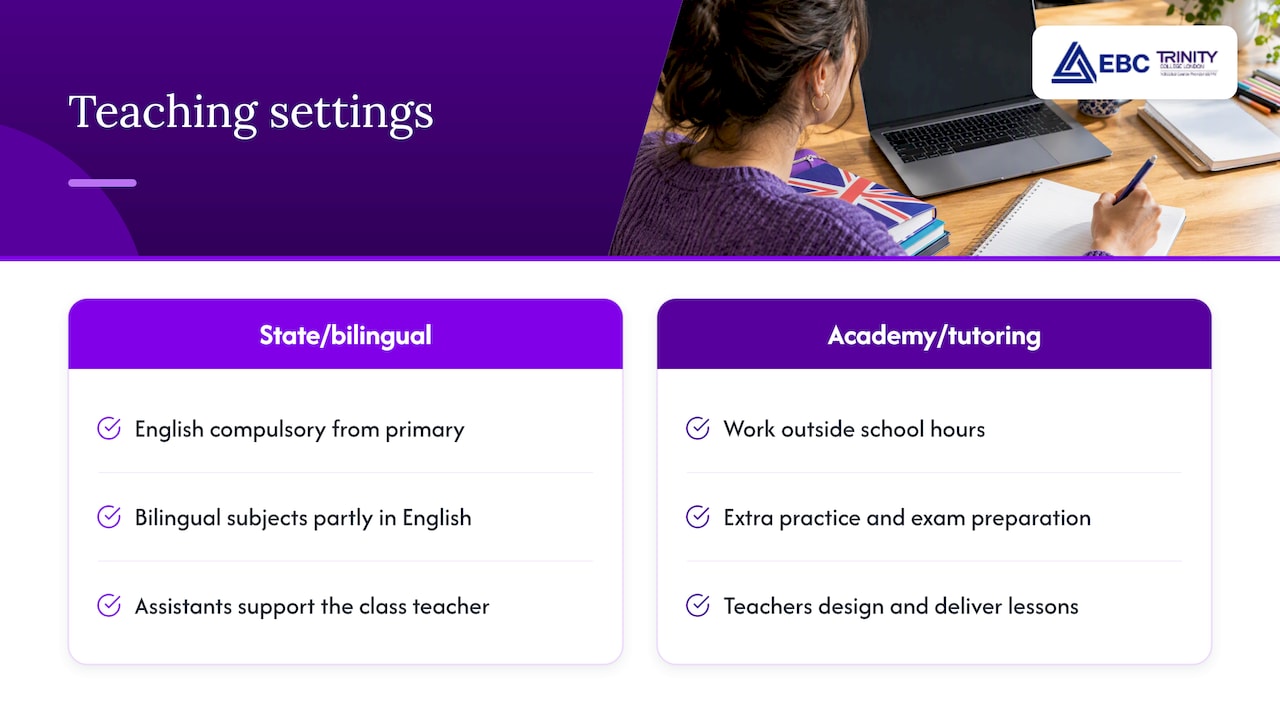
Spain’s school system runs through primary education, secondary education, and vocational or academic tracks, with English taught as a compulsory foreign language from primary level onward. Many regions also run bilingual programmes, where subjects such as science, art or physical education are taught partly in English rather than Spanish.
This is where CLIL training becomes directly relevant: bilingual schools need teachers and assistants comfortable delivering subject content in English, not just running conversation practice. Alongside the state and bilingual school system, a large private sector of language academies operates outside school hours, serving students of every age who want extra practice, exam preparation, or adult business English.
Official language assistant placements usually sit inside the state or bilingual school system, working alongside a Spanish class teacher. Academy work and private tutoring sit outside it entirely, following their own hours, pricing and client base. Understanding which part of the system a role belongs to helps you judge what’s expected: a classroom assistant role supports a qualified teacher’s lesson plan, while an academy or tutoring role usually means you design and deliver the lesson yourself. Knowing this distinction before you apply saves you from taking a role that doesn’t match your experience or your certificate’s focus.
Cultural insights and classroom expectations specific to Spain
Classrooms in Spain tend to be lively, with students more willing to interrupt, ask questions and talk over each other than teachers from quieter classroom cultures might expect. This isn’t a discipline problem so much as a different norm around participation, and firm, warm classroom management usually works better than a strict, silent-room approach.
Spanish students and parents also place real value on personal rapport. Taking time to greet students individually, remembering personal details and showing genuine interest in their interests outside class tends to build trust faster than formal distance.
Timetables matter too: many academies run lessons in the late afternoon and early evening, reflecting the later Spanish working day and school schedule, so your own daily rhythm may need to adjust. Punctuality expectations can feel more relaxed socially than in some other countries, but professional settings, including academy staff meetings, still expect you to show up on time.
Finally, adapting your teaching style to communicative, speaking-focused methods tends to land well, since many Spanish students have had years of grammar-heavy English instruction at school and respond strongly to lessons built around real conversation and practical use.
EBC’s 1-year study and work abroad programme in Spain
Our Road2Spain programme bundles everything a reader at this stage usually has to piece together separately: Spanish language study, a Trinity-accredited TEFL certificate, and visa support, within a single programme. The combined route pairs language study with TEFL training, while the post-graduate version adds a postgraduate study component for those who want an academic credential alongside their teaching certificate.
Language study runs alongside your teaching training, so by the time you finish, you’re better placed to navigate daily life, parent conversations and staffroom relationships in Spanish, not just teach in English. Visa support covers the paperwork stage we outlined earlier: acceptance documentation, timing guidance, and help preparing the file your consulate will expect, though as with any visa process, the final decision always rests with the consulate itself.
Graduates of the programme also receive worldwide job-placement support available to our other certificate holders, meaning the programme isn’t just a study year. It’s a built-in bridge into paid teaching work once your training and language study are complete. You can review the full structure, including entry requirements and the difference between the Spanish-only and TEFL-combined tracks, on our Road2Spain page, or check the postgraduate route on our Road2Spain post-graduate page.
Public schools versus private academies: what actually differs
Public and bilingual state schools mostly bring in English speakers through the official language assistant programme, working under a Spanish class teacher’s supervision rather than running independent lessons. Hours are fixed by the programme calendar, the role is support-focused, and the pay is a set stipend rather than a negotiated salary.
Private academies work differently. You’re usually hired directly by the academy owner or director, often on a part-time or fixed-term contract, and you plan and deliver your own lessons rather than supporting someone else’s. Student ages and goals vary far more, from young children working through phonics to adults preparing for Cambridge or Trinity exams, which means academy teachers often juggle several very different lesson styles across a single week.
Academies also tend to offer more room to negotiate hours and, in some cases, pay, since you’re dealing with an individual employer rather than a centrally administered programme. The trade-off is less structure: assistant placements come with a clear calendar and defined role, while academy work expects you to be more self-directed from day one, often with less onboarding support than a formal placement provides.
Why Trinity College London qualifications carry weight in Spain
Spanish academies and bilingual schools regularly see Trinity exam preparation as part of their own student offering, since Trinity’s graded exams are a recognised benchmark in the Spanish private language sector. That familiarity extends to teacher qualifications: when a hiring manager sees a Trinity-accredited teaching certificate, it sits alongside a standard they already use with their own students, which shortens the trust-building step that an unfamiliar certificate might need.
This matters most at the hiring stage, where academies filtering through applications use accreditation as an early screen before they get to interview or demo-lesson stage. A Trinity CertTESOL, with its assessed teaching practice component, gives a concrete answer to the question every academy director asks: has this person actually taught a class before, under observation, and did they do it well? That’s a harder question to answer with a certificate based purely on self-study hours.
Common challenges new teachers face when starting out
Bureaucracy tends to surprise new arrivals more than teaching itself. Getting an NIE (foreigner identification number), opening a bank account, and registering with local authorities can involve more paperwork and waiting than you’d expect, so building in time for these errands during your first weeks helps avoid unnecessary stress.
Adapting your teaching method is the second common hurdle. Many new teachers arrive with lesson plans built for quieter, more individually-paced classrooms, then find Spanish students respond better to pair work, open discussion and movement-based activities. Adjusting your pacing and classroom management style in the first few weeks, rather than fighting against local classroom norms, tends to produce better results faster.
Housing and short-term contracts can also take adjustment, particularly for academy roles that only run during term time, which means planning your finances across the academic year rather than assuming income continues through the summer break in the same way. None of these challenges are unusual for new teachers anywhere, but knowing they’re coming makes them far easier to handle when they arrive.
How EBC can help you get started
If you’d rather not piece together certification, visa paperwork and job hunting on your own, our Trinity CertTESOL and Road2Spain programmes are built to handle that together. The Trinity CertTESOL gives you an internationally recognised qualification with assessed teaching practice built in, while Road2Spain Spanish + TEFL pairs that same certification with structured language study and visa support for a full year abroad.

- Trinity-accredited training with hands-on teaching practice, not just theory.
- Specialist pathways in Business English, CLIL and online teaching for targeted roles.
- Lifetime worldwide job-placement support once you’ve qualified.
Whichever route fits your plans, you can check current dates and entry requirements on our Trinity CertTESOL page or review the combined study and visa route on Road2Spain. If you’d rather talk it through first, book a free consultation and we’ll help you map out the right starting point.
FAQ
Which country has the highest demand for English teachers?
Demand for English teachers is strong across many regions worldwide, including Asia, the Middle East and Europe, rather than concentrated in a single country. Spain remains one of the more popular European destinations thanks to its bilingual school programmes and large private academy sector.
Is it easy for Americans to get a job in Spain?
Americans can find teaching work in Spain through routes such as language assistant placements or academy jobs, though a study or placement-linked visa is usually required since there’s no general standalone work visa for teaching. Starting the acceptance and visa paperwork early, and choosing a route suited to your qualification, makes the process considerably more manageable.
What is the difference between TEFL and TESOL?
TEFL (Teaching English as a Foreign Language) and TESOL (Teaching English to Speakers of Other Languages) are closely related terms, and in practice many certificate programmes use them interchangeably. The more meaningful distinction is the qualification’s level and content, such as whether it includes assessed teaching practice, like a Trinity CertTESOL, rather than the label itself.
How to be an English teacher in Spain?
Start by earning a recognised TEFL or TESOL certificate, ideally one with supervised teaching practice, then choose a route such as a language assistant placement, a private academy job, or private tutoring. If you need a visa, gather your acceptance documents and apply well ahead of your intended start date.
Recommended
- Step-by-Step Guide to Teaching in Spain Successfully
- Complete Guide to Teaching English in Spain
- How to be an English teacher in Spain: 2026 guide
- How to Teach English in Spain Without a Degree in 2026
This page provides commentary based on information, facts, and experiences available at the time of publication. It does not constitute legal advice, and EBC accepts no liability for decisions made based on the information provided. If you require legal advice, please consult a qualified lawyer.