
We recommend a play- and meaning-focused, communicative approach built around clear routines, short staged activities and plenty of recycling. Open your lesson with a rhythmic song to settle the class, then introduce new language through a short, modelled task rather than a grammar explanation. The sections below walk through the evidence and show you exactly how to put this into practice.
Key Points
- A 30 to 45 minute lesson works best in five stages, with brief presentation, guided practice, freer production, and a five minute recap.
- Younger beginners need heavily modeled exchanges and visual support, while older primary learners can manage multistep tasks and more explicit attention to grammar patterns.
- Finger signals, exit slips, oral rounds, and observation notes track progress; a silent period does not mean a child has stopped learning.
- A supervised practicum gives employers evidence of classroom management and lesson staging, but training providers cannot guarantee a job or visa.
Table of Contents
- Which pedagogical approaches work best for young learners?
- Setting up routines, classroom language and smooth transitions
- Staging a lesson so short attention spans stay with you
- A bank of activities you can run tomorrow
- Checking progress and supporting mixed-ability classes
- How these classroom skills make you more employable
- Bringing parents and caregivers into the learning process
- Using storytelling and role play for real language practice
- Understanding how young learners actually acquire language
- Building a learning environment that motivates young learners
- Weaving in cultural awareness and intercultural communication
- Turning these skills into an accredited, hireable qualification
- FAQ
- Sources
Which pedagogical approaches work best for young learners?
A synthesis of 257 peer-reviewed studies published between 2010 and 2025 found that Communicative Language Teaching (CLT) and Task-Based Language Teaching (TBLT) are consistently effective for young learners because they prioritise meaning-making, oral interaction and functional use of language over isolated grammar drills. CLT asks you to centre lessons on genuine communication: children ask real questions, share real opinions and respond to each other, not just to you.
TBLT takes this further by wrapping language around a purposeful task: building a shared poster, planning a pretend shopping trip, or sorting objects by colour while naming them aloud. The target language becomes a tool for finishing something tangible, which suits children who find abstract explanation hard to sit through.
Neither approach needs to be followed rigidly. A principled eclecticism framework works well in practice, adapting your approach to the age, attention span and resources in front of you rather than importing one method wholesale:
- Younger beginners respond best to short, highly scaffolded CLT exchanges with lots of modelling.
- Older primary learners can handle multistep TBLT tasks with less teacher support.
- Mixed-ability groups benefit from tasks with built-in stretch, such as open-ended endings.
Pro Tip: Keep core routines and songs the same for weeks, but swap the vocabulary or props inside them, so children feel secure while still meeting fresh language.
Setting up routines, classroom language and smooth transitions
British Council and TeachingEnglish guidance recommends introducing classroom language and routines from the first lessons, modelling instructions visually and physically so children understand before they can read. Teach simple commands such as “stand up”, “sit down”, “quietly please” and “your turn” from day one, display them on a poster, and practise them as a mini-game in the first few sessions.
Settling activities (a hum, a stretch, a one-minute breathing count) work well at the very start of a lesson, while energisers suit the midpoint when attention dips, typically lasting two to three minutes. A short, co-created class contract, where children suggest two or three rules in their own words and you translate them into simple English, tends to get more buy-in than a list you simply post.
A few routines are worth fixing from week one:
- Use a consistent signal (a raised hand, a clap pattern, a chime) to ask for quiet.
- Hand out materials row by row with a named “helper of the day” to speed distribution.
- Line up using a call-and-response chant rather than a shouted instruction.
- Allow toilet trips through a silent card system so the lesson does not stop.
Staging a lesson so short attention spans stay with you
Young learners rarely hold focus for a full block, so staging matters more than content volume. A 30 to 45 minute session typically splits into five short stages: a two to three minute lead-in to activate interest, five to seven minutes of presentation where new language is modelled, ten minutes of guided practice, ten minutes of freer production, and a brief five-minute consolidation to recap and praise effort.

When you set up a task, say less and show more. Demonstrate the activity yourself first, then repeat with gestures and visual cues, then invite a volunteer to try before the whole class begins. This staged demonstration reduces confusion and cuts down on the “what do we do?” questions that eat into practice time.
Recycling previous language inside new contexts, rather than treating each lesson as a fresh start, builds retention far more reliably than one-off teaching:
- Open each lesson with a fast recap game using last week’s target words.
- Fold old vocabulary into new tasks instead of retiring it.
- Use quick formative checks (a show of fingers, a thumbs signal) to confirm understanding before moving on.
A bank of activities you can run tomorrow
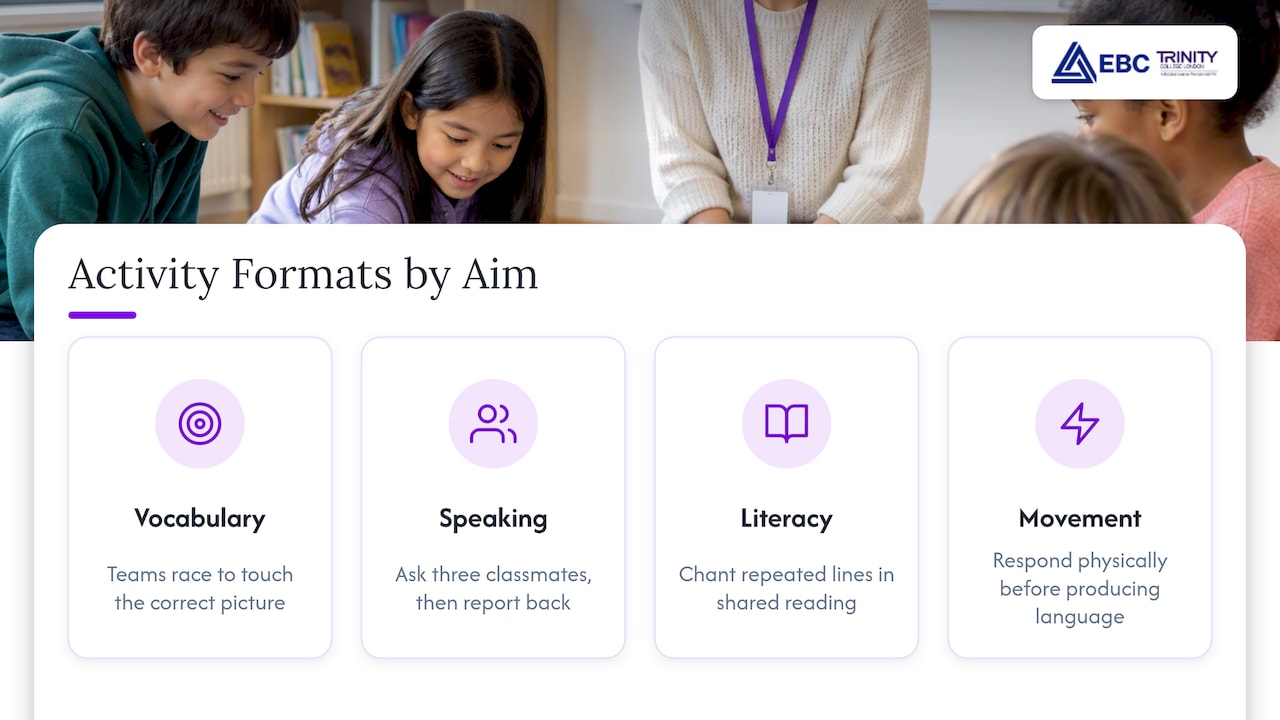
A ready stock of short, flexible activities saves planning time and keeps lessons varied without losing structure. Below are tested formats organised by aim.
Vocabulary: flashcard races where teams run to touch the correct picture, Kim’s game (show objects, hide one, children guess what is missing), and matching or labelling worksheets that reinforce new words visually.
Speaking: pair surveys where children ask a simple question to three classmates and report back, guided role-plays built around a shopping or café scenario, and structured dialogues using sentence starters such as “I like…” or “Can I have…?” to scaffold output.
Phonics and early literacy: rhyme games that chain words by sound, shared reading of big books with the group chanting repeated lines, and sound hunts where children find classroom objects beginning with a target letter. Supporting oral language and phonological awareness this way lays groundwork for reading, in line with guidance on early literacy development for English language learners, which recommends developmentally appropriate, meaning-based literacy activities.
Movement and sensory tasks: action songs where lyrics map onto gestures, and Total Physical Response (TPR) activities where children respond physically to commands (“touch your nose”, “jump twice”) before producing language themselves.
Repetition is unavoidable with young learners, but it need not feel repetitive. TESOL practitioner guidance recommends turning drills into short, game-like rounds with points and brief reflection prompts to sustain engagement.
Pro Tip: Run repetition in two to four minute rounds with a quick point tally, then ask one reflection question (“what was tricky?”) before the next round begins.
Checking progress and supporting mixed-ability classes
Formal testing has limited value with young learners, so low-prep formative checks do most of the work. A thumbs-up or thumbs-sideways signal, a one-word exit slip on the way out, a quick oral round where each child says one sentence, and brief observation notes jotted during tasks all give you a usable read on progress without extra marking time.
Differentiation does not require separate lesson plans for every child. A few adjustable levers cover most mixed-ability groups:
- Set tiered outcomes: all children attempt the task, but stronger learners extend it with an extra sentence or detail.
- Use role cards to give quieter children a defined, lower-pressure speaking part.
- Offer extra modelling and visual supports to learners who need more scaffolding before producing language independently.
Keep your progress expectations realistic: steady, small gains over a term matter more than rapid leaps. Recording a few annotated examples (a child’s worksheet, a short observation note, a lesson plan with outcomes) builds a useful record for your own teaching portfolio over time.
How these classroom skills make you more employable
Recruiters hiring for young-learner classrooms consistently look for demonstrated classroom management, clear staging and activity design, not just a certificate. Being able to show, rather than simply claim, that you can run a settled class and a staged lesson sets you apart in a competitive hiring pool.
Accredited training with a supervised teaching practicum helps consolidate exactly these skills under feedback, which is harder to build through self-study alone. A practicum gives you real children, real timing pressure and real feedback on your staging, questioning and management.
Build a portfolio as you train rather than scrambling for evidence later:
- A full lesson plan with staged timings and clear aims.
- A short video of a microteaching session, where your training programme allows it.
- Sample assessment notes from a real or observed class.
- A brief reflective log tracking what worked and what you changed.
Bringing parents and caregivers into the learning process
Parents and caregivers extend what happens in the classroom far beyond your contact hours, and a short weekly update, whether a note home, a photo of the target vocabulary, or a simple “ask me about…” prompt, invites that extension without demanding extra teaching time from you.
Simple home tasks work best: naming five objects in English around the house, singing the week’s song together, or looking at a picture book and pointing out familiar words. None of this requires parents to speak English themselves; it only asks them to notice and encourage.
Where caregivers can attend, a short open lesson or an informal showcase lets children perform a song or short dialogue they have learned, which builds motivation and gives families a concrete sense of progress. Keeping communication simple and consistent, rather than occasional and detailed, tends to sustain parent engagement over a full term.
Using storytelling and role play for real language practice
Stories give children a structure they already understand instinctively: a beginning, a problem and a resolution, which makes new language easier to predict and retain. Reading a simple story aloud with exaggerated intonation, pausing before key words for children to guess, and repeating refrains together all turn a story into active language practice rather than passive listening.
Role play builds on this by letting children step into a character and use language with a clear purpose. A simple shop, doctor’s visit or family breakfast scene gives learners a script-like structure to lean on at first, with sentence starters providing enough support that shy children can still participate.
Over several lessons, the same story or scenario can be revisited with less support each time: first with you narrating and children repeating, then with children taking roles using prompt cards, and finally with children improvising short exchanges of their own. This staged withdrawal of support mirrors the recycling principle that runs through effective young-learner teaching generally.
Understanding how young learners actually acquire language
Children do not learn a second language the way teenagers or adults do: they rely more on implicit pattern-spotting from meaningful input than on explicit rule explanation, which is part of why task-based, communicative approaches outperform grammar-first instruction with this age group. TESOL guidance on prioritising the child’s developmental stage, often summarised as “teach the child, not just the subject”, reinforces that methods appropriate for teenagers or adult learners frequently fail to suit the attention span, motor needs and social development of a seven-year-old.
Younger beginners typically need more physical movement, shorter task cycles and heavier visual support, while older primary learners can sustain longer, more abstract tasks and begin noticing some grammar patterns explicitly. Silent periods, where a child understands far more than they produce, are also normal and should not be mistaken for lack of progress. Matching your activities to these developmental realities, rather than to a fixed curriculum pace, tends to produce steadier long-term gains.
Building a learning environment that motivates young learners
A motivating classroom for young learners is colourful, predictable and forgiving of mistakes. Visual displays of recent vocabulary, a visible routine chart, and a dedicated space for children’s work all signal that the room belongs to them, not just to you.
Praise focused on effort and specific achievement (“you remembered all five colours today”) tends to sustain motivation better than generic praise, and celebrating small wins publicly, through a sticker chart or a simple round of applause, reinforces that progress is noticed. Keeping activities short and varied protects attention far more effectively than lengthening any single task.
Physical comfort matters too: seating that allows movement, enough space for TPR activities, and a predictable daily rhythm all reduce the anxiety that can otherwise block language production in younger children.
Weaving in cultural awareness and intercultural communication
Even in a monolingual classroom, English carries culture with it, and young learners benefit from early, light-touch exposure to the fact that English is spoken differently and means different things in different places. Simple activities, comparing greetings, festivals or foods from different English-speaking contexts, build curiosity without requiring deep explanation.
Picture books, songs and stories drawn from a range of cultural settings give children a sense that English belongs to many communities, not one. Framing differences as interesting rather than strange, and inviting children to share their own customs in return, builds the reciprocal curiosity that underpins genuine intercultural communication later in life.
This groundwork matters professionally too: teachers who can plan culturally inclusive lessons are better prepared for the genuinely global classrooms they are likely to work in over a career that may span several countries and age groups.
Turning these skills into an accredited, hireable qualification
Everything in this guide, staging, routines, activity design, differentiation, becomes far more powerful once it sits inside structured, accredited training with real practice teaching and feedback. We offer teacher training built on Trinity College London accreditation, combining hands-on classroom practice with worldwide job placement support.

Our Trinity CertTESOL course includes a supervised practicum to put young-learner techniques into practice before stepping into paid roles, and our young-learner pathway focuses on age-appropriate methods. We also offer an online TEFL course with trainer support.
- Trinity CertTESOL combines certification with live teaching practice and job placement support.
- Specialised CertPT pathways help build expertise in areas such as Content and Language Integrated Learning (CLIL) or online teaching.
- Our advisory team can discuss visa and work pathways, though no course can guarantee a visa or job outcome.
If you are ready to turn these classroom skills into a credential employers recognise, book a free consultation and talk through which pathway fits where you want to teach.
FAQ
How do you teach English to very young learners?
Very young learners respond best to short, highly physical activities: songs with actions, picture-based vocabulary games and simple TPR commands rather than explanation. Keep tasks under five minutes each and repeat core routines daily so children feel secure enough to start producing language on their own.
How do you teach speaking English to young learners?
Speaking develops through structured, low-pressure practice: sentence starters, paired surveys and guided role-plays give children a script to lean on before they improvise. Modelling the target language yourself first, then inviting a volunteer to try, reduces hesitation and builds confidence quickly.
What are the five steps of teaching a lesson to young learners?
A common staging model runs: lead-in, presentation, guided practice, freer production and consolidation. Each stage should be brief, since young learners sustain focus better across several short segments than one long block.
How do you teach English to a seven-year-old child?
A seven-year-old can usually manage slightly longer tasks and some explicit noticing of patterns, alongside the movement and visual support younger children still need. Storytelling, simple role play and short written or drawing tasks alongside speaking practice tend to suit this age well.
Do accredited TEFL courses help you get a young-learner teaching job?
Accredited training that includes supervised teaching practice gives recruiters concrete evidence of classroom management and lesson staging, which TESOL guidance notes is something employers actively look for. A portfolio built during training, including lesson plans and observation notes, strengthens an application further.
Recommended
- How to Teach Young Learners: A Practical Step-by-Step Guide
- Teaching Methods: 6 Step Lesson Sequence That Boosts Employability
- How to Teach Business English for Global Career Success
- Young Learners TEFL: Pathways to Global Teaching Success
This page provides commentary based on information, facts, and experiences available at the time of publication. It does not constitute legal advice, and EBC accepts no liability for decisions made based on the information provided. If you require legal advice, please consult a qualified lawyer.