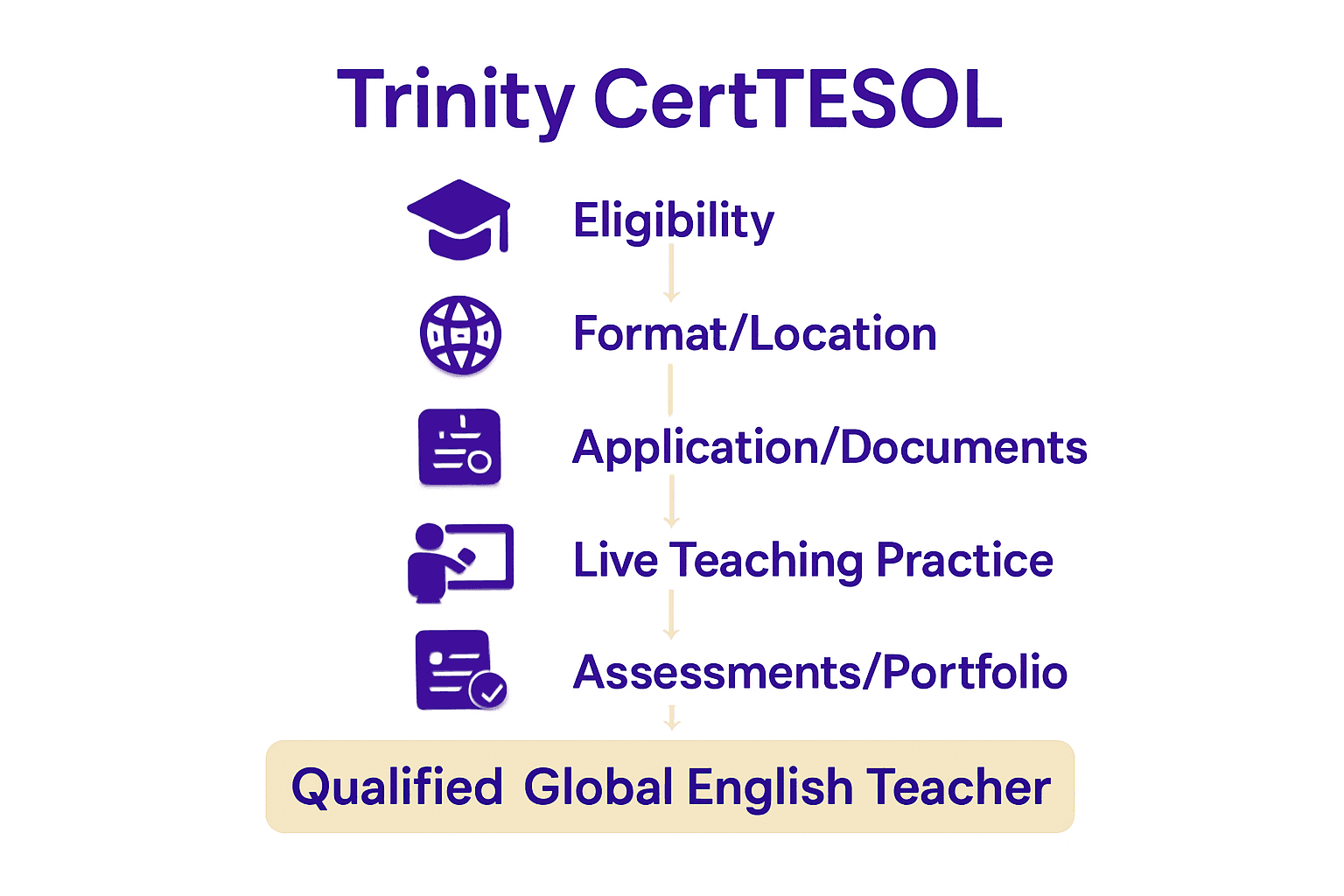
The Trinity CertTESOL is an established qualification for people who want to teach English to speakers of other languages. It combines language awareness, teaching methodology and practical classroom experience. For aspiring teachers, it offers a structured route into the profession.
However, applying for a professional teaching qualification involves several important decisions. You need to check your eligibility, choose an approved training centre, prepare for the admission process and understand the course assessments. After qualifying, you can use your training to explore teaching opportunities at home or abroad.
This guide explains each stage of the Trinity CertTESOL journey. It also covers practical preparation, course formats and the steps you can take to develop your teaching career.
Table of Contents
- Quick Summary
- Step 1: Check Your Eligibility
- Step 2: Choose Your Course Format and Provider
- Step 3: Prepare Your Application
- Step 4: Prepare for the Admission Interview
- Step 5: Complete Your Training and Teaching Practice
- Step 6: Complete Your Assessments and Portfolio
- Step 7: Explore Teaching Opportunities
- How to Prepare for Success
- Frequently Asked Questions
- Recommended Reading
- Start Your Trinity CertTESOL Journey
Quick Summary
| Stage | What You Need to Do |
|---|---|
| 1. Check eligibility | Meet the minimum age, educational and English language requirements. |
| 2. Choose a provider | Compare approved centres, course formats, timetables and support. |
| 3. Apply | Complete the application and prepare the requested documents. |
| 4. Attend the interview | Demonstrate your English language awareness, communication skills and suitability for training. |
| 5. Complete training | Study language systems and teaching methodology, then undertake supervised teaching practice. |
| 6. Pass the assessments | Complete the required teaching practice, written work and other assessment components. |
| 7. Plan your career | Use your qualification to explore suitable teaching opportunities and further development. |
Step 1: Check Your Eligibility
Before applying for the Trinity CertTESOL, check that you meet the qualification’s entry requirements. This first step helps you establish whether you are ready for the academic and practical demands of the course.
Minimum age and educational background
Applicants must normally be at least 18 years old. You also need educational qualifications that demonstrate your ability to study at higher education level.
For many applicants, a secondary school qualification or its equivalent will provide the necessary academic background. However, individual circumstances can vary. Ask your chosen training centre to confirm whether your qualifications meet the entry requirements.
English language proficiency
You need a high level of English to complete the course successfully. Strong spoken and written communication skills are essential because you will study language systems, prepare lessons and explain English to learners.
Being a native English speaker is not a requirement in itself. Non-native English speakers can also apply if they demonstrate the necessary proficiency.
Some providers assess applicants through written tasks and an admission interview. These activities help the course team evaluate your language awareness and suitability for teacher training.
Personal suitability
Successful trainees need more than good English. You should also enjoy working with people, responding to feedback and solving problems.
Teaching practice can be demanding, so a positive attitude and willingness to learn are important. Previous teaching experience may help, but the Trinity CertTESOL is an initial teacher training qualification.
For additional guidance, read How to Choose a TEFL Course That Is Best for You.
- Check that you meet the minimum age requirement.
- Confirm that your education meets the entry criteria.
- Assess your spoken and written English skills.
- Consider whether you can commit to the course workload.
- Prepare to explain your interest in English language teaching.
Once you understand the entry requirements, you can start comparing training providers and course formats.
Step 2: Choose Your Course Format and Provider
Choosing the right training centre is an important decision. Your provider will shape your learning experience, timetable, tutor support and practical teaching arrangements.
Start by identifying centres that offer the Trinity CertTESOL. Then compare their programmes carefully rather than choosing on price or convenience alone.
Compare available course formats
Training centres may offer full-time, part-time or blended learning arrangements. Some also use online learning for parts of the programme.
However, the qualification includes practical teaching requirements. You should therefore check how each centre organises supervised teaching practice and tutor observation.
Consider the following factors when comparing courses:
- Timetable: Does the course fit around your work and personal commitments?
- Teaching practice: How does the centre arrange observed teaching with real learners?
- Tutor support: What guidance and feedback will you receive?
- Location: Can you attend the required training sessions?
- Course costs: What does the advertised fee include?
- Career guidance: Does the provider offer job-search advice or alumni support?
Your preferred learning environment also matters. Some trainees value direct classroom interaction, while others prefer a programme with more online learning. Choose a format that meets the qualification requirements and suits your circumstances.
Our guide Teach Online and Face-to-Face: Get Certified to Do Both explains why teachers may want to develop skills for different teaching environments.
You can also compare English Language Teaching Skills for Successful TEFL Teachers to understand the practical abilities that support effective teaching.
Check the training centre’s approval
Always confirm that the provider offers the qualification through the appropriate Trinity College London approval arrangements. Ask about the course specification, assessment process and certificate arrangements before you enrol.
For official information, consult Trinity College London’s CertTESOL qualification information.
Step 3: Prepare Your Application
Once you have selected a suitable provider, you can begin the application process. Most centres ask prospective trainees to complete an application form and provide information about their education and experience.
Read the instructions carefully. Each provider may have its own application procedure and supporting document requirements.
Prepare your supporting documents
Depending on your circumstances and the provider’s requirements, you may need some or all of the following:
- Passport or other accepted identification.
- Educational certificates or equivalent evidence of qualifications.
- Curriculum vitae or résumé.
- Information about your English language background.
- Details of relevant work or teaching experience, if applicable.
- Completed application forms and any requested written tasks.
Not every applicant will need to provide exactly the same documents. Contact the training centre if you are unsure whether a particular certificate or document is acceptable.

Submit your application carefully
Check every section before submitting your application. Make sure your contact details are correct and that your supporting documents are clear and readable.
It also helps to keep digital copies of everything you send. This makes it easier to answer follow-up questions and track your application.
After submission, the provider will explain the next stage. This may include a pre-admission task, an interview or an additional language assessment.
Step 4: Prepare for the Admission Interview
The pre-admission interview helps the training centre assess your readiness for the Trinity CertTESOL. It gives the course team an opportunity to explore your English language awareness, communication skills and motivation.
Some providers ask applicants to complete a written task before the interview. The interview may then explore your answers and assess how you communicate your ideas.
What might the interview cover?
The exact format varies between providers. However, you may be asked to discuss:
- Your reasons for wanting to teach English.
- Your experience of learning languages.
- Your understanding of basic English grammar.
- How you explain language concepts.
- Your approach to learning and receiving feedback.
- Your ability to communicate clearly in English.
You do not need to know everything about teaching before you start. The course provides professional training. Nevertheless, you should demonstrate curiosity, a willingness to learn and an appropriate level of English.
How to prepare effectively
Review basic grammar terminology and practise explaining simple language points. Think about why you want to teach English and what you hope to achieve after qualifying.
Prepare honest examples from your education, work or personal experience. These can help you explain your motivation and demonstrate your ability to reflect on new challenges.
Our guide, How to Pass Your Trinity CertTESOL Pre-Admission Interview, provides further preparation advice.
You may also find All You Need to Know for a TEFL Job Interview useful when developing your confidence in professional interviews.

Once the provider confirms your place, you can prepare for the training itself.
Step 5: Complete Your Training and Teaching Practice
The Trinity CertTESOL combines academic study with practical teacher training. You will explore how English works, learn teaching techniques and apply your knowledge in the classroom.
This combination is important. Understanding language theory is useful, but effective teachers must also know how to help learners use English in real situations.
Develop your language awareness
Language awareness forms an important part of your preparation. You will study areas such as grammar, vocabulary, pronunciation and language functions.
You will also learn how to explain language clearly. For example, you may need to help learners understand a tense, practise a pronunciation feature or use new vocabulary in context.
Study teaching methodology
Teaching methodology explores how teachers plan and deliver effective lessons. You will consider learner needs, classroom interaction, teaching materials and lesson aims.
Different learners need different types of support. Therefore, you will develop the ability to select activities that match their language level and learning objectives.
Complete observed teaching practice
Practical teaching is a central part of the Trinity CertTESOL. You will plan and deliver lessons to real English language learners while experienced tutors observe your performance.
These sessions give you the opportunity to apply your training in a supervised environment. You will also receive feedback that helps you identify strengths and areas for development.
During teaching practice, you will typically need to:
- Identify appropriate lesson aims.
- Prepare clear and structured lesson plans.
- Select suitable learning materials.
- Deliver lessons to real learners.
- Manage classroom activities and interaction.
- Respond to learner needs.
- Reflect on tutor feedback and improve subsequent lessons.
Teaching practice can feel challenging at first. However, each session provides an opportunity to develop your confidence and improve your classroom skills.
Ask your tutors whether you can record any teaching sessions for personal review. Always obtain the necessary permission and follow the centre’s privacy requirements before recording learners.

Understand the course workload
The Trinity CertTESOL requires a significant commitment. In addition to scheduled training, you should allow time for lesson preparation, reading, written assignments and independent study.
Course duration and delivery arrangements depend on the programme and approved centre. Check the current qualification specification and the provider’s timetable rather than relying on figures from older course descriptions.
For more information about the qualification itself, visit Trinity CertTESOL information.
Step 6: Complete Your Assessments and Portfolio
Assessment takes place throughout your Trinity CertTESOL training. You need to demonstrate both your understanding of teaching principles and your ability to apply them in practice.
The qualification includes practical teaching assessments and written work. Your training centre will explain the current assessment requirements and submission arrangements.
Prepare your written assignments
Written assignments allow you to demonstrate your understanding of language and teaching. They may ask you to analyse language, consider learner needs or reflect on teaching decisions.
Read each assignment brief carefully. Pay attention to the assessment criteria and make sure your work addresses the task directly.
Maintain your teaching records
Keep your lesson plans, feedback and reflective notes organised throughout the course. Regular documentation makes it easier to review your progress and prepare any required portfolio material.
Your records may include:
- Lesson plans and teaching materials.
- Written feedback from tutors.
- Reflective notes about teaching sessions.
- Language analysis and assignment work.
- Evidence of lesson development and professional progress.
The exact portfolio requirements depend on the current qualification specification. Follow your tutors’ guidance and use the assessment criteria to check your work.
Use feedback to improve
Feedback is an essential part of professional development. Instead of treating comments as criticism, use them to identify practical changes you can make.
For example, you might need to improve your instructions, adjust lesson timing or give learners more opportunities to practise speaking. Apply these observations to your next lesson.
Our guide, How to Pass the Trinity CertTESOL, offers further advice on preparing for the course and its assessments.
Step 7: Explore Teaching Opportunities
After completing the Trinity CertTESOL, you can begin exploring suitable English language teaching opportunities. Your qualification provides an initial professional foundation, while your teaching practice helps you demonstrate practical classroom skills.
However, employment requirements vary between countries and employers. A qualification does not guarantee a job, salary or work visa. Research each destination carefully before making career decisions.
Prepare your professional profile
Update your CV to include your Trinity CertTESOL qualification and relevant teaching practice. Highlight the skills you developed during training, such as lesson planning, language analysis and classroom management.
You can also prepare a professional portfolio with suitable examples of your work. Make sure you respect learner privacy and do not share confidential course materials.
Research teaching destinations
Different countries have different requirements for English language teachers. Some employers may ask for additional qualifications, previous experience or specific visa documentation.
Research the local job market before applying. Check employer requirements and confirm whether your qualifications meet the relevant immigration rules.
Our article 11 Good Reasons to Take a TEFL Course explores the professional opportunities that teacher training can support.
Use professional networks
Networking can help you discover vacancies and learn about different teaching environments. Stay in contact with tutors, fellow trainees and other professionals in the English language teaching sector.
In addition, ask your training provider whether it offers career guidance, alumni support or job-search resources.
Our guide to Accredited TESOL Certification with Job Placement explains why career support can be worth considering when choosing a provider.
Consider different teaching environments
English language teachers work in a range of settings. You might explore private language schools, adult education, online teaching or other educational environments.
Your options will depend on your experience, employer requirements and location. As your career develops, you may also choose to specialise in areas such as business English, young learners or examination preparation.
How to Prepare for Success
Good preparation can make the Trinity CertTESOL experience more manageable. The course combines several demanding activities, so a clear routine will help you balance your responsibilities.
Review English grammar and pronunciation
Start by revisiting common grammar structures, vocabulary and pronunciation features. Practise explaining language points in simple terms.
This preparation will help you when you plan lessons and respond to learners’ questions.
Organise your study time
Create a realistic weekly schedule for reading, assignments and lesson preparation. Break larger tasks into smaller activities and allow extra time for unexpected challenges.
Consistent preparation is usually more effective than leaving everything until the deadline.
Take an active approach to feedback
Ask questions when you do not understand a tutor’s comments. Reflect on the feedback after each teaching session and identify specific improvements for your next lesson.
Over time, this approach will help you become a more confident and reflective teacher.
Learn from other teachers
Discuss teaching ideas with fellow trainees and observe how experienced teachers manage their classes. Different perspectives can help you develop a broader understanding of classroom practice.
For further guidance on teaching methodology and professional development, explore our article on English Language Teaching Skills for Successful TEFL Teachers.
Frequently Asked Questions
What are the entry requirements for the Trinity CertTESOL?
Applicants must normally be at least 18 years old and have educational qualifications suitable for entry into higher education. They must also demonstrate the English language proficiency needed to complete the course. Check your chosen centre’s admission requirements before applying.
Do I need previous teaching experience?
No. The Trinity CertTESOL is an initial teacher training qualification, so previous classroom experience is not generally essential. However, you should be ready to learn new teaching methods and take part in supervised practical teaching.
Do I need to be a native English speaker?
No. Native English speaker status is not a requirement in itself. However, you need a high level of spoken and written English to study language systems and teach English effectively.
What happens during the pre-admission interview?
The interview helps the provider assess your English language awareness, communication skills and suitability for the course. Some centres also ask applicants to complete a written task before the interview. The exact process varies between providers.
What documents do I need for my application?
Depending on the provider, you may need identification, educational certificates, a CV and a completed application form. Some centres also request written tasks or additional evidence of English proficiency. Follow the instructions supplied by your chosen provider.
Does the Trinity CertTESOL include practical teaching?
Yes. Supervised teaching practice with real English language learners is a core part of the qualification. Trainees plan and deliver lessons, receive tutor feedback and reflect on their performance.
How long does the Trinity CertTESOL take?
Course duration depends on the delivery format and the approved centre. Full-time programmes are more intensive, while part-time options spread the workload over a longer period. Ask the provider for its current timetable and guided learning details.
Can I complete the Trinity CertTESOL online?
Course delivery arrangements vary between approved centres. Some programmes may include online or blended learning, but the qualification has practical teaching requirements. Confirm how the centre organises observed teaching practice before enrolling.
Will the Trinity CertTESOL guarantee me a teaching job abroad?
No. No certificate can guarantee a job. However the Trinity CertTESOL is a highly valued, respected, and recognised qualification that gives strong support in applications for suitable teaching positions, but employers set their own requirements. Your experience, location, visa eligibility and other qualifications may also influence your opportunities.
What should I do after qualifying?
Update your CV, prepare a professional portfolio and research suitable employers. You can also contact your training provider about career guidance, alumni networks and job-search resources.
Recommended Reading
These EBC resources provide further information about Trinity CertTESOL, teacher training and professional development.
- What Is the Trinity CertTESOL? How Do I Pass the Course?
- What Is the Difference Between Trinity CertTESOL and CELTA?
- Improve Your English Teaching Career with a Trinity CertPT Course
- How to Pass the Trinity CertTESOL
- How to Pass Your Trinity CertTESOL Pre-Admission Interview
- Teach Online and Face-to-Face: Get Certified to Do Both
- How to Choose a TEFL Course That Is Best for You
- All You Need to Know for a TEFL Job Interview
- 11 Good Reasons to Take a TEFL Course
- English Language Teaching Skills for Successful TEFL Teachers
- Accredited TESOL Certification with Job Placement
Start Your Trinity CertTESOL Journey
Becoming a qualified English language teacher involves more than completing an application form. You need to prepare for the admission process, commit to intensive training and develop the practical skills that effective teaching requires.
The Trinity CertTESOL provides a structured route into the profession. With careful preparation and the right training provider, you can build a strong foundation for your teaching career.
At EBC, we help aspiring teachers understand their training options and prepare for the next stage of their professional development. You can explore our TEFL and TESOL certification courses to learn more about available pathways.
If you would like to discuss your eligibility, course options or career plans, book a free consultation with EBC. Our team can help you understand the available training pathways and decide which option best matches your goals.
You can also visit the EBC TEFL and TESOL website or explore our course information and resources.