
Key Points
- Internationally recognized Trinity CertTESOL is essential for a competitive TESOL career.
- The qualification includes real classroom teaching practice with real students.
- Ongoing professional development through advanced courses and networking boosts long-term success.
The global demand for qualified English teachers has never been stronger, and standing out in this competitive market requires more than enthusiasm. Thousands of aspiring educators each year discover that internationally recognised certification is the foundation of a successful teaching career. The Trinity College London CertTESOL is a Level 5 Ofqual-regulated qualification equivalent to CELTA, making it one of the most respected entry points into the profession. Whether you want to teach in Spain, Japan, or Brazil, this guide walks you through each step of TESOL professional development, from eligibility to advanced career progression.
Table of Contents
- Understand eligibility and certification requirements
- Choose the right TESOL course and provider
- Master teaching methodologies and practical skills
- Steps for ongoing professional development and advancement
- What most aspiring TESOL teachers get wrong – and how to stand out
- Advance your TESOL career with accredited courses and expert guidance
- Frequently asked questions
Key Takeaways
| Point | Details |
|---|---|
| Eligibility requirements clarified | You must be at least 18, have higher education entry qualifications and C1 English to start. |
| Practical hands-on teaching | Trinity CertTESOL courses provide live practice with real students to boost your skills. |
| Advancement with CPD | Move beyond CertTESOL with CertPT, DipTESOL, and networking for long-term growth. |
| Selecting the right course | Compare full-time, part-time, and blended options to suit your lifestyle and goals. |
Understand eligibility and certification requirements
Before you enrol in any programme, you need to confirm that you meet the basic entry requirements for Trinity CertTESOL. Getting this right from the start saves time and prevents unnecessary setbacks.
According to the Guide to Trinity CertTESOL Certification, the core eligibility criteria are straightforward:
- Age: You must be at least 18 years old.
- Academic background: You need a qualification that meets the standard for higher education entry in your country.
- English proficiency: A minimum of C1 level on the Common European Framework of Reference (CEFR) is required.
- Language awareness: Some providers may assess your grammatical knowledge at the point of application.
The Trinity CertTESOL overview explains that the qualification is available in several formats to suit different schedules and learning preferences:
| Format | Duration | Best suited for |
|---|---|---|
| Full-time intensive | 4 weeks | Career changers, recent graduates |
| Part-time | 3 to 6 months | Working professionals |
| Blended/online | Flexible | Those with geographic constraints |
Choosing an accredited provider is non-negotiable. Trinity College London validates each centre, meaning the quality of training and assessment meets a consistent international standard. When comparing providers, look carefully at whether the course includes live teaching practice with real students. This is a requirement of the qualification, not an optional extra.
It is also worth considering practical matters before you begin. For example, understanding your TEFL teacher insurance obligations is something many first-time teachers overlook entirely.
Pro Tip: Always ask prospective providers how many hours of observed teaching practice are included. The Trinity standard requires a minimum of six hours, but the best courses offer more.
The step-by-step CertTESOL guide is an excellent starting point for mapping out your personal route to certification, including how to compare providers across different countries.
Choose the right TESOL course and provider
After confirming your eligibility, the next step is selecting the course and provider that best match your goals, lifestyle, and budget. This decision shapes your entire training experience.
The two most widely recognised initial teacher training qualifications are Trinity CertTESOL and CELTA. Both are Level 5 Ofqual-regulated qualifications, and both are accepted by employers worldwide. However, there are meaningful differences between them that can influence your choice.
| Feature | Trinity CertTESOL | CELTA |
|---|---|---|
| Awarding body | Trinity College London | Cambridge Assessment English |
| Regulation | Ofqual Level 5 | Ofqual Level 5 |
| Teaching practice | Real students required | Real students required |
| Assessment style | Portfolio and observation | Portfolio and observation |
| Provider network | Global, varied centres | Primarily British Council centres |
The CELTA vs CertTESOL comparison breaks down these differences in detail, helping you make a confident, informed decision.
When evaluating providers, work through this checklist:
- Is the centre validated by Trinity College London?
- Does the course include a minimum of six hours of observed teaching practice?
- Are the trainers experienced, qualified educators with real classroom backgrounds?
- Is peer support and feedback built into the programme structure?
- Does the provider offer any post-course job placement assistance?
The why take CertTESOL page outlines the specific career advantages of choosing a Trinity-accredited route, particularly for those targeting teaching roles in Europe, Asia, and Latin America.
Pro Tip: Speak directly with a course trainer before you enrol. Their responsiveness and depth of knowledge will tell you a great deal about the quality of support you can expect throughout the programme.
Format matters too. A full-time intensive course suits those who want to qualify quickly and move abroad fast. Part-time and blended formats work better for professionals who need to manage existing commitments during training.
Master teaching methodologies and practical skills
Once you have chosen your provider, the real work begins. The Trinity CertTESOL is not a passive qualification. It demands active engagement with teaching theory and consistent classroom practice.
The core methodologies you will study include:
- ESA (Engage, Study, Activate): A flexible lesson framework developed by Jeremy Harmer, widely used in communicative language teaching.
- PPP (Presentation, Practice, Production): A structured approach to introducing and consolidating new language items.
- Learner-centred teaching: Placing student needs, interests, and goals at the heart of every lesson.
- Task-based learning: Designing activities around real-world communicative tasks rather than isolated grammar drills.
As the CELTA vs Trinity CertTESOL Guide notes, reflective practice is strongly emphasised throughout the course, with journals and self-evaluation forming a core part of your professional growth.
“The best teachers are not those who never make mistakes. They are those who reflect on every lesson and adapt their approach with purpose and curiosity.”
Teaching real students is a formal requirement of the Trinity CertTESOL. You will plan and deliver observed lessons to actual language learners, not role-playing peers. This experience is invaluable. It builds genuine classroom confidence that no amount of theory can replicate.

The CertTESOL preparation guide offers practical advice on how to approach your observed lessons and manage the natural nerves that come with being assessed.
Before travelling abroad to teach, it is also sensible to review your travel insurance options as part of your broader preparation.
Pro Tip: Keep a reflective teaching journal from your very first lesson. Recording what worked, what did not, and why will accelerate your growth far more quickly than simply completing the required hours.
The passing the CertTESOL resource provides targeted guidance on the written assignments and portfolio requirements that accompany your teaching practice.
Steps for ongoing professional development and advancement
Completing your initial certification is a significant achievement. But for those serious about a long-term teaching career, it is the beginning rather than the end of professional development.
Here are the key steps for advancing your career after CertTESOL:
- Progress to CertPT (Level 6): Designed for practising teachers, this qualification deepens your pedagogical knowledge and is recognised globally by schools and language institutions.
- Pursue DipTESOL (Level 7): The diploma is the highest level of initial teacher training in TESOL and positions you for senior teaching, teacher training, and academic management roles.
- Attend TESOL conferences: Events such as IATEFL and regional TESOL conferences connect you with global educators, researchers, and employers.
- Join professional networks: Organisations like IATEFL and TESOL International Association offer journals, webinars, and community forums that keep your practice current.
- Complete specialised courses: Business English, CLIL (Content and Language Integrated Learning), and online teaching qualifications expand your employability significantly.
As outlined in the 7 Steps to Become a TEFL Teacher, progression from CertTESOL to CertPT and then DipTESOL represents a clearly structured pathway recognised by institutions worldwide.
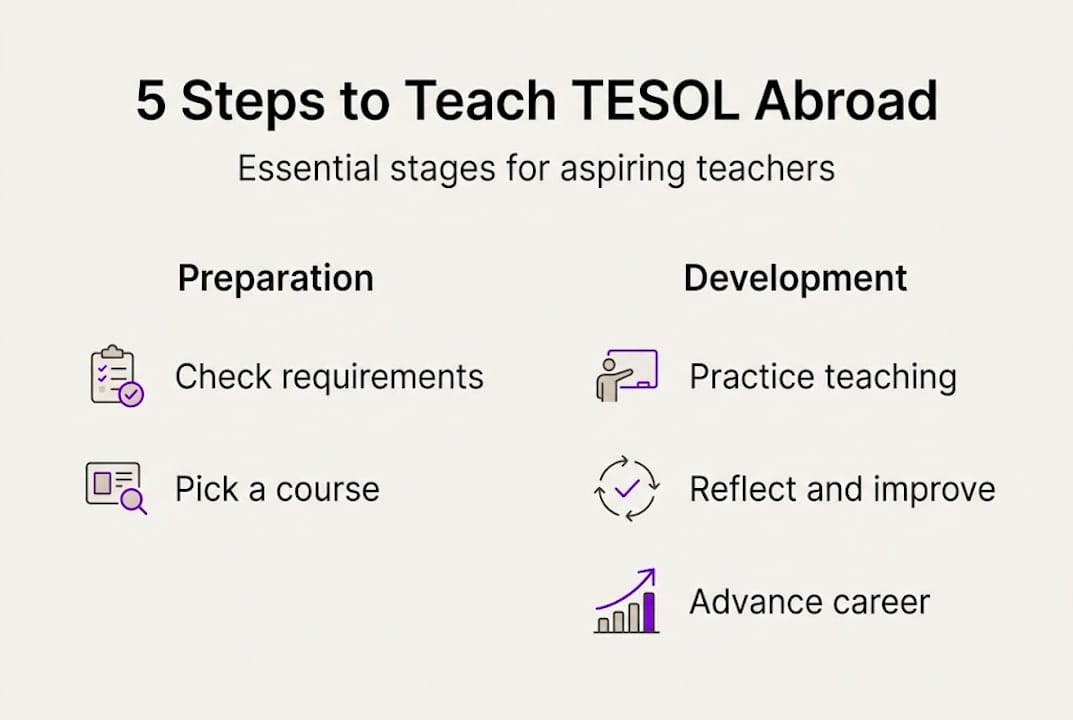
Teachers who engage in regular continuing professional development (CPD) are consistently more competitive in the job market. Schools in Europe, Asia, and the Middle East actively prioritise candidates who demonstrate commitment to ongoing learning.
Key CPD activities to prioritise:
- Peer observation and collaborative lesson planning
- Online courses in specialised areas such as young learners or exam preparation
- Subscription to professional journals such as ELT Journal or TESOL Quarterly
- Participation in teaching communities and online forums
The accredited TESOL online page outlines how EBC supports teachers at every stage of this journey, from initial certification through to advanced qualifications. The step guide for educators provides a clear framework for mapping your personal development plan.
What most aspiring TESOL teachers get wrong – and how to stand out
After working with aspiring teachers across multiple continents, we have noticed a pattern. Many candidates invest in the right qualification but undermine their own progress in three predictable ways.
First, they choose theory-heavy courses with minimal live teaching practice. A certificate earned without real classroom experience does not prepare you for the realities of teaching abroad. Employers notice the difference immediately.
Second, they treat reflective practice as a box-ticking exercise. The teachers who grow fastest are those who genuinely interrogate their own lessons, not those who write the minimum required in a journal. Reflection is where real skill development happens.
Third, they skip CPD entirely after qualifying. The TESOL field evolves constantly, and teachers who stop learning quickly fall behind. Networking at conferences and engaging with TEFL development impact resources keeps your practice sharp and your career moving forward.
The solution is straightforward. Prioritise hands-on training, treat every lesson as a learning opportunity, and build professional relationships from day one. These habits separate good teachers from exceptional ones.
Advance your TESOL career with accredited courses and expert guidance
You now have a clear picture of what it takes to qualify, grow, and succeed as a TESOL professional. The next step is finding the right partner to support that journey.
At EBC, we connect aspiring teachers with Trinity College London accredited courses and international careers across Europe, Asia, Latin America, and beyond. Our one-year study and work abroad programmes in Spain, France, and Italy combine certified teacher training with language study, visa support, and cultural immersion. We also offer free lifetime job placement assistance, because your career does not stop at graduation. Explore the TEFL and TESOL benefits of our programmes and book a free consultation to get personalised guidance from our expert team today.
Frequently asked questions
What is the minimum age and qualification for Trinity CertTESOL?
You must be at least 18, hold a qualification suitable for higher education entry, and demonstrate English proficiency at C1 level or above.
Do Trinity CertTESOL courses include actual classroom practice?
Yes. Trinity CertTESOL requires you to teach real students as a formal component of the qualification, not simulated or peer-taught sessions.
Are Trinity CertTESOL and CELTA equivalent qualifications?
Both are Level 5 Ofqual-regulated certifications and are recognised internationally by schools and language institutions as equivalent entry-level teaching qualifications.
What are the next steps after CertTESOL for career advancement?
You can progress to CertPT or DipTESOL and participate in conferences and professional networks to build your CPD record and advance into senior teaching or training roles.
Recommended
- TESOL Abroad Application Process: Guide to Teaching Worldwide
- How Do I Teach English Abroad: Accredited Programmes Guide – EBC TEFL courses
- Step-by-step guide to becoming an English teacher abroad – EBC TEFL courses
- International TEFL Career Steps: Your Path to Global Teaching – EBC TEFL courses
- Step-by-Step Guide to Teaching Geography Games Effectively – The World Game