

The Trinity CertTESOL is an internationally recognised initial qualification for people who want to teach English to speakers of other languages. Trinity College London awards the qualification, which sits at Level 5 on the Regulated Qualifications Framework (RQF) in England.
Unlike many short online TEFL courses, the CertTESOL combines teaching theory with assessed classroom practice. Trainees plan and teach lessons to real English learners, receive feedback from experienced tutors and develop the skills they need to begin a teaching career.
Whether you want to change careers, teach English abroad or develop your professional skills, this guide explains what the Trinity CertTESOL involves. You will learn about its structure, entry requirements, international recognition and career opportunities. We also compare it with other TEFL qualifications to help you make an informed decision.
Table of Contents
- What Is the Trinity CertTESOL?
- Who Awards the CertTESOL?
- What Does Level 5 Mean?
- How Is the CertTESOL Course Structured?
- Assessed Teaching Practice and External Moderation
- Trinity CertTESOL Entry Requirements
- CertTESOL vs Generic Online TEFL Certificates
- International Recognition and the British Council
- Career Opportunities with the CertTESOL
- Professional Confidence and Career Development
- Graduate Experiences
- Trinity CertTESOL vs CELTA
- Is the Trinity CertTESOL Worth It?
- How EBC Delivers the CertTESOL
- How to Choose the Right Course
- Frequently Asked Questions
- Your Next Step
- Sources and Further Reading
What Is the Trinity CertTESOL?
TESOL stands for Teaching English to Speakers of Other Languages. The Trinity Certificate in Teaching English to Speakers of Other Languages (CertTESOL) is Trinity College London’s initial qualification for people who want to enter the English language teaching profession.
Trinity describes the CertTESOL as an internationally recognised teaching qualification. It prepares people with little or no previous teaching experience for their first professional roles.
The course suits a range of applicants. You might be a recent graduate, a career changer or someone planning to teach English while travelling. You do not need an established teaching career to apply.
Understanding TEFL and TESOL
Job advertisements often use TEFL (Teaching English as a Foreign Language) and TESOL interchangeably. Both terms relate to teaching English to people whose first language is not English.
In practice, employers usually look beyond the acronym. They want to know who awards your qualification, what level it holds and whether you have completed assessed teaching practice.
Our guide to TEFL or TESOL and why you can have both explains the terminology in more detail.
Who Awards the CertTESOL?
Trinity College London is an international awarding organisation with qualifications in English language, teaching and the arts. It sets the CertTESOL syllabus and approves the centres that deliver the course.
Approved centres provide the training, supervise teaching practice and assess trainees throughout the programme. Trinity also uses external moderation to check that centres maintain consistent assessment standards.
This arrangement gives the qualification a clear identity. Your certificate carries the name of Trinity College London, rather than relying solely on the reputation of the training provider.
Employers can therefore assess the qualification against an established framework, even if they have never worked with your particular training centre.
What Does Level 5 Mean?
The Trinity CertTESOL appears on the Ofqual Register of Regulated Qualifications as a Level 5 qualification. Ofqual regulates qualifications in England, and the framework provides a recognised way to compare their levels.
The CertTESOL includes at least 130 guided learning hours within a total qualification time of 200 hours. The remaining time covers independent study and course-related work.
Trinity also explains the qualification level in its guidance on the qualifications framework. Its Diploma in TESOL sits at Level 7.
What the Level Means for Employers
Level 5 indicates the qualification’s position within the English framework. It does not guarantee employment or give you an automatic right to teach in every country.
Each country sets its own rules for teachers. Public-sector schools, for example, may require a university degree, a national teaching licence or both. The CertTESOL mainly prepares teachers for English language schools, private institutes, companies and online teaching environments.
Always check the requirements of your intended employer and destination before making career or travel plans.
How Is the CertTESOL Course Structured?
Trinity requires trainees to complete all five units of the CertTESOL. The course includes a minimum of 130 guided learning hours and 70 hours of independent study, giving a total qualification time of 200 hours.
Trinity’s qualifications overview explains the course units. Its CertTESOL key features guide also outlines the learning hours and course requirements.
Providers may offer full-time, part-time, face-to-face, online or blended delivery. The calendar length therefore depends on the centre and the study format.
The Five CertTESOL Units
- Unit 1: Teaching Skills. You plan, teach and evaluate lessons under the guidance of experienced tutors. You also reflect on your progress through a teaching practice journal.
- Unit 2: Language Awareness. You study English grammar, vocabulary and phonology. This knowledge helps you explain language clearly and anticipate common learner difficulties.
- Unit 3: Learner Profile. You analyse a learner’s needs and identify ways to support their development. This work helps you adapt lessons rather than simply follow a coursebook.
- Unit 4: Materials. You evaluate, adapt and create teaching materials for language learners.
- Unit 5: Unknown Language. You study a language you have never learned before. This experience helps you understand the challenges beginners face in the classroom.
The unknown language unit often gives trainees a fresh perspective on teaching. You experience the uncertainty of learning unfamiliar vocabulary and grammar. You also see how clear instructions, supportive feedback and careful lesson pacing can make a difference.
Every unit matters. Strong teaching practice cannot compensate for an incomplete assignment or weak reflective work. Treat the CertTESOL as a complete professional training programme.
Assessed Teaching Practice and External Moderation
Teaching practice is one of the most important parts of the Trinity CertTESOL. It gives you the opportunity to apply teaching methods with real learners, rather than only studying classroom techniques in theory.
Trinity’s study skills guidance for CertTESOL trainees highlights the importance of practical training. The CertTESOL course regulations set out the formal teaching practice requirements.
Trainees must complete at least six hours of observed and assessed teaching with real English language learners. They must also teach learners at a minimum of two different proficiency levels.
During this process, you plan lessons, deliver classroom activities and receive feedback from tutors. You then reflect on that feedback and use it to improve your next lesson.
Skills You Develop Through Teaching Practice
Practical training helps you develop skills that employers expect from new teachers. These include:
- Planning lessons with clear learning objectives.
- Explaining grammar, vocabulary and pronunciation.
- Giving instructions that learners can follow.
- Managing classroom activities and encouraging participation.
- Responding to learner questions and difficulties.
- Adapting activities to different language levels.
- Evaluating lessons and acting on feedback.
You also observe experienced teachers and consider how their methods support learning. These observations help you connect teaching theory with classroom practice.
How External Moderation Works
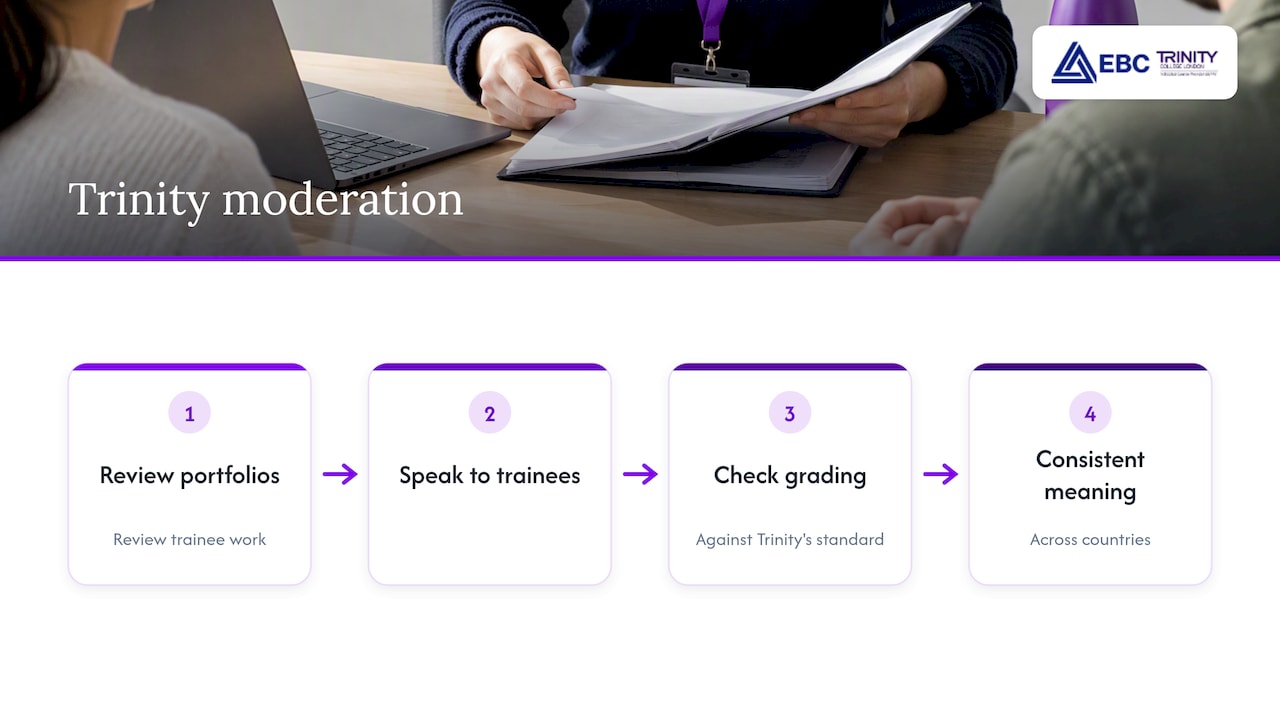
Trinity appoints external moderators to review the assessment standards at approved centres. Moderators examine trainee portfolios and speak with trainees as part of the quality assurance process.
This independent review helps Trinity maintain consistent standards across its training network. It also gives employers greater confidence in the qualification, regardless of where a trainee completed the course.
Reflective practice plays an important role in this process. The British Council’s Continuing Professional Development framework also recognises reflection as a key part of professional growth.
For more insight into the value of classroom experience, read our guide to the role of practical training in TEFL.
Trinity CertTESOL Entry Requirements
The CertTESOL welcomes applicants from different academic and professional backgrounds. You do not need a degree in English or previous teaching experience to apply.
Trinity’s official CertTESOL information outlines the typical entry requirements. Applicants generally need to meet three conditions:
- Age: You must be at least 18 years old.
- Education: You need a qualification that provides access to higher education in your home country. In the UK, this may include A levels or an equivalent Level 3 qualification.
- English proficiency: You need a high standard of spoken and written English. Trinity generally expects non-native speakers to demonstrate proficiency around CEFR C1.
Do You Need Previous Teaching Experience?
No. The CertTESOL is an initial teacher training qualification. It is designed for people who have little or no experience of teaching English.
Individual training centres may arrange interviews, language assessments or additional selection activities. Contact your chosen provider to confirm its application process.
Our step-by-step guide to Trinity CertTESOL certification explains the application stages in more detail.
CertTESOL vs Generic Online TEFL Certificates
Many online TEFL courses offer flexible study and a relatively short route to a certificate. Some suit people who want an introduction to English language teaching or need a basic qualification for a particular role.
The Trinity CertTESOL follows a different approach. It combines structured learning, assessed teaching practice and external moderation. The table below compares the CertTESOL with a typical self-paced online certificate.
| Feature | Trinity CertTESOL | Typical Self-Paced Online Certificate |
|---|---|---|
| Regulated level | Level 5 on the RQF and listed on the Ofqual register | Often unregulated or without a stated framework level |
| Awarding body | Trinity College London | Often the training company itself |
| Teaching practice | At least six hours of assessed teaching with real learners | Often none, or optional |
| External moderation | Yes, through Trinity-appointed external moderators | Usually none |
| Course hours | 130 guided learning hours and 200 total qualification hours | Varies by provider and course |
| Reflective and written work | Includes mandatory written and reflective assessment | May rely mainly on quizzes and online exercises |
The main difference is not simply the number of course hours. It is the opportunity to practise teaching, receive feedback and demonstrate your skills with real learners.
A British Council-published review of changes in English language teaching highlights the importance of practical teaching experience in initial teacher education.
However, the CertTESOL is not the only possible route into the profession. EBC also offers an Online TEFL Certification Course with trainer support. This is a different qualification with a different training structure.
Our guide to Trinity CertTESOL compared with other TEFL certificates can help you assess the options. You can also read our article on the difference between Trinity CertTESOL and CELTA.
International Recognition and the British Council
Trinity describes the CertTESOL as an internationally recognised teaching qualification. Its regulated status, structured assessment and external moderation help employers understand the training it represents.
The qualification can support applications to language schools, private institutes and other English language teaching organisations in different countries. However, international recognition does not mean that every employer or government uses identical recruitment rules.
Some employers require a university degree alongside an initial teaching qualification. Others may ask for previous experience, specialist training or evidence of particular language skills. Visa and work-permit requirements also vary between countries.
Does the British Council Recognise the CertTESOL?
The British Council identifies the Trinity CertTESOL alongside the Cambridge CELTA as an example of a suitable certificate-level qualification for English language teaching professionals.
This recognition is useful, but it does not guarantee eligibility for every British Council vacancy. Applicants may also need a degree, relevant experience and other professional qualifications.
You can consult the British Council’s published information about its English language teaching requirements for further details.
Before accepting a job abroad, check the relevant employer requirements and official government guidance. A teaching certificate alone cannot guarantee a job, a visa or permission to work.
Career Opportunities with the CertTESOL
The Trinity CertTESOL can help you apply for a range of English language teaching positions. Your options will depend on your qualifications, experience, work permission and the needs of each employer.
Possible career directions include:
- Private language schools: Teach general English to adults or young learners.
- Teaching abroad: Apply to language schools and education providers in other countries.
- Online English teaching: Explore opportunities with online schools and independent teaching platforms.
- Private tuition: Provide individual lessons or teach small groups.
- Business English: Work with professionals who need English for their careers.
- Academic English: Develop the skills needed to support learners in educational settings.
Teaching English Abroad
For many trainees, teaching abroad is a major reason to take the CertTESOL. The qualification can help you meet the requirements of international language schools and demonstrate that you have completed practical teacher training.
However, each destination has its own employment and immigration rules. Some schools accept an initial teaching qualification, while others also require a degree or previous experience.
Explore our guide to certification for teaching English abroad to learn more about entering the profession internationally.
Finding Your First Teaching Position
Start by researching the employers and countries that interest you. Read job advertisements carefully and note the qualifications, experience and documents they request.
Your CertTESOL experience can help you prepare for interviews. You can discuss your lesson planning, assessed teaching practice, tutor feedback and approach to learner development.
Professional networking can also help you discover vacancies and learn about different teaching environments. Read our advice on networking to find jobs and professional opportunities.
You can also use our practical guide to finding English teaching jobs abroad when planning your next steps.
Professional Confidence and Career Development
Starting a teaching career can feel challenging, particularly if you have never managed a classroom. The CertTESOL gives you opportunities to practise essential skills before you take on your first professional role.
Experienced tutors observe your lessons and provide feedback. You can use their advice to identify your strengths, address weaknesses and improve your teaching approach.

During the course, you develop several important professional skills:
- Lesson planning: Set clear aims and choose activities that support learning.
- Classroom management: Organise activities and encourage learner participation.
- Language awareness: Analyse English and explain language points accurately.
- Communication: Give clear instructions and respond to learner questions.
- Reflective practice: Evaluate your teaching and act on feedback.
- Adaptability: Respond to different learner needs and classroom situations.

Building on Your Initial Qualification
The CertTESOL provides a foundation for your teaching career. However, professional development does not stop when you complete the course.
As you gain experience, you may decide to specialise in areas such as:
- Teaching English to young learners.
- Teaching Business English.
- Preparing learners for English language examinations.
- Teaching English for academic purposes.
- Developing online teaching skills.
- Teacher training or academic management.
Trinity offers further qualifications for teachers who want to develop specialist skills. Experienced teachers may also consider the Trinity CertPT course as one route for professional development.
Your initial qualification does not restrict you to one teaching environment. It gives you a foundation that you can build on as your interests and experience develop.
Graduate Experiences
Course specifications explain what a qualification covers. Graduate experiences can show how trainees use that knowledge in real teaching situations.
Former trainees may describe their first teaching roles, the challenges they faced during training and the ways they developed their classroom skills. Their experiences can help you form a realistic picture of the course and the profession.
Visit the EBC Knowledge Centre to explore graduate stories and interviews. These accounts can offer useful perspectives on teacher training and career development.
Remember that every graduate follows a different path. Individual stories can provide inspiration, but they cannot guarantee the same outcome for every trainee.
Trinity CertTESOL vs CELTA
People who want to enter English language teaching often compare the Trinity CertTESOL with the Cambridge CELTA. Both qualifications provide initial teacher training and have an established reputation in the profession.
They share several important features. Both cover language awareness and teaching methodology, and both include assessed teaching practice with real learners.
| Feature | Trinity CertTESOL | Cambridge CELTA |
|---|---|---|
| Awarding organisation | Trinity College London | Cambridge English |
| Purpose | Initial training for English language teachers | Initial training for English language teachers |
| Practical teaching | Assessed teaching practice with real learners | Assessed teaching practice with real learners |
| Qualification level | RQF Level 5 | RQF Level 5 |
| Professional recognition | Widely recognised by English language teaching employers | Widely recognised by English language teaching employers |

Neither qualification is automatically the best choice for every applicant. Your decision should reflect the course structure, training centre, tutor support, assessment arrangements and preferred learning environment.
Read our detailed guide to the difference between Trinity CertTESOL and CELTA before deciding which route suits your plans.
Is the Trinity CertTESOL Worth It?
The value of a teaching qualification depends on your career goals. If you want structured initial training and a recognised route into English language teaching, the Trinity CertTESOL may be a worthwhile investment.
It offers several practical advantages:
- It provides a regulated Level 5 teaching qualification.
- It combines teaching theory with practical classroom experience.
- It includes assessed teaching practice with real learners.
- It gives employers evidence of structured initial teacher training.
- It can strengthen applications for suitable teaching positions.
- It provides a foundation for further professional development.
You should also consider the course fee, study commitment and your personal circumstances. The qualification cannot guarantee a job, a particular salary or permission to work abroad.
Before enrolling, compare approved training providers. Ask what their fees include and check their teaching practice arrangements, tutor support and assessment requirements.
For a broader explanation of the course, visit our complete Trinity CertTESOL course guide.
How EBC Delivers the CertTESOL
EBC offers Trinity CertTESOL training as part of a wider network of teacher training and work-abroad programmes. Our graduates pursue teaching opportunities in different countries, including destinations across Europe and Asia.
The CertTESOL programme includes live, observed teaching practice. EBC also provides lifetime worldwide job placement support to graduates.
For people who want to combine teacher training with an international experience, EBC also offers longer programmes in Spain, France and Italy. These programmes combine study, teacher training and opportunities to work or teach part-time, subject to local rules and individual eligibility.
Visa decisions always rest with the relevant authorities. No training provider can guarantee a visa or work permit.
Explore EBC Training Options
You can find more information about the qualification on our Trinity CertTESOL course page. To explore longer study and work-abroad options, visit our EBC programmes page.
If you already teach and want to develop specialist skills, explore our professional development courses for teachers.
How to Choose the Right Course
Before you enrol, consider what you want to achieve. The CertTESOL involves a significant commitment, so make sure its structure and assessment approach suit your plans.
Use these questions to guide your decision:
- Where do you want to teach? Research the requirements of your preferred country, employer or teaching environment.
- Do you want practical classroom experience? Assessed teaching practice can help you develop skills and prepare for interviews.
- Do you need an internationally recognised qualification? Check the awarding body, qualification level and assessment standards.
- Can you commit to the study hours? The CertTESOL includes at least 130 guided learning hours and 70 hours of independent study.
- Which course format suits you? Compare full-time, part-time, face-to-face, online and blended options.
- What support does the provider offer? Ask about tutor feedback, teaching practice, assessment and graduate support.
If you only need a basic certificate for a particular entry-level role, a shorter course may meet that requirement. If you want a more substantial foundation for a long-term teaching career, compare the CertTESOL with other regulated initial qualifications.
Frequently Asked Questions
Is the Trinity CertTESOL internationally recognised?
Yes. Trinity College London describes the CertTESOL as an internationally recognised teaching qualification. Many English language teaching employers accept it as an initial qualification. However, individual employers and countries may set additional requirements.
What level is the Trinity CertTESOL?
The CertTESOL sits at Level 5 on the Regulated Qualifications Framework in England. It includes 130 guided learning hours within 200 total qualification hours. Trinity’s Diploma in TESOL is a higher-level qualification at Level 7.
Does the British Council accept the Trinity CertTESOL?
The British Council identifies the Trinity CertTESOL alongside the Cambridge CELTA as an example of a suitable certificate-level teaching qualification. Applicants must still meet the other requirements for each vacancy.
Do I need a degree or teaching experience?
You do not need previous teaching experience to take the CertTESOL. You must normally be at least 18, hold a qualification that gives access to higher education and demonstrate a high level of English. Some employers and countries require a degree separately.
How long does the CertTESOL take?
The course includes a minimum of 130 guided learning hours and 70 hours of independent study. Providers offer different timetables, so the calendar length varies. EBC’s programme runs over four weeks. Contact the provider to confirm its current schedule.
Does the CertTESOL guarantee a teaching job or visa?
No. The qualification can strengthen your applications, but employers make their own recruitment decisions. Immigration authorities also set their own visa and work-permit requirements. Always check the official rules for your intended destination.
Can non-native English speakers take the CertTESOL?
Yes. English does not have to be your first language. However, you must demonstrate a high level of spoken and written English and meet the provider’s entry requirements.
Is the Trinity CertTESOL better than CELTA?
Neither qualification is automatically better for every applicant. Both provide recognised initial teacher training and include assessed teaching practice. Compare their course specifications, providers and delivery arrangements before choosing.
Can I use the CertTESOL to teach English online?
Yes. The qualification can support applications for some online English teaching positions. However, employers may also ask for teaching experience or specific online teaching skills. Check the requirements of each platform or employer.
Your Next Step Towards Teaching English
The Trinity CertTESOL offers more than a certificate. It gives aspiring teachers structured training, supervised classroom experience and a recognised professional foundation.
Its international standing can help you apply for suitable English language teaching positions. Its practical focus also helps you develop skills that you can use throughout your career.
The training provider matters, too. Compare course formats, teaching practice arrangements, tutor support and fees before you make a decision.
If the Trinity CertTESOL fits your goals, explore the course details or read about the different routes available to graduates. You can also book a free consultation with EBC to discuss your options.
There is no pressure to choose a particular route. The aim is to help you select a qualification that supports your professional goals.
Sources and Further Reading
Official Qualification and Professional Guidance
- Trinity College London: Certificate in Teaching English to Speakers of Other Languages (CertTESOL)
- Trinity College London: Official CertTESOL qualification information
- Trinity College London: Aims of a CertTESOL course
- Ofqual Register: TCL Level 5 Certificate in Teaching English to Speakers of Other Languages
- Trinity College London: CertTESOL and the qualifications framework
- Trinity College London: Qualifications in TESOL
- Trinity College London: CertTESOL key features
- Trinity College London: Study skills for the Trinity Certificate in TESOL
- Trinity College London: CertTESOL course regulations
- British Council TeachingEnglish: CPD Framework for teachers
- British Council TeachingEnglish: What’s changed in English Language Teaching?
- British Council: English language teaching requirements and services
EBC Guides and Further Reading
- Your complete guide to the Trinity CertTESOL course
- What is the Trinity CertTESOL? How do I pass the course?
- Step-by-step guide to Trinity CertTESOL certification
- How to pass the Trinity CertTESOL: A step-by-step guide
- 7 key advantages of the Trinity CertTESOL for aspiring teachers
- Trinity CertTESOL certification: Boosting global teaching careers
- CELTA vs Trinity CertTESOL: Which is the best qualification?
- CELTA and Trinity CertTESOL: Course requirements
- TEFL or TESOL: Why not both?
- The role of practical training in TEFL
- EBC Online TEFL Certification Course with trainer support
- Trinity CertTESOL vs other TEFL certificates
- What is the difference between Trinity CertTESOL and CELTA?
- Certification for teaching English abroad
- Networking to find jobs and professional opportunities
- Finding English teaching jobs abroad
- Trinity CertPT courses for professional development
- EBC TEFL Knowledge Centre
- Types of TESOL courses: Your path to global teaching
- Certification to teach English abroad
This page provides general information and commentary about the Trinity CertTESOL and English language teaching. It does not constitute legal or immigration advice. Requirements can vary by country and employer, so consult the relevant official authorities or a qualified professional before making decisions.